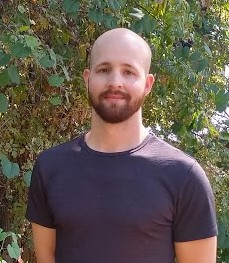
MATH 118 Trigonometry
MATH 118 Trigonometry
Purpose: to help other instructors teaching the same course
Common Course ID: Math 118 Trigonometry
CSU Instructor Open Textbook Adoption Portrait
Abstract: This open textbook is being utilized in a Mathematics course for undergrad students by Jay Gatton at Calif State University, Chico
Mathematics 118 Trigonometry
Brief Description of course highlights: A Thorough study of trigonometric functions, graphs, identities, and related coordinate geometry concepts.
Student population: The majority of students taking Trigonometry are beginning the sequence of mathematics coursework designed to gain a degree in science, technology, engineering, or mathematics. Zero college prerequisites exist for Trigonometry. To be enrolled, students must be declared general education ready by Executive Order 1110 from the California State University. Students take this course as a prerequisite to the Calculus series.
Learning or student outcomes: Upon successful completion of this course, students will be able to:
- Use the unit circle to determine exact values, at specific angles, for the six major trigonometric functions
- Understand and shift between radian and degree measure
- Understand and use the connection between the Pythagorean Theorem and distance formula
- Solve right, obtuse and acute triangle problems, and use technology where appropriate
- Understand and use the Law of Sines and Law of Cosines
- Use prior identities to transition between expressions
- Solve trigonometric equations, both by hand and with the use of technology
- Graph trigonometric functions, both by hand and with the use of technology, and utilize translations, amplitude changes, and phase shifts.
Key challenges faced and how resolved: The biggest challenge I experienced was maintaining motivation to continue the work for a course that I have not been scheduled to teach for future semesters. As a lecturer, we have little to zero stability in courses we teach, and as such, I will likely not see the fruits of my labor until the opportunity to teach Trigonometry is granted in future semesters. However, an instructor at CSU Chico will be adopting my OER materials for Fall of 2021.
Textbook or OER/Low cost
Brief Description: Students will engage in group and whole class discussions to construct viable arguments for the solving and reasoning of mathematical problems, theorems, and definitions. Using a modified moore method, students will only use provided definitions and theorems to solve the problems from the course notes. No external resources will be useful since all content must be made by the individuals within the course.
For this OER adoption, the materials from Ted Mahavier’s Trigonometry course notes openly published from jiblm.org have been altered to meet the needs of CSU, Chicos students. The course notes have been adjusted to increase accessibility of the content by providing all necessary prior mathematical theorems and definitions with the assumption that students will be from very diverse backgrounds.
Student access: All materials for students are google documents presented weekly. These documents will be accessible to students using the learning management system blackboard.
Students often do not like IBL when they are first introduced to the classroom structure. Since example problems are prohibited by the instructor, many students do not understand how the learning process should occur. It is very important for the instructor to make clear exactly how students are expected to learn. Generally, the students find this style of learning the most effective and powerful by the end of the semester. Many students are not used to having to think on their own, so as an instructor it is extremely important to set up protocols in the classroom for students to be successful in their communications, expectations, and presentations of content.
Cost Savings: This course is now a zero cost course. Many Trigonometry content options are available for instructors, however, most currently adopted by public institutions are for profit curriculums. The intent for this OER material is to not only provide a better education given that for profit materials often lack creativity but also to be sustainable and accessible to all students.
OER/Low Cost Adoption Process
Provide an explanation or what motivated you to use this textbook or OER/Low Cost option. As a recent graduate, the financial cost of education has been a heavy burden. Recognizing the privilege of having a financially supportive family, I was able to graduate with zero debt. However, many of my students are not so lucky. With my background as a public middle and high school educator, and later transitioning to higher Ed, it became clear to me that for-profit resources exploit the intentions of those who want to learn. OER not only saves students money and improves the learning materials, it builds a sense of community that fosters an unrestricted growth of society.
How did you find and select the open textbook for this course? The Faculty at California State University, Chico in the mathematics and statistics department informed me of the many opportunities for professional development. OER fit the area of growth I tend to focus and enjoy.
Sharing Best Practices: I plan to share my work and my OER experience with other faculty in the mathematics department by having irresistible content, and providing the support for new faculty to successfully teach this content.
How do you plan to share this OER experience with other faculty, staff, etc. who develop curriculum and teach?
OER, CSU faculty, and staff should organize and promote legislature that requires public institutions to provide free materials for all their courses. If a cost is required for the course content to be successfully taught, the CSU should be providing that content as part of the tuition fees.
Jay Gatton
California State University, Chico