Human Development
Human Development
Purpose: to help other instructors teaching the same course
Common Course ID: Psychology 311
CSU Instructor Open Textbook Adoption Portrait
Abstract: This open textbook is being utilized in a psychology course for undergraduate or graduate students by Brandilynn Villarreal, Ph.D.at Humboldt State University. The open textbook provides an exploration of lifespan development from a psychological perspective. The main motivation to adopt an open textbook was for the well-being of her students. Most students access the open textbook online or as .pdfs.
Course Title and Number: PSYC 311. Human Development has a prerequisite of PSYC 240 (C) or PSYC 242 (C). Course catalog.
Student population: Psychology 311 is an upper division course specifically for psychology majors. The students who take this course will already be well-versed in basic psychology concepts.
Learning or student outcomes: List student learning outcomes for the course.
For students to understand the multidimensional changes that occur at each stage of the lifespan.
To be able to analyze and apply classic and modern theories of development.
To enhance your critical thinking skills and be able to critique research and theory.
To hone your written and oral communication skills.
To understand connections between class material and your own life (integrative thinking).
For students to gain skills and resources to help in their own parenting and enhance their own
development.
To recognize the important influences of culture and context on developmental trajectories.
Key challenges faced and how resolved: At first, Villarreal was worried about the fact that the new OER textbook she found didn’t go into as much detail as the textbook she replaced it with and that her students might not be learning as much. What surprised her was that she found that her students were sometimes more engaged by the material. She found that they were more willing to do their own research or to come to class and ask more engaging questions.
Textbook or OER/Low cost Title: Lifespan Development: A Psychological Perspective - Second Edition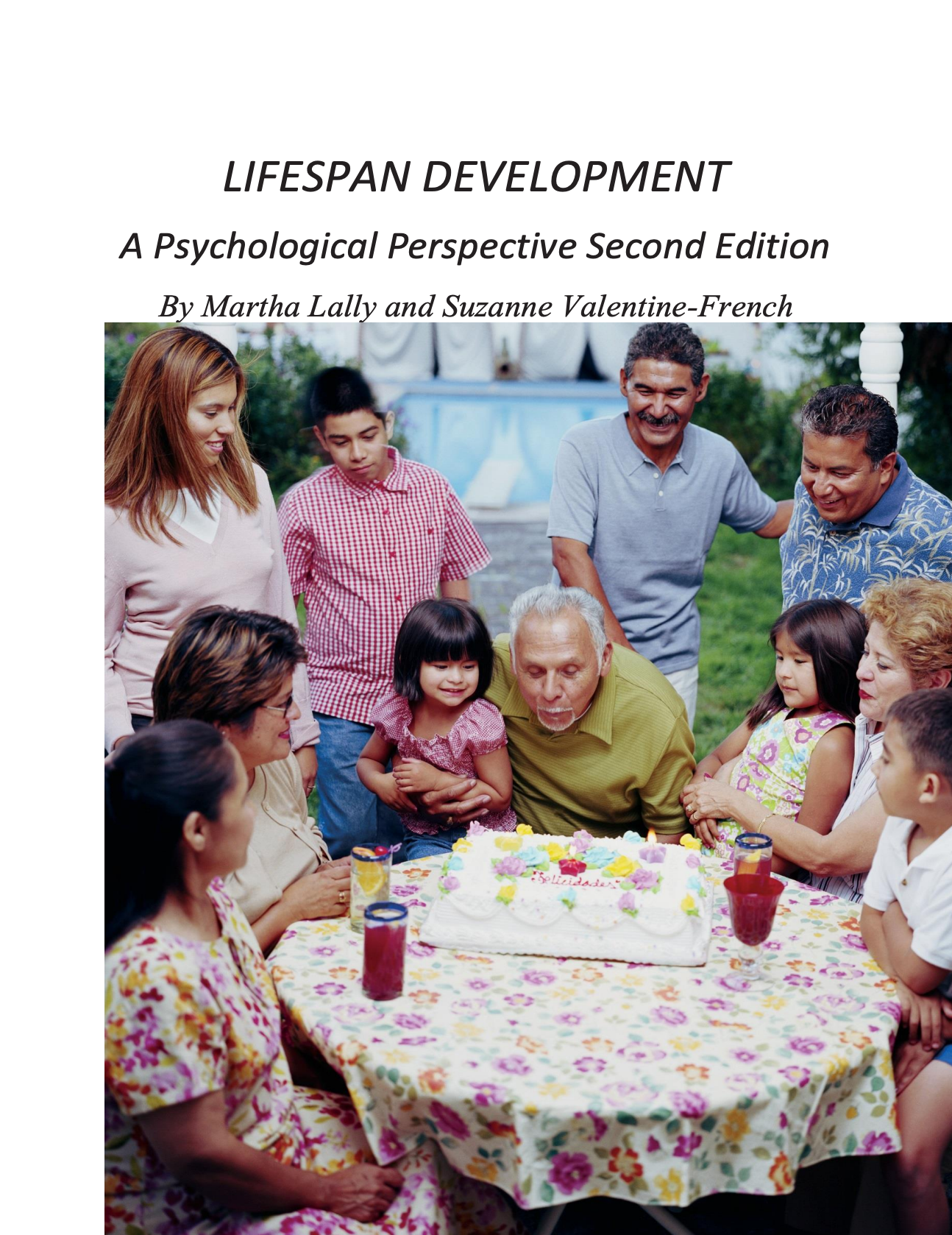
Brief Description: The textbook provides a clear and comprehensive exploration of every stage of lifespan development. It approaches each subject with diversity and inclusion at the forefront, taking into account topics like gender, class, and race.
Authors: Martha Lally, Suzanne Valentine-French
Student access: I post my OER textbooks online as .pdfs but also link my students to the websites that host said OER materials. I like to give the students a choice because the websites are slightly more navigable than the .pdfs because they’re separated chapter by chapter.
Supplemental resources: I supplement my OER textbook with free journal articles.
Cost Savings: A new version of the textbook she used to require costs $170.
License: Attribution-Non Commercial-Share Alike CC BY-NC-SA.
OER/Low Cost Adoption Process
Provide an explanation or what motivated you to use this textbook or OER/Low Cost option. OER had been on her radar since about ten years ago, back when she was a graduate student as a teaching assistant for her advisor. When she started teaching on her own, however, she couldn’t find any textbooks on the subjects that she was asked to teach.
How did you find and select the open textbook for this course? After attending a workshop put on by the Affordable Learning Solutions (AL$) program in 2018, she was able to find a textbook that worked for her and started implementing it in the spring of 2019.
Sharing Best Practices: The sustainability of open education relies on sharing with others. Please give suggestions for faculty who are just getting started with OER or Low Cost options. List anything you wish that you had known earlier.
Describe any challenges you experienced, and lessons learned. The switch did take some time to get started--she had to change around tests and quizzes and materials like that before implementing it, but Villarreal argues that the results outweigh the bit of work that goes into adopting OERs.
Share any curricular or pedagogical changes that you made: The biggest change that Villarreal notices in her curriculum is in the class where she started using free articles instead of one textbook. She finds that using scholarly articles allows for her to create a curriculum tailored to the course topic of adolescence. This has led to her classroom discussions feeling more meaningful to her and her students.
Brandilynn VIllarreal, Ph.D.
Humboldt State University
 Provide a statement of your teaching philosophy and courses you teach (or taught)
Inclusivity is a central goal of the course. Dr. Terri Vandercook describes inclusive excellence as working together and serving as both teachers and learners in the classroom community: “It is important to recognize that our individual differences can be a source of strength and learning for each of us individually and collectively. In this class, people of all ethnicities, genders and gender identities, religions, ages, sexual orientations, disabilities, socioeconomic backgrounds, regions, and nationalities are encouraged to share the rich and varied perspectives and experiences that make you who you are today. We want to create an environment that facilitates a robust exchange of ideas, assisting each of us to learn and grow based upon the content we grapple with together. We want each person in this classroom community to experience an authentic sense of belonging and feel supported to actively engage in and contribute to both the teaching and learning that occurs.” We will work together to create a classroom that is inclusive and that minimizes microaggressions. Microaggressions are brief, everyday messages and interactions that marginalize individuals based on group membership (e.g., race or ethnicity, gender, sexual orientation, individuals with disabilities, individuals with mental health issues, religion, etc.). As a group, we are responsible for identifying microaggressions and providing education and information to combat microaggressions. (from syllabus).