
Geospatial Concepts
Geospatial Concepts
Purpose: to help other instructors teaching the same course
Common Course ID: GSP 101
CSU Instructor Open Textbook Adoption Portrait
Abstract: This open textbook is being utilized in a geospatial science course for undergraduate by Nicolas R. Malloy, M.S. at Humboldt State University. The open textbook provides a thorough introduction to geospatial concepts. The main motivation to adopt an open textbook was flexibility and reduced cost to students. Most students access the open textbook in .pdf form through HSU Press.
GSP 101 - Geospatial Concepts
[Coreq: GSP 101L. Rec: basic computer literacy. D-LD.] Include a link to the Course Catalog
Student population:
Since this is the introduction to Geospatial Analysis, I assume everyone who’s taking it is interested in majoring/minoring in the field and that they’re all presumed newcomers to the field, but this isn’t information I got from Malloy himself.
Some students seem to think that they are GSP majors. Additionally, I sometimes hear complaints such as, “This class covers too many subjects outside of the major,” or “Labs should focus more on the major.” If you are a person that fits this description, I hate to disappoint you; however,
there are no GSP majors at Humboldt State University.
There is a GSP minor here at Humboldt State University, available to many different departments. Some departments have geospatial options within
their degrees. However, the Geospatial Analysis (GSP) curriculum belongs to no single college or department within Humboldt State University.
The following degree programs at HSU have students that commonly integrate Geospatial Analysis classes within their major options and electives:
• Anthropology
• Biology
• Computer Science
• Environmental Science and Management
• Environmental Studies
• Forestry
• Geography
• Geology
• Rangeland Resource Science
• Wildlife
Students are expected to have a sound basis of academic and personal effectiveness competencies outlined in the U.S. Department of Labor
Geospatial Technology Competency Model, including:
• Interpersonal Skills
• Integrity
• Professionalism
• Initiative
• Lifelong Learning
• Reading
• Writing
• Mathematics
• Basic Computer Skills
• Communication
• Critical Thinking
Learning or student outcomes:
• Describe fundamental concepts that are the basis for all geospatial sciences
• Distinguish between sources of geospatial data needed for a particular task
• Critique maps used by the media, politicians, and scientists.
• Demonstrate an understanding of spatial data types
• Integrate new tools and technology into project workflows
• Collect and create geospatial data
• Communicate findings through graphic media and visualization techniques
Key challenges faced and how resolved: Whenever Malloy would run into a problem, he would use his students as play testers. By this, he means that he would tweak and adjust his textbook according to the questions the students had. If something was unclear to his students, he would update it.
Nicolas R. Malloy, M.S.
Humboldt State University

OER/Low Cost Adoption Process
Provide an explanation or what motivated you to use this textbook or OER/Low Cost option. Malloy likes how malleable OER textbooks can be. It’s much easier to make changes and update them. He also says that they provide greater accessibility. Malloy has noted that feedback with OER is overwhelmingly positive. Students appreciate being able to save $100 while taking his class.
How did you find and select the open textbook for this course? I made the textbook myself, co-writing it with Dr. Amy Rock.
Sharing Best Practices: For prospective professors who want to publish their own OER material, Malloy suggests starting with WordPress like he did. WordPress makes it easy to do all of the formatting without requiring too much effort on the part of the writer. He suggests starting there and seeing how they feel about being able to update their material alongside their classroom.
Share any curricular or pedagogical changes: Instead of trying to change your class to fit the book, you’re changing the book to fit your class.
Textbook or OER/Low cost Title: Geospatial Concepts: The Fundamentals of Geospatial Science
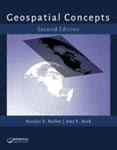
Brief Description: Taken from the HSU Press abstract: The concepts and tutorials presented in this book are for readers with little to no experience using geographic information systems (GIS) software. This book is intended for use in an introductory college-level course. It contains seven chapters, each representing approximately two-weeks of work for a three-credit 16-week semester course. Each chapter starts with text related to fundamental concepts related to geospatial science and its sub-disciplines. The chapters also include one or more tutorials designed to reinforce the concepts learned. Tutorials may take between one to six hours to complete, depending on their complexity. When possible, the authors provide an estimated time to complete tutorials. Additional references, such as video content and external websites, may also be mentioned throughout the text.
Authors: Nicolas R. Malloy, M.S. and Amy Rock, Ph.D.
Student access: The textbook is free to students through HSU Press, but there are also epub versions and print versions available for purchase.
Cost Savings: While this current textbook is free, he used to use a textbook that all 200 of his yearly students had to spend roughly $100 on. Each semester, his students collectively save around $20,000.
License: Copyright© 2019, Geospatial Institute™. It’s not openly licensed, but it is free to HSU students through HSU Press.