
Communication 20
Communication 20
Stand Up, Speak Out: The Practice and Ethics of Public Speaking
Common Course ID: COMM 110
CSU Instructor Open Textbook Adoption Portrait
Abstract: This open textbook is being utilized in a communication studies course for undergraduate students by Elizabeth S. Harris, M.A. at San Jose State University. The open textbook has two chapters, (ethics and research), that students can compare with the text currently being used. The main motivation to adopt an open textbook was to simplify and unify the content delivery by embedding the chapters in the course Learning Management System, Canvas. Most students access the open textbook in Canvas on phones and computers.
Reviews: The book has been reviewed by a faculty member from CSU and one from CCC of the California higher education systems.
About the Textbook
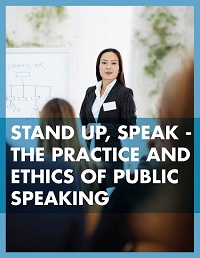
Stand up, Speak - The Practice and Ethics of Public Speaking
Authors:
- Bernardo A. Attias - California State University Northbridge
- Anne Goding - The State University of New York
- Jason S. Wrench - SUNY New Paltz
- Danette Ifert Johnson - Ithaca College
Formats:
The free, open textbook version is available in PDF and DOC format from Saylor.org. Online access to the textbook, including downloadable ebook formats and printed versions, can be purchased from Flat World Knowledge.
Supplemental resources:
Students may purchase the online textbook with study tools from Flat World Knowledge. This includes note-taking and highlighting; study aids like flashcards; and study view, which collapses each chapter into key terms and key takeaways. Flat World Knowledge also provides free faculty-onlysupplements such as lecture slides and test bank quesions.
Peer reviews:
This book has been peer reviewed by a CSU faculty member and a CCC faculty member.
Cost savings:
This is a free textbook. The average cost of textbooks in a basic public speaking class is usually $50.00. I teach around 150 students per semester, so for a year, the total savings would be $15,000.
Accessibility and diversity statement:
Although not all versions of the textbook have been verified for accessibility, a Digital Accessible Information System (DAISY) and Braille-Ready-Format(BRF) formats are available from Bookshare.org.
License:
Standup and Speakout: The Practice and Ethics of Public Speaking from Saylor.org is licensed under a Creative Commons Attribution-NonCommercial-ShareAlike 3.0 Unported License.
About the Course

COMM 20: Public Speaking
Description: In this course students develop strategies for designing well-organized, researched, extemporaneous speeches on socially significant topics adapted to a diverse audience.
Prerequisites: None. This course is usually populated with First Year students (and those who have procrastinated).
GE credit: 3 units
Learning outcomes:
- Identify and assess socially significant and intellectual topics, then compose and deliver extemporaneous oral presentations (using note cards or key-word outlines) on those topics.
- Engage in critical and analytical listening.
- Analyze audiences, adapt oral presentations to diverse audiences and use that information to accomplish the purpose of the speech.
- Assume the ethical responsibilities of the public speaker, including basic understanding of the economic, legal and social issues surrounding the access and use of information.
Curricular changes:
None at this time.
Teaching and learning impacts:
Collaborate more with other faculty: No
Use wider range of teaching materials: No
Student learning improved: Unsure
Student retention improved: Unsure
Any unexpected results: Not at this time
Sample assignment and Syllabus:
Assignment
This is an assignment in which students were asked about the online chapter.
Syllabus
This is the syllabus I used for COMM 20 Fall 2015
Textbook Adoption
OER Adoption Process
The reasons I am interested in adopting this text are two-fold. The first reason, it is free. The students don't have to carry any financial burden for this text. Secondly I can deliver the two chapters to all of the students at the same time. I chose to embed the chapters in the course management shell making them available at a specified time in the semester.
I have found that some students either cannot afford the books required or have to wait for the funds to arrive at a later date missing assignment deadlines.
Student access:
Many of the students use their phones, tablets and laptops to get online into the Canvas shell (LMS). The two chapters are embedded in two assignments.
Student feedback or participation:
In an assignment, I asked the students in five of my classes to compare the chapter of the OER online text with the current text. While they did note that the online text was much longer than the course text they did like the chapters for many reasons. Some of the responses appear below:
- Two things that I liked from the OER was that they went more in depth when they talked about certain topics, for example about plagiarism and I also like how they give helpful tips to consider when giving a speech.
- The examples are the end of each section which allow the reader to utilize the skills used right away rather than having to remember everything at the end of the chapter.
- Two things I liked about the online reading is objective layout and the easily understandable content.
- Two things about the OER online chapter I liked was the structure of the text (how it went from connecting it to modern day to a graphic and further explanation) and the examples provided in the text for better understanding.
- I liked how the OER chapter gave a lot of different examples from different people, so if a concept was confusing it was very easy to find help on that concept.
- Two things that I really liked from the OER chapter was that every so often there would be key takeaway sections that summarized the key points from the text above. Another thing that I liked was that before a section started like 2.1 or 2.2 there would be a learning objective listing the main ideas of what was going to be covered in the text ahead.
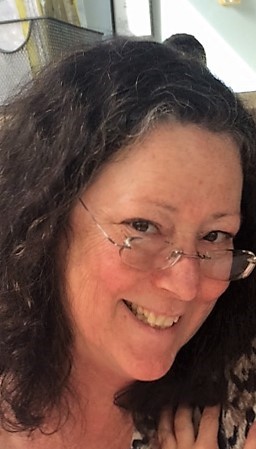
I am an adjunct professor at San Jose State University. I teach Public Speaking, Argumentation and Interpersonal Communication.
I use a mix of interactive, performance and collaborative methods in the classroom. I like to see the students engaged in skill building that will empower them.