Home

Multicultural Health: A Course in Diversity for Health Students
Melody Proebstel, MSW
in collaboration with Lyndall Ellingson, Yan Huang, and Jessica Candella
California State University, Chico
Course Name: HCSV/MCGS 328 Multicultural Health
Project Abstract: This course is a bottleneck course at CSU Chico. Three faculty and a student mentor collaborated to redesign curriculum for the class, flipping the instructional design and creating new opportunities for students to learn from eath other. Increased student engagement with the content and additional in-class activities have contributed to higher success rates, with increased GPA and lower DFW rates.
GE Credit: This is an approved US Diversity course.
Keywords/Tags: diversity, active learning, flipped instruction
Instructional Delivery: In-class
Pedagogical Approaches: Flipped classroom
Class Size: 36 students
About the Course Redesign Stage 1 |
Background on the Redesign
Purpose for Course Redesign
Course Characteristics
Health and Community Services (HCSV) 328: Multicultural Health is a required diversity course for all students in HCSV. The course is cross-listed in Multicultural and Gender Studies (MCGS) and is offered as an elective in the MCGS program. Focusing on contributing factors and results of health disparities in the US, the pedagogical model for the course has been didactic, with some classroom discussion, passive writing assignments, and group presentations.
The Learning Problem
Changes in the world both inside and outside the classroom have increased the need for this course. As diversity has increased within CSU Chico, there is a great benefit for students to learn from each other about this topic. Flipping the class can provide more in-class time for exchange and exploration, deepening understandings and grounding proficiencies. This redesigned course will improve student engagement and, therefore, improve both the pass rate and the depth of the learning for all students.
Course History/Background
First taught in Fall 1991 and granted ethnic designation to meet University diversity requirements in 1993, the upper division course has been co-listed in MCGS since 1997. In addition to being a core competency course for HCSV and an MCGS elective, this course is required for the minor and certificate in gerontology, as well as an elective for the Social Science option in gerontology and the Medical Anthropology track. Students in the HCSV program may have previously taken or are taking this course concurrently with Community Health, which introduces a range of topics in the health field, including an overview of culture and oppression. This course helps to prepare students for internships they complete during their senior year because it contextualizes challenges that may be experienced by the people they will work with.
High Demand / Low Success Issues
One of a limited number of US Diversity courses, which are required to graduate from CSU Chico, this is a high-demand course. A course redesign will increase understandings of essential content and improve overall success. There will be more time for students to learn from each other and gain relevant insight into health disparities.
Syllabus from pre-designed course
Syllabus used in course prior to redesign. Course instructor at the time was Lyndall Ellingson.
About the Students and Instructor Stage 2 |
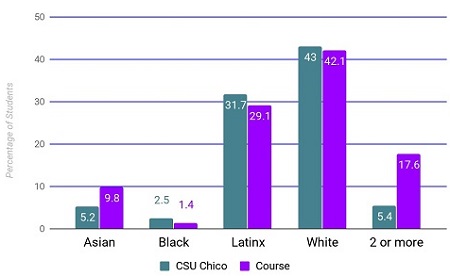
Student Characteristics
- CSU Chico undergraduate student demographics have changed considerably in recent years. There has been a 10% increase of Latinx students in the past five years and a 940% increase of undocumented students in the past six years.
- More than half (55%) are first generation college students, and 42% report experiencing food insecurity. The average age of a CSU Chico student is 22, and 54% of the student population is female.
- Although the course population is similar, there are some notable differences. The rates of students who identify as Asian (10%) or 2 race/ethnicities (18%) are at least twice the campus population.
- While a smaller percentage (30-45%) of the students in this course are first generation college students, almost 50% spoke a language other than English at home.
- Most students in this course are females (86%) completing their Junior or Senior year.
- Approximately 2/3 of the students in each section are HCSV majors. Other students include a few from MCGS or Nursing. Other majors represented include Psychology, Nutrition, Business, and Biology
Advice I Gave My Students to be Successful
- This course is structured as a “flipped” classroom, and very little information will be delivered via traditional lecture during class time.
- Resources (readings, media, assignments, etc.) provided on Blackboard are to be viewed, read, and completed before class. Each week includes 60-90 minutes of video, four to six readings, and an activity.
- During the three-hour class period we will practice use of these resources through immersion, discussion, analysis, presentations, case studies, simulations, etc. It is essential that you come to class prepared.
- Materials are often emotionally charged and can be overwhelming, so please take time throughout the week to review them and think about them.
Impact of Student Learning Outcomes/Objectives (SLOs) on Course Redesign
Upon engaged participation in and successful completion of this course, students will:
- understand the effects of history, oppression, racism, classism, immigration, poverty, religion, sexuality, gender, and health beliefs and practices upon the health status and access to health care in various U.S. communities;
- understand assets and strengths within marginalized U.S. communities, which serve to buffer life events, enhance quality of life and maintain a positive health status;
- be able to evaluate cultural competencies of the U.S. health delivery system needed to meet the health needs of communities of color and other marginalized communities;
- be able to identify personal stereotypical thinking, common prejudices, and ethnocentrism and their negative impact upon the health and delivery of services to U.S. communities of color and other marginalized people;
- move towards cultural humility and sensitivity (awareness of differences) and culturally responsive service delivery; and
- be able to articulate a personal vision for improving or enhancing the health status of communities of color in the U.S.
Alignment of SLOs With Course Redesign
- Course has been flipped to allow more in-class time for students to collaborate and interact with the concepts. Simulations are conducted weekly for class preparation as well as in class to help students contextualize the information they are learning.
- With only three mini-lectures throughout the semester, most of the learning happens through in-class discussions and inquiry-based learning activities.
- These changes to the course design increase students’ engagement and support stronger understanding of the SLO concepts.
Assessments Used to Assess Students' Achievement of SLOs
- SLOs are assessed in three ways. Throughout the semester, students record their reflections on weekly course materials in journals. Each student’s journal is collected three times during the semester for assessment and feedback.
- Students are organized into groups at the beginning of the semester based on their responses to a questionnaire about their background and awareness of cultures. Each group of 6 students selects a topic from the weekly themes to present in class. The themes are directly correlated with the concepts identified in the SLOs.
- Discussions in class happen within their small groups and as a whole class. This creates a synergistic environment and allows students to learn from each other.
Accessibility, Affordability, and Diversity Considerations
Accessibility
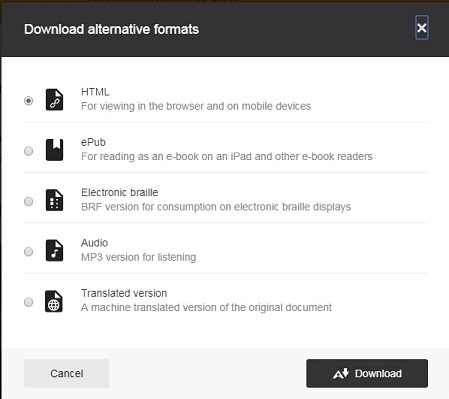
Weekly course materials are provided through the campus online learning system, Blackboard. I have collaborated with the CSU Chico Office of Accessible Technology to increase accessibility of these online course materials. Videos have closed-captioning, and most readings are accessible with alternative formats (HTML, ePub, Electronic braille, mp3 Audio, Machine translated version) through Blackboard's ALLY tool.
Affordability
Only one book is required. It is available on reserve in the library or can be purchased for less than $10. Other course materials are provided through Blackboard.
Diversity
New strategies help students to think more critically about the course content. Students are able to contextualize their own experiences and challenges in the larger community setting, and they feel that the experiences they share with classmates are valued.
About the Instructors
- Melody Proebstel completed her Master's degree in Social Work at CSU Chico. Her teaching and research interests include community organizing, sexual identities, multicultural communities, and experiences of marginalized populations. In addition to this course, she teaches "Research Methods" in two departments, Social Work and Health and Community Services.
- Professor Lyndall Ellingson earned her doctorate in Public Health from Indiana University. Her research and teaching interests include sexuality, sexuality education, multicultural health, women's health, and research methodology. Dr. Ellingson has published in several health-related journals.
- Dr. Yan Huang received her doctorate in Health Behavior with a minor in Inquiry Methodology from Indiana University-Bloomington. She also earned her Master's degree in International Health Policy and Management from Brandeis University. Yan's research and teaching interests include community health, multicultural health, health education techniques, global health, health program planning and evaluation, substance use among minority population, and health disparities among minority population.
Instructor Reflection
My experience with multicultural curriculum had been limited to courses within Social Work and the Multicultural and Gender Studies programs. Students in those classrooms are very engaged with topics around privilege and oppression, which is not always the situation in other programs. This was my first opportunity to learn about methods for curriculum design to enhance student participation and learning. I have benefited a lot from the process of critique, discussion, and reflection in this project.
I also recently completed the Institute for Teaching Writing through the CSU Chico Faculty Development Office. This program uses John C. Bean’s Engaging Ideas: The Professor’s Guide to Integrating Writing, Critical Thinking, and Active Learning in the Classroom. Primary assignments will be restructured in Fall 2018 to incorporate new critical thinking activities, encouraging students to develop meaningful reflections on their journal entries that enhance their learning experience.
This course redesign as an ongoing process. The dimensions and concepts that are covered in class are not static, and the curriculum must evolve to stay in alignment with current factors in health and society. Through the collaborative redesign process and the resources available to me at CSU Chico, I will continue to improve students' ability to think criticially about factors that affect health disparities in the US.
Course Redesign Planning Stage 3 |
Implementing the Redesigned Course
Aspects of Redesigned Course
- Videos that were previously watched in class are now viewed before class to allow more time for activities and experiential learning.
- Students work in groups throughout the semester on a central project that helps them make meaning of the readings and concepts explored through course materials. Groups are organized to increase student interactions with diverse perspectives and experiences in order to enhance their understanding.
- Course discussions are student-driven, resulting in increased engagement and investment in the materials.
- Students use Google Docs and Google Slides to collaborate on their group projects, which facilitates interaction with less need to meet outside of class.
Adopted Technologies
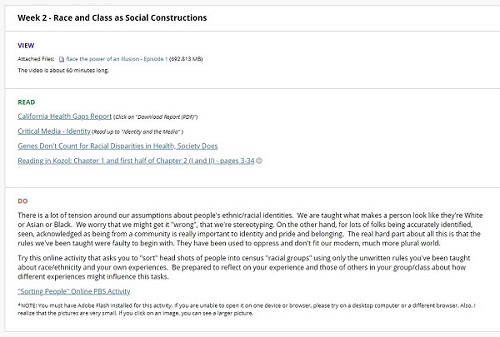
Blackboard is used to provide access to weekly materials. Videos have been loaded into Kaltura so that students can come to class prepared for discussion. Each week, materials are organized into three sections: View, Read, and Do.
Professional Development Activities Participation During Course Redesign
In Fall 2017 I participated in Honing Your Teaching Practice, a Faculty Learning Community through the CSU Chico Center for Excellence in Learning and Teaching. This FLC helped me to reflect on the order of content and methods that I use to present information to students. Through discussions with other faculty and using Linda B. Nilson’s Teaching at Its Best: A Research-Based Resource for College Instructors, I identified additional activities that will increase engagement with the course materials.
Additional Resources for the Redesign
- The CSU Chico Technology and Learning Program provided guidance and support with course setup in Blackboard. They loaded videos into Kaltura and showed how to make them available for students. They have also offered suggestions for utilizing individual and group tools in Blackboard in order to increase interactions between students outside of class.
- The CSU Chico Office of Accessible Technology and Services has also been essential to increasing accessibility of course materials on Blackboard with video captioning and PDF formatting.
- I have ongoing dialogue with other faculty in the department to increase vertical curriculum alignment, in order to increase students' perceived value of course content.
Course Syllabus for Spring 2018
Course assignments have evolved to meet student needs and understandings of content. Syllabus used for the course after the redesign.
Questionnaire
Students complete this questionnaire on the first day of class. The information they provide is used to organize students into diverse groups that enhance their learning experiences.
Redesign Results Stage 4 |
Course Redesign Impact on Teaching and Learning
- There is more time in class available for interactive discussions and group activities. A safe environment in the classroom and relationships within established groups encourage students to share insight and understanding that are more indepth than previous class discussions.
- Students demonstrate understanding of social factors in health disparities and community assets through meaningful group presentations and end-of-semester projects. Additionally, student journals reflect increased awareness of power, privilege, and oppression both in their own lives and their own behaviors. These reflections and presentations demonstrate insight into identities and intersectionality that previously was not measured.
Assessment Findings
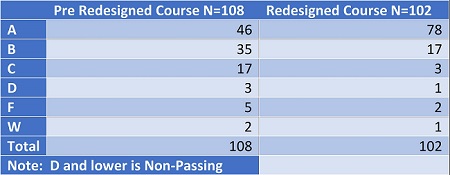
Increased student engagement is demonstrated in the shift in grades between Pre Redesign and the Redesigned course. Overall Grade Point Average for the Pre Redesigned course was 3.03 and for the Redesigned course was 3.45. Distribution of grades looks very different after the course redesign, with considerably more students earning an A.
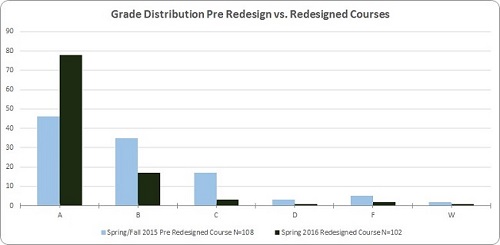
As shown in this table, the number of A's were much higher in the redesigned course than in the course before the redesign. Additionally, the number of DFWs are less than half of the number in the Pre Redesigned course.
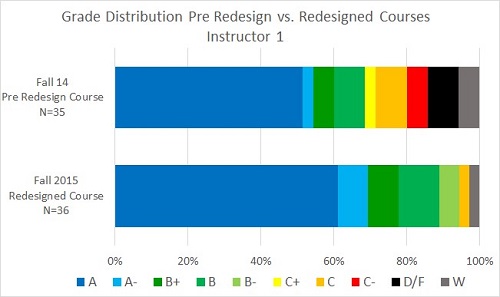
Course Redesign was implemented in a two phase experimental design. In the first phase, Instructor 1 implemented the redesigned course in Fall 2015, while Instructor 2 continued teaching the Pre Redesigned curriculum. The change in grade distribution in Phase 1 is remarkable, where more than 90% of grades were B- and higher.
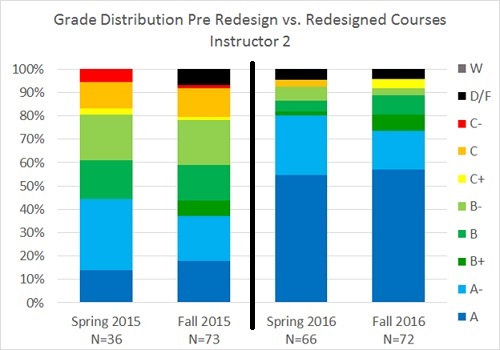
Instructor 2 implemented the redesigned course in Phase II. Spring and Fall 2015 were pre-redesign, and 2016 courses were the redesigned course. Similar to Phase I, more than 90% of student grades in the redesigned course were at least a B-.
Student Feedback
As we anticipated, students consistently report that the class activities and discussions contribute to their understanding of course materials. Below are comments that were shared in qualitative assessment:
- I have found it very easy to learn when we do activities that involve the entire class, this provides different views on topics based on others peoples background and believes. I also enjoy all the articles and videos since they are very educational.
- Hearing personal stories is one of the most rewarding experiences in this class.
- The small group discussions and then the large group discussions that follow give me more perspective on the topics we learn about.
- I like the groups it gives a sense of safe space within the class and a group of people I really feel comfortable sharing my thoughts with.
- I believe that pretty much the in class and at home activities have been crucial, it binds together so that we know what we are learning. I love how the lecture isn't like other lectures where the professor is just standing there and reading off a powerpoint, I like how the class is very engaged and hands on. By hands on I mean us doing different activities to get a feel of how our careers are later going to be working on in the future.
- The group discussions are the most helpful to my learning in this class. I enjoy learning about other classmates' experiences and sharing my own experiences with others. Group discussions help me understand others' experiences and perspectives. The weekly journals are also helpful in analyzing the materials we learned and to think deeper regarding the ideas we just learned.
- I liked the class activities. A lot of what we did opened it up for discussion, and my time in class helped me to understand the material better.
- I feel that all the activities have taught me a ton! I love how every class has an interactive component to it. These activities have really put a lot of things in perspective! Also, the way you put people into groups is very cool and it works!! I have learned SO MUCH from my group members.
- I think the class discussions have been the most helpful because it really shows the different perspectives on the topics that we discuss. You can watch movies and read books, but when the people who are sitting next to you share their experiences, it really brings home the topics.
Challenges My Students Encountered
- There were a few unanticipated technical difficulties. Sometimes videos were inaccessible for students. Also, some of the out-of-class simulation activities are incompatible with students' electronic devices. Because technology changes quickly, online simulations that worked well just two years ago would not open for some students during the most recent school year.
- Students are frustrated with the preparation that is expected for a flipped course. Often this is related to the amount of time they must invest outside of class, and sometimes students are emotionally overwhelmed by the topics covered. Another issue that results from this is that some students do not prepare for class, which is frustrating for students who have invested the necessary time and effort.
Lessons Learned & Redesign Tips
Teaching Tips
- Keeping students engaged for a full 3-hour class period is difficult. Break up the class sessions into different types of activities.
- Content for this course is emotionally challenging. Sometimes students need extra support and encouragement to stay engaged with discussions. Incorporate self-care practices into class activities, and encourage students to discuss course content with people outside of class so they can have additional opportunities to process the information.
Course Redesign Obstacles
An ongoing challenge is finding classroom space that meets our needs. Traditional classrooms are not conducive to facilititating group meetings and conducting activities with a class of 36 students. While I have found spaces that work well with my needs, they are rarely available for a flipped classroom schedule (3-hour block, once a week).
Strategies I Used to Increase Engagement
Each student is assigned to a group for the entire semester. Based on a questionnaire that is completed on the first day of class, groups are organized to be expose students to experiences and cultural ideas that are unfamiliar or they might not otherwise hear about. This includes identities related to socioeconomic status, disability, gender identity, sexual orientation, religion, language, culture, age and major. Because they stay in these groups throughout the semester, students grow comfortable sharing and learning from each other.