
Principles of Financial Accounting
Principles of Financial Accounting
Increasing Student Engagement in ACCT 201 through a Flipped Classroom & More
Curtis L. DeBerg
Department of ACCT, CSU, Chico
cdeberg@csuchico.edu
Principles of Financial Accounting is the first required course for business majors. Traditionally, the repeatable course rate (grade of C- or lower) has approached 50%. Using a flipped classroom, Dr. DeBerg requires students to view classroom lectures before the first class meeting each week. In the second meeting, students are broken into four groups of 30, with each sub-group broken down into groups of three. The breakout sections are led by four outstanding senior accounting majors, called mentors. During the breakout session, students do their "homework" during class time. Hence, what formerly was homework becomes classwork; what was classwork now becomes homework.
Summary of Redesign Effort
This PPT presentation summarizes what worked, what didn't, and what the future holds for our redesign effort in Spring 2014.
Final Report Submitted to Chancellor's Office
This is the final report submitted to the CO. The report contains detailed results as reported by the redesign team of Dr. Ken Chapman and Dr. James L. Sager.
Principles of Financial Accounting Syllabus (for Redesign)
In Spring 2014, 120 students enrolled in this "flipped" course.
Principles of Financial Accounting Course Schedule
Note how the course schedule is detailed by in-class activities, videos due, and homework due for each day.
Links to 70 YouTube Videos (Khan-like and Excel Camtasia)
Seventy videos were created as part of the redesign initiative.
Cases and Course Readings Created Under the Redesign Effort
Several cases and course readings were developed for the redesigned course. Note that most of the cases are Excel based, and they are linked to the YouTube videos.
Comparing the Traditional Bookkeeping Approach with a 21st Century Database Approach
Luca Pacioli described three books in his 1494 treatise on manual bookkeeping: Memorial, Journal, and Ledger. Debits and credits were utilized to make sure the books always balanced. In a 21st century approach, transactions can be recorded in just one place--the database--and students can see the effect of each transaction directly on each of the financial statements.
Why did you redesign your course?
All prospective business majors must successfully complete this course with a C or better. Approximately 90-95% of enrolled students do not plan to major in accounting. This course, however, continues to be taught by most accounting professors/teachers as though all students are going to be accounting majors. As a result, nearly 50% of the students receive grades of C-, D+, D, or F (note: a grade of C- should be included with grades of D and F when measuring low success rates because a C- is a “repeatable grade"). In fact, in fall 2012, the rate exceeded 50%, with the average GPA for this course in fall 2012 was 1.76. Thus, for the majority of prospective business majors, this course can be accurately viewed as a barrier to graduation. By flipping the classroom, we want students to: (1) learn more, (2) be more successful, and (3) work smarter, using available technology. The model is called the “flipped” model because students are required to watch several short videos the night before each Tuesday’s large lecture. Upon entering the large lecture class, students will be given a simple, brief quiz to determine if they have viewed the videos. The professor can then present a lecture that is richer, deeper, and more understandable. Then, on Thursday, students will get hands-on experience in small-group settings. Often, students will be able to complete homework during the breakout session. In essence, by watching the video lectures at home, students are now completing “homework” that formerly was “classwork.” And by completing hands-on work in the breakout session, they are now doing their homework during class time.
What did you change through the redesign?
For the flipped course, I created 70 short videos (ranging from 3 to 17 minutes in length), authored approximately 20 cases based on Excel spreadsheets, and wrote several reading assignments. These materials, combined with a free, on-line acounting textbook, have replaced the traditional, hard-bound textbook (cost of $250) as the primary learning materials. Before each Tuesday's large lecture, students are required to watch several videos and complete one or two assignments. Coming into the Tuesday lecture, I then administer a 5-question multiple-choice quiz using "clicker" technology. This allows me to guage student understanding and tailor my lecture accordingly. The lectures allow me to explore more interesting topics, and also allow me to go deeper conceptually. On Thursday's, students meet in four small breakout classrooms (n=30 students each). The breakout rooms are "staffed" by four outstanding senior accounting majors, called Breakout Session Mentors (BSMs). During these sessions, students get hands-on learning in small groups of three. The mentors guide the students during these sessions, often helping students with their homework. In summary, under the flipped model, what used to classwork becomes homework; what used to be homework becomes classwork.
Why will the "redesign" lead to better learning?
Students will be better prepared for class. They will learn valuable Excel spreadsheet skills. They will be more engaged, both in the large lecture session and also the small breakout sessions.
Syllabus Before Redesign
This is my Principles of Financial Accounting syllabus before redesign.
Syllabus AFTER Redesign
This is my revised syllabus after the redesign.
Course and Student Background
What course are you redesigning? Principles of Financial Accounting, ACCT 201, the first Lower Division for business majors.
Who are your students Most students are prospective business majors. Options within the major include accounting, information systems, management, marketing, finance, entrepreneurship, and human resource management. This is a sophomore level course, and is the first required lower-division business course. Most students have very little skills with electronic spreadsheets. However, almost all of them are adept at using obile devices and online discussin forums.
Accessibility, Affordability, and Diversity
1. Does the technologies used in the redesign meet section 508 accessibility requirements so students with disabilities can have an equally effective learning experience?
Yes. In my syllabus, I state:
Students with a verified learning disability can take a proctored exam at Accessibility Resource Center (ARC). Upon identifying themselves to the instructor and the university, students with verified disabilities will receive reasonable accommodation for learning and evaluation (e.g., exams). Please make sure to get the instructor the signature form well in advance of an exam. For more information, contact ARC at 898-5959.]
2. Are the technologies used readily available and affordable for your students?
Yes.
3. Do the pedagogical strategies support students' learning with their diverse cultural, ethnic, and gender backgrounds?
Yes, I do my best to include examples that are balanced by gender, ethnicity and sexual orientation.
Impact on Teaching and Learning
Before describing the impact on teaching and learning, I encourage visitors to watch the 7 minute video above. It summarizes the flipped classroom approach used in Spring 2014 semester with 118 students.
Conclusions
The redesigned financial accounting course utilized a flipped environment and took a nontraditional approach to a variety of aspects to the course. The nontraditional approach included not having a textbook, having all content available via online sources, and teaching accounting without as much emphasis on the traditional credit and debit, accounting ledger approach. Furthermore, the flipped environment meant having students watch videotaped lectures outside of class and having 50% of class time and break-out sessions focused on working on assignments and homework. In addition, the course focused more on the use of Excel as an accounting tool. As stated in the original course redesign proposal, the objectives of the redesign were that students would 1) learn more, 2) be more successful, and 3) work smarter, using available technology. Generally speaking, students in the flipped course did not do as well as other students on the final exam and thus were not more successful. The survey data suggest that students did feel have positive attitudes and beliefs about the flipped, nontraditional course, valued the emphasis on Excel and the use of YouTube videos to explain course concepts.
Recommendations
One semester’s worth of data is not enough to declare that the course didn’t work. The complexity of developing the materials and structure of the course likely leave room for improvement and this first attempt should be considered a positive step toward continuous improvements in the flipped course and more generally, for all ACCT 201 sections. It is recommended that the course be modified and run again in Fall 2014. Changes might include:
• A mechanism to get students to 1) watch the videos, and 2) spend more time watching the videos o Ask students to write a brief summary of videos. o Have a keyword embedded in videos that must be used to access future videos.
• Develop a way to monitor student’s time spent watching the videos
• Better feedback on homework and quizzes
• Better preparation for the final
• Development of a final exam with input from all instructors and is more consistent with the material used in the flipped course.
• Breakout sessions were given strong ratings in both the quantitative and qualitative data. It is recommended to keep the breakout sessions and perhaps find ways to better utilize these sessions.
• Generally, students had positive attitudes and beliefs toward many elements of the flipped course. Many of these elements could be incorporated into other sections. A focus on Excel, the use of videos to explain concepts, and the use of breakout sessions could all be incorporated into other sections of ACCT 201.
Furthermore, an additional metric to decide if students in the flipped course learned the material is to track students into ACCT 202. All four breakout session mentors indicated that they believe the flipped model gives students a broader understanding of introductory accounting. If the flipped students do better on an entry exam into ACCT 202, this could provide a signal that retention improve using the flipped model. In conclusion, there were two main objectives of the “Reducing Bottlenecks and Improving Student Success” initiative: 1. Reduce bottleneck courses through the use of innovative online technologies 2. Promote student success programs that further the priorities of the CSU Graduation Initiative Proposals were encouraged to implement or expand nationally identified high-impact practices, support student engagement, and acquiring/implementing technology solutions that support academic success.
Teaching Tips
Videotaping lectures in short, punchy sizes has made me a better "lecturer." Also, students have told me that the review the lectures more than once, and they take notes. When they come to class, they are better prepared to ask questions and be engaged on task. Other important things to note about the "redesigned" class:
1. Flipped classroom | · Classwork becomes homework, by watching videos and reading free, online accounting books and other online materials · Homework becomes classwork, when students work in their breakout sessions under the direction of a Breakout Session Mentor |
2. No hardbound textbook | · With 120 students at a new book cost of $250, we save students $30,000 |
3. New technologies | · Clickers allow for instant assessment and grading; they also allow the instructor to see where students need remediation, and he can then launch into the day’s large lecture using the questions as a springboard · Blackboard/Learn is a repository for all course materials, including syllabus, course schedule, reading assignments, cases, Excel spreadsheets, and links to YouTube videos · Group video teleconferencing is used by the professor to communicate, live, with the four breakout session leaders |
4. Use of Excel spreadsheets to teach students double-entry bookkeeping with and without debits and credits | · A manual system using the left/right, two-column, plus/plus bookkeeping system is compared with a computerized left/right, single-column, plus/minus bookkeeping system · The father of modern-day bookkeeping, Luca Pacioli, is honored by explaining his contribution, and comparing it to the 21st century approach to bookkeeping |
5. Cases (individual and group) that grow in complexity encourage students to relate their work at a personal level before expanding to a business level | · Students start the course by calculating their personal net worth, and then preparing a budget for a month; from this, they then win the lottery and thereby are able to invest their personal cash to finance their sole proprietorship · Later, the sole proprietorship is expanded to a partnership and then a corporation |
6. Real-world examples are used to show the importance of financial statements | · Wal-Mart is compared to Target · Coke is compared to Pepsi |
7. Senior accounting majors serve as breakout session mentors | · Four outstanding seniors lead each Thursday’s breakout session while the professor monitors the sessions live, via group video teleconferencing |
8. Common final exam, constructed by a neutral expert in financial accounting | · Test is authored according to specific learning outcomes; results can be compared by class and by instructor to determine if the redesign effort is inferior, the same, or superior to the non-redesigned classes; formative assessment feedback can also be provided to each instructor |
9. Students simulate working as an “audit team” when they attest to the fairness, completeness, and accuracy of “clients” on mid-term exams | · This is an “assessment-as-learning” technique that provides another learning opportunity for students; audit teams work together to render an audit opinion on their peers’ examinations |
10. Students can choose to author a formal “Memorandum of Appeal” at the end of the semester | · This technique allows students to make a case for more points to be added to their grade record. These students believe they have earned more points than their record reflects. Justifiable reasons for appeal include missed class due to illness, death in the family,and special occasions such as weddings, funerals, & participation in NCAA sports. Students can choose to author a formal written explanation for why more points should be added to their record, and include supporting documentation. |
What's Special About Teaching with the Redesigned Activity?
To date, students appear to be learning more; my lectures are more fun to teach; use of clickers, which I used to mock, has made a believer out of me now. I can guage student learning and quickly remediate where there appears to be s significant problem.
MERLOT Pedagogy Portal
MERLOT's Pedagogy Portal has a collection of online resources on over 25 types of pedagogical strategies. Explore what other faculty and higher ed institutions are doing and recommending for student engagement strategies.
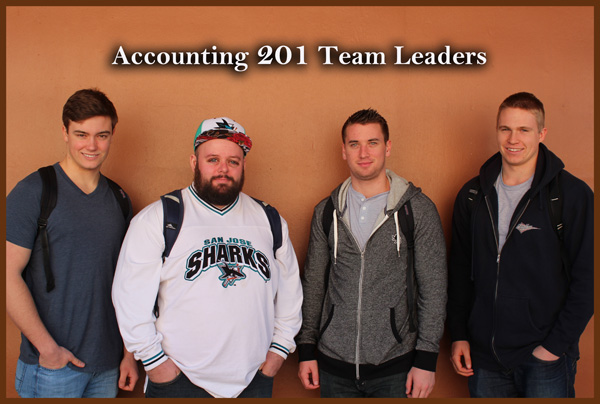
Breakout Session Mentors, Spring 2014
Left to Right: John Lagomarsino, Jerry Knight, Shaun Duckworth, Nathan Fisher. All four of these Breakout Session Mentors have a GPA of 3.7 or higher. What better role models for their younger proteges!
PURPOSE OF BREAKOUT SESSION MENTOR (BSM) PROGRAM:
• To enlist the support of older mentors in support of the development of critical thinking and team building skills on the part of their younger proteges in Accounting 201.
• To acquaint senior accounting majors with recent innovations in accounting education, especially those involving business decision processes.
• To build teamwork, communication, and leadership skills of the senior accounting majors.
• To provide introductory accounting students with role models that exhibit qualities desired of individuals who are about to enter the profession.
• To provide a vehicle for expression of highly professional conduct, attitude and ethics.
Breakout Session Mentor - Description of Duties
This file provides a detailed description of the roles and responsibilities of Breakout Session Mentors (BSMs).
Did The Redesign Strategy Make A Difference?
I will know this after grading the common final exam and comparing this with other instructors who teach the traditional, non-redesigned method.
Based on our work in ACCT 201 at CSU, Chico, we did not reduce bottlenecks in the redesigned course. Dr. DeBerg issued final grades with a class GPA of 2.1, about the same as his historical grade distribution. Other ACCT 201 instructors continued to use their own, historical grade distributions without taking into consideration their students’ performance on the final common exam vis a vis other instructors. Innovative online technologies were used (e.g., Khan-like videos, clickers, communication via Blackboard/Learn and a class listserv, free online textbook, accessing the most recent financial reports on the Internet).
As for promoting student success programs, our project was successful as evidenced by (1) overall positive student attitudes in the redesigned class and (2) comments submitted by the senior accounting majors–the Breakout Session Mentors (BSMs)–in their end of semester, follow up report. The BSM program was not only beneficial to the ACCT 201 students, but the senior mentors themselves reported greater understanding of key concepts by having to explain them to younger peers. This is entirely consistent with the high-impact practice known as Supplemental Instruction (SI). SI provides “peer-facilitated study sessions led by qualified and trained undergraduate SI leaders who attend classes with undergraduate students and encourage undergraduate students to practice and discuss course concepts in sessions. Sessions are open to all undergraduate students who want to improve their understanding of the material, as well as their grades” (see http://www.sa.sc.edu/ssc/supplementalinstruction/).
Readers of this report should note that, in July 2012, the nationally-recognized Pathways Commission issued a report entitled, “Charting a National Strategy for the Next Generation of Accountants.” The Pathways Commission is a joint undertaking of the American Accounting Association and the AICPA. The two organizations were charged in 2008 by the U.S. Treasury Advisory Committee on the Auditing Profession with studying a possible future structure of higher education. Much of the report was devoted to the first two courses in accounting, including nonmajors. The report indicated that “the next crucial step will be specifying the body of knowledge, learning levels, and models for first accounting courses.” This statement implies that the current body of knowledge, learning levels, and models are in need of change. One action item is of particular interest:
Action Item 4.1.8: Craft a first course in accounting that reflects the possibilities and challenges of a vibrant profession.
Building on the recommendation to attract diverse, high-potential entrants into the profession, the Commission believes the body of knowledge for accounting should be foundational with mapped competencies for the first accounting course, wherever it is taught, to establish accounting’s value proposition and students’ understanding of accounting’s larger role–our brand identity. Non-accounting majors may only take one or two accounting courses in their academic pursuits; in those cases, learning outcomes for the first course must include the societal value and purpose of both accounting and accountants as well as the essential financial literacy skills needed to navigate in the world of today and tomorrow. Nonmajors should emerge from the first course with a strong appreciation of the critical role of accounting in business and society; accounting majors should emerge with a keen anticipation of entering a vibrant profession with a critical leadership role in global business, education, and culture. The next crucial step will be specifying the body of knowledge, learning levels, and models for first accounting courses. Expectations for levels of learning (e.g., Bloom’s Taxonomy) will differ, depending on school level (i.e., high school, undergraduate, or graduate level) and institutional mission.
Change is difficult, however, and change agents are often discouraged or even thwarted. The prevailing culture at CSU, Chico can be more greatly understood by reference to Appendix H which includes a letter sent to our ACCT 202 (Principles of Managerial Accounting) students and instructors in April 2012, co-signed by our senior most accounting professor (and ACCT 202 Course Coordinator) and the ACCT Department Chair. Especially note:
“A recent article published in Issues in Accounting Education (February, 2012, Vol. 27, No. 1) states that “introductory accounting classes typically have a high percentage of students who either fail or withdraw from the class.”(pg. 268). The article reports that “Letter grades of ‘D,’ ‘F,’ or ‘W’ accounted for 40.8 percent of all introductory accounting grades.” (pg. 268). These findings were based on a large nationwide sample of four-year institutions of higher education in the United States. The College of Business requires a higher degree of mastery than a “D” to advance. Although a “D” is a passing grade at the University level, the College of Business requires you to earn a letter grade of “C” or better for advancement towards your degree. Thus, given the national findings coupled with the College of Business advancement standards it is likely that more than 50% of all students who initially enroll in ACCT 202 will be unable to advance as a business major without repeating this course. All instructors of ACCT 202 are aware of these grade expectations.”
The letter sends out a clear message to our students, and to our instructors (most of whom are part-time lecturers): we expect more than half of our students to repeat the course.
With expectations so low, is it any wonder we have high bottlenecks? Isn’t our goal, as educators, to find ways to improve on such a low rate? Wouldn’t innovation and experimentation be encouraged, under the circumstances, rather than discouraged, by our academic leaders? Or will we always be satisfied with such a low pass rate, under the banner of “rigor” and “quality?”
We thank the Chancellor’s Office for giving us the opportunity to battle the status quo as we seek increased learning for our students, try to create fewer bottlenecks in our most high-demand courses, and as we experiment with new online technologies to teach students relevant knowledge and skills in the 21st century.
This is one example of the 70 videos created for the flipped classroom.
This is another video (out of 70). It demonstrates how an entrepreneur would account for his business, "Mike's Bike Business." The video uses Excel to demonstrate the accounting, and it uses Camtasia software to create the video.
There are two files in the boxes immediately below this one. The first box shows how we account for "Doe's Printing Business" using the traditional 10-step, manual accounting cycle. This method is based on Luca Pacioli's famous bookkeeping model that relied on a left/right, debit/credit, plus/plus system. Pacioli's method is called the "Venetian" method.
The second file shows how we account for the same exact transactions using more efficient techniqes in Excel. Instead of several separate steps to ensure that each transaction balances, we simply employ a "Pacioli check" to make sure all changes in assets (the left), less the sum of all changes in liabilities and equity (the right), equals ZERO. Such a procedure reduces the 10-step manual cycle to a three or four-step computerized cycle. This can be done WITHOUT compromising conceptual or practical undestanding. I unashamedly call this the "California" method. :)
The second box provides a file that illustrates a left/right, plus/minus system without journals, ledgers and trial balances (undajdusted, adjusted, and post-closing). Furthermore, temporary accounts NEVER need to be closed to retained earnings.
One more note. No matter what method one uses--be it the Venetian method or the California method--please note that students can see the effect on all three financial statements as each transaction is recorded. This technique cannot be taught nearly so effectively using a traditional hard-bound textbook or an "e-book."
Doe's Printing Business (Venetian method)
This shows how Doe's Printing Business accounts for several transactions using the tradtional, ten-step accounting cycle.
The following link shows how Doe's Printing Business accounts for several transactions using the modern, four-step accounting cycle. I call this the California method (as compared to the "Venetian" method).
Examples of Student Feedback After the First Mid-Term Exam
Dear Coach DeBerg,
My name is Jeffrey Ortega and I am a student athlete here at Chico State and I spoke with you in your office today regarding the class and the midterm. I really like how the course is structured from the youtube videos all the way to the breakout sessions. I like how the videos are online and required to be watched prior to class. I think this is very beneficial because having watched the videos I already have an understanding on what is to be taught in the large lectures. I also am a big fan of the youtube videos because I am a visual learner and I think seeing examples for me is very beneficial has opposed to just reading out of a textbook. Also being able to stop and rewind the videos to catch details or get extra review is very helpful. I think the breakout sessions are very helpful in terms of getting some individual help. I also think that it’s easier to ask questions in these breakout sessions because sometimes asking a question in front of 100 students can be a little intimidating at times and in these smaller structured classrooms it’s easier to interact with other students and mentors. I am in the combined breakout session with Shaun and John and I really like having both of them in the same classroom because one can manage the projector in front of the class while the other can walk around and answer individual questions. I really enjoy the fact that the mentors are willing to help students get the best grade possible. I have already benefited greatly from these breakout sessions in terms of understanding all the material. In all I really like the way the class is structured and its not like any other class I have taken before. I am very excited for the rest of the semester and the next 3 years as an accounting major.
Jeff
Dr. DeBerg,
Your class is changing the way I looked at financial accounting, hopefully the accounting field in general. The virtual interactive "flip the class" type of teaching approach is working incredibly well, please do not let people tell you this does not work efficiently or engagingly. I wanted to simply reach out to you and thank you for your all the effort and time it has taken to make all of these videos.
I am a transfer student from Indiana University Bloomington, financial accounting was dropped from my last semester course load at IU due to its difficulty. Having some knowledge of financial accounting I did not watch some of the videos the first week as I am still a little fuzzy with Black Board.
I just wanted to say WOW. THANK YOU. These videos are great. They are slow enough but fast enough to act as a refresher or with the pause ability you can watch it at you own pace, fantastic stuff. This new type of interactive learning is helping me understand financial accounting more than I ever thought was possible after my first attempt at IU.
Thank you for being patient and polite and acting according to your profession, you not only have my attention but my respect, I hope that I can interact more in class to display this new found interest. Now that I have this interest I don’t want to lose it, call me out in class some time to answer something, the pressure will just feed my interest.
I am going to go back through ALL of your videos this week and meet with you to answer a few questions I have. Just wanted to say thank you for all your time and effort in making these videos, sending corresponding bi weekly emails, tending to your students’ needs, and being probably the coolest guy with a CPA I've ever met.
Regards,
Ty
Curt,
Thank you so much for helping me in your office hours today, I feel like I have a better understanding of the methods we have been practicing with accrual accounting. Your class is by far more enjoyable and comprehensible than the first accounting class I took here at Chico State. The videos that you prepare for us have been such a valuable addition to learning accounting. I love that I can refer to them at any time and have the option to pause or go back if I need to. Whereas learning through lectures in the class setting can seem too fast for my mind to comprehend for such a heavy load of material to cover. I'm so grateful I was recommended to your class this semester, the enthusiasm you share for accounting makes it a subject I am excited to learn about Tuesday and Thursday mornings. It is great to see a professor who is so active and involved with students, while paying special attention to student success. Keep doing what you are doing, I know you'll go far!
Always,
Allison
(3rd year HR Management Major)
Hi Dr. DeBerg,
On this past exam, I did really well and got an A! I think part of this deals with how you teach the class so I wanted to give you some feedback.
For me, I really love this class and how it is set-up. I find that your lectures are interesting and entertaining and they make the class just fly by. I also like that we have breakout sessions with mentors. The break-out sessions allow me to ask questions in class while working with the other students.
In addition, one of the most useful tools you do for this class that I like is the videos. They help me understand the material as I can take as much time as I want with them and they give me a lot of clarity on information we talked about in class.
Another positive about this class is Excel. I feel like this class is very current in letting us use our laptops and not doing databases by hand. In addition, I feel like so many businesses use excel, or something similar to excel, so giving us practice now is helping prepare us for the future. Personally, in high school we were required to take classes that taught us about word and excel so I had a lot of experience coming in. I've noticed the people who have trouble with excel, are mostly people who own Macs. I think excel is different on Macs compared to Windows.
Lastly, I will give one negative about the class, I do not learn a lot from the Wikipedia reading assignments. I feel like they have too much detail so sometimes I miss the big picture. I learned a lot more from the documents you personally created because they were very clear and to the point.
I hope this feedback is helpful, and keep up the good work coach!
Melissa
About Me
Dr. Curtis L. DeBerg earned his Ph.D. and M.S. at Oklahoma State University in business administration (emphasis: financial accounting) and economics, respectively. Before that, he was employed as a CPA for the national accounting firm of Ernst & Whinney in Des Moines, Iowa. From September 1993 to May 2005, he was the Sam M. Walton Free Enterprise Fellow at Chico State. The duties of a Walton Fellow are to be the adviser for a Students in Free Enterprise (SIFE) team on campus. One of the SIFE team’s most outstanding projects was called “Cal-High SIFE.” Based on the success of Cal-High SIFE, Dr. DeBerg founded Students for the Advancement of Global Entrepreneurship (SAGE) in summer 2002. SAGE is a global community of teenage entrepreneurs sharing a common purpose: to make the world a better place. SAGE’s mission is to advance ethical business practices, social responsibility, civic engagement and environmental awareness worldwide through high-school level youth participation in entrepreneurship and community service. Youth use their school learning to become self-reliant, create wealth, and help others. SAGE is currently operating in seven U.S. states and 21 countries. Dr. DeBerg has traveled to over 25 countries in the past ten years to advance SAGE’s mission.
Dr. DeBerg has published several articles in many academic refereed journals, and served three years as Associate Editor of the Journal of Accounting Education. From 1995-1997, he served as Project Co-director of a U.S. Department of Education grant entitled “Reengineering Elementary Accounting.” Dr. DeBerg was a leader in reengineering principles of accounting during this time period when CSU, Chico made significant changes in both content and pedagogy in principles of accounting.
Curriculum Vitae
My C.V. with the details of my background and interests.
My MERLOT Member Profile
This URL shows my interests, learning objects, and other materials in my MERLOT profile.