Home
Home

CHEM 111 Laboratory Redesign
Carolynn Arpin
California State University, Chico
Course Name & Description
CHEM 111, "General Chemistry I": Principles of chemistry for students in science and engineering programs. Topics include atoms, molecules and ions, reactions, stoichiometry, the periodic table, bonding, chemical energy, gases, and solution chemistry. The laboratory sequence supports the above topics including both qualitative and quantitative experiments, analysis of data, and error propagation.
Project Abstract
Our overarching goal is to enhance the General Chemistry I (CHEM 111) laboratory experience for students as a result of improved preparation for lab, a deeper understanding of the experiments and their application of lecture content; thus strengthening numerous learning outcomes of the course and increasing its success rate. This goal will be accomplished by: (1) developing a new low-cost lab manual with current and new experiments adapted to fit the manual, (2) incorporating videos, simulations, and online submissions into the students’ pre-laboratory preparation, along with student presentations of pre-lab lectures.
Other Information
GE Credit: The course is an approved general education course.
Keywords/Tags: Chemistry Laboratory, Online Instructional Videos, Pre-Laboratory Preparation, Laboratory Manual.
Instructional Delivery: In-class
Pedagogical Approaches: In-house laboratory manual, laboratory instructional videos, novel content for pre-laboratory preparation.
Class Size: 90-160 students per section; 3-4 sections per semester
About the Course Redesign
Background on the Redesign
Purpose for Course Redesign
- General chemistry I (CHEM 111) serves as a pre-requisite course for many different majors and is in excessivly high demand which is only exacerbated by the number of students needing to re-take the course as a result of earning a D, F or withdrawing in a previous semester.
- Most notably, this DFW rate poses a distinct and bleak achievement gap for underrepresented minority students.
- In an effort to improve the student success rate and close the achievement gap between students in CHEM 111, we propose a redesign of the laboratory experience for students.
- The current CHEM 111 lab experience is characterized by a formal pre-lab lecture followed by a “cookbook-like” experiment with a pre-determined outcome.
- In our redesign, we will develop an affordable lab manual with new experiments and incorporate technology — specifically instructional videos — into the students’ weekly preparation for lab.
- Our redesign will render students more prepared for lab, and enable a deeper exploration of the lab’s concepts while performing the experiment, thus resulting in an enhanced laboratory experience and subsequent strengthening of the course’s learning outcomes, increasing its success rate and lowering the achievement gap.
Course History/Background
- CHEM 111 is the foundational course in chemistry for students studying science and engineering. Thus, completion of CHEM 111 is an introductory pre-requisite for many different courses among numerous majors of study.
- To enroll in CHEM 111, the only mandated pre-requisite criterion of students is completion of the Entry Level Mathematics (ELM) requirement.
- Many students who complete CHEM 111 are also required to complete General Chemistry II (CHEM 112), which concludes the foundational principles of chemistry for students.
- Since CHEM 111 is a service course, some version of it has been offered since the department was founded; low student success in the course has always been an issue.
High Demand / Low Success Issues
- As a pre-requisite course for many different majors, CHEM 111 has an immense demand every semester; last year alone, the course had over 800 students.
- In the last academic year, 242 out of 808 students (30%) earned the grade of a D or F or withdrew from the course.
- Unfortunately, 84 of these students who earned a D, F, or withdrew were consequently delayed in their proposed date of graduation.
- Importantly, this poor success rate displayed a marked achievement gap for underrepresented minority students: 40% of underrepresented minority students earned a D, F or withdrew as compared to only 20% of non-underrepresented minority students.
About the Students and Instructor
|
Student Characteristics
General
- 54% Male, 46% Female
- 35% Underrepresented Minorities
- 45% Pell Eligible
- 50% First Generation
Student Major and Academic Level
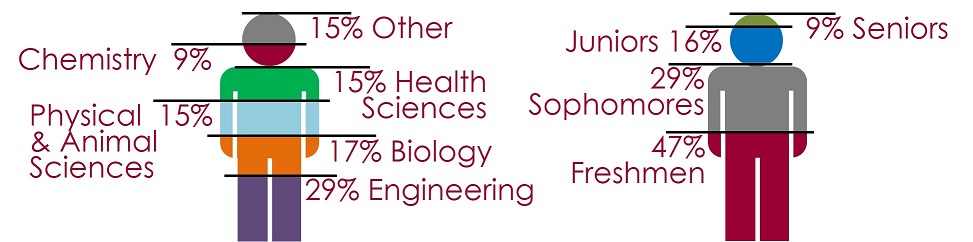
Incoming Knowledge
- CHEM 111 is an entry-level course that is mostly comprised of freshmen that graduated high school only several months prior.
- In the fall of 2016, our incoming freshmen class had an average high school GPA of 3.30 and a mean SAT score of 1016.
- The official prerequisites for the course are high school algebra and one year of high school chemistry; these prerequisites are not enforced.
- For many students, CHEM 111 is the first chemistry course they have ever taken.
Advice I Gave My Students to be Successful
To be successful in the course overall, I emphasized how much work the course is, and I tried to really hit hard the benefits of the growth mindset to students in my first lecture. Other tips I gave regarding successful CHEM 111 students are listed below.
- Attend and Participate in lecture
- Complete the homework (without procrastinating!)
- Work hard (6-8 hours per week)
- Use multiple resources
- Believe in the "Growth Mindset" model of intelligence
Since our redesign is focused on the laboratory experience associated with the course, I also fully informed students of all the new elements associated with the lab, along with their point values, through a PowerPoint slide and a Bb Syllabus Reading Quiz. All of the lab activities I discussed are listed below.
- Pre-lab prep with new instructional videos and virtual labs
- Questions about this content (1 point per experiment)
- Pre-lab questions (4 points per experiment)
- In-lab data sheets (10 points per experiment)
- Student presentations of pre-lab content will be utilized
You can find links to the following items just down below:
- Slide with tips regarding successful CHEM 111 students
- Laboratory information I gave students
- Bb Syllabus Reading Quiz
Impact of Student Learning Outcomes/Objectives (SLOs) on Course Redesign
In an integrated effort from both lecture and laboratory, students of CHEM 111 can expect to work toward achieving these (very) general learning objectives:
- Understand how the chemical and physical behavior of atoms and compounds are related to their internal structure and geometric shape.
- To gain understanding in the interactions between atoms and molecules.
- Understand how chemical reactions occur.
- To gain understanding about the relationship of energy to chemical reactions.
- To gain understanding and implement the scientific process through hands-on laboratory experience.
Alignment of SLOs With Course Redesign
Our redesign goals will be accomplished by completing two primary tasks: (Task 1) developing a new low-cost lab manual with current and new experiments adapted to fit the manual, and (Task 2) incorporating instructional videos, laboratory simulations, and student-led pre-lab lectures into the students’ pre-laboratory preparation.
- Through the creation of our own “in-house” lab manual, Task 1, we will be able to offer this valuable resource for only about $30. We anticipate that all students will then be able to afford this manual and are thus more likely to purchase it and use it regularly. This will render students more prepared for lab, and enable an enhanced laboratory experience and subsequent strengthening of the course’s learning outcomes.
- In watching the instructional videos, completing the simulations, and presenting pre-lab lectures through Task 2, students will be better equipped and have a greater understanding of the experiment before entering the lab, thus enabling a deeper exploration of the lab’s concepts while performing the experiment. This enhanced laboratory experience will strengthen the connections between the lab’s hands-on and real-world application of the course’s content, and allow for more hypothesis-driven, creative, and inspired thinking.
Assessments Used to Assess Students' Achievement of SLOs
We will utilize several assessments and compare results to those from semesters prior to the implemented design:
- Average overall laboratory
- Average overall lecture scores
- The standardized multiple choice General Chemistry I exam provided by the American Chemical Society (ACS)
- A pre- and post-course attitude survey regarding the students’ laboratory experience
Feel free to check-out our laboratory attitude survey below!
Accessibility, Affordability, and Diversity Considerations
Accessibility
- Our new "in-house" laboratory textbook is being developed and published with Hayden-McNeil; they are committed to meeting all accessibility needs (as stated here).
- The new instructional videos for the General Chemistry laboratory will be fully captioned through the help of YouTube's or Kaltura's services, and through our own campus available resources.
- All CHEM 111 lecture and laboratory syllabi will be designed for accessibility by visually-impaired students.
Affordability
- The current costs associated with the course total almost $530 including a laboratory textbook that costs $133, MUST be purchased new, and CANNOT be sold back because report sheets from the book must be torn out to be turned-in.
- These outrageous costs are what inspired this redesign; after its lauch, our newly developed "in-house" laboratory textbook will only be $30.
- In one year alone, this will result in at least $80,000 ($100 × 800 students) in savings for students.
- The only other technology required for this redesign is Blackboard Learn, to which students have free access; students will use Blackboard Learn to view the online instructional videos and additional content for their pre-laboratory preparation and assignment submission.
Diversity
- With the new laboratory text being only $30, all students — including underrepresented minorities — will be better able to afford this manual and are thus more likely to purchase it and use it regularly.
- The online instructional videos will also support a diverse array of students including visual learners, learners to need to re-watch or review content multiple times, and learners who regularly utilize online content through their computers, smartphones, and/or tablets.
About the Instructor
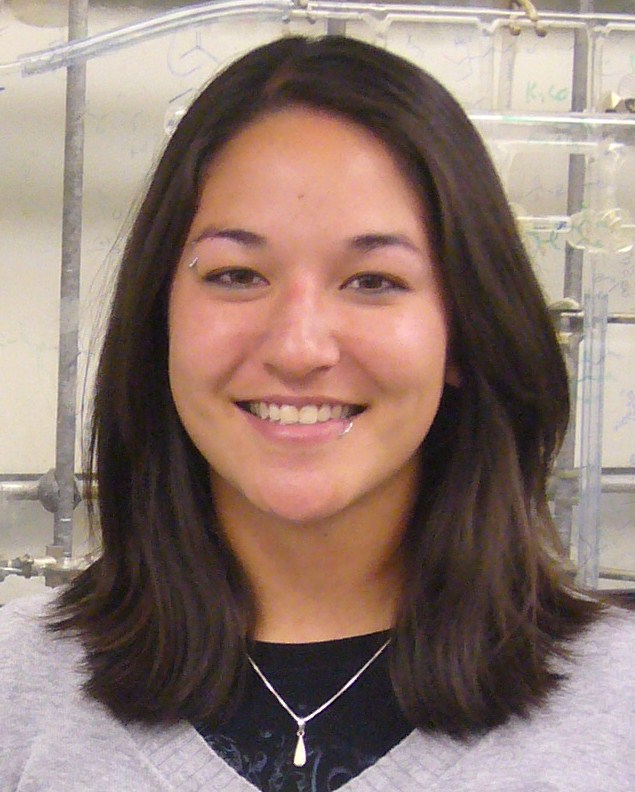
Dr. Carolynn Arpin
I am a research chemist with a background in reaction methods development, total synthesis and medicinal chemistry. Currently, my research students and I are investigating novel drugs that target and kill cancer cells through the inhibition of key protein-protein interactions. My passion for research is only rivaled by my love for teaching. While I primarily teach General and Organic Chemistry, I strive to instill excitement in chemistry among all of my students.
Education Background
B.S. in Chemistry: Georgia Southern University, Statesboro, GA
Ph.D in Chemistry: University of Colorado at Boulder, Boulder, CO
Post-Doctoral Associate: University of Toronto, Mississauga, ON, Canada
Feel free to check-out my CV (below) to learn more about me!
Challenges My Students and Lab Instructors Encountered
Issues with Late Nite Labs (LNL). Students conveyed difficulties obtaining access to LNL. However, it should be noted that these students did not follow the step-by-step tutorial that was provided to gain access. Once students were again given the tutorial, they had no issues. Most often, the lab instructors were the front-line in fielding these questions, so these issues affected them as well.
Understanding that there were two sets of pre-lab questions. One set of questions was used to ensure students engaged with the new pre-lab virtual lab or instructional video. Completion of this first set on Bb adaptively released the second set, and answering both sets was necessary to earn full points. Especially at the start, many students did not understand that they needed to answer two sets of questions, and only completed the first set. Consequently, these students missed out on four out of five possible points for the pre-lab. Unfortunately, some students continued with this lack of understanding until mid-semester. Of course, the lab instructors are the primary contacts for students in dealing with these issues, and all instructors did their best to convey all of the necessary logistical information.
Getting the pre-lab questions done. Pre-lab questions were due by midnight before the student’s lab section met; this caused issues among the students with getting their work done on time. Sometimes students also simply forgot about the early due date. Additionally, lab instructors noted that students often skipped the difficult questions. Perhaps if the questions were due immediately before their section meeting time, students would have more time to obtain help from instructors or others to answer the harder questions.
Completing the pre-lab questions without plagiarism. Evidence of copying from the internet and/or the lab manual was abundant among the answers submitted to the pre-lab questions. Students were informed that their work was an epitomical example of plagiarism and dealt with appropriately. This issue served as a challenge for the lab instructors as well, since they needed to be on the lookout for cheating and they had to deal with the unethical students directly.
Incorrect due dates set accidentally. Since the new pre-lab content had to be uploaded to each of the 15 lab sections’ Bb pages every week, accidental errors in due dates or adaptive release settings were inevitable. Gratifyingly, the lab instructors handled these mistakes very professionally and left very few — if any — students frustrated or upset.
Lessons Learned & Redesign Tips
Strategies I Used to Increase Engagement
- Wrote a new and improved lab manual which cost $100 less than previous
- Replaced decades-old experiment with a new and more relevant one
- Incorporated virtual lab and instructional video technologies into students’ pre-lab preparation
- Tailored pre-lab questions for online submission; enabled weekly Bb submission of questions
- Utilized student presentations of pre-lab lecture content
Course Redesign Obstacles
Ensuring students engaged with the new pre-lab preparatory material
- To ensure students engaged with the Late Nite Labs (LNL) virtual lab or the instructional video, we had one set of pre-lab questions that were specifically about the virtual lab or video
- Only after answering this first set of directed questions would the full set of pre-lab questions (worth a majority of the pre-lab points) become available
“Single sign-on” to Late Nite Labs unexpectedly became unavailable
- Intended for students to simply click a link on their lab’s Blackboard (Bb) page to take them directly to the LNL virtual lab; our technology staff unexpectedly informed us that LNL was not approved for such capability
- Implemented a last-minute solution of providing each student with their own LNL code to bypass paying for access
Adding content to the Bb pages for 15 different lab sections each week
- To ease the transition to the new content, lab instructors were not asked to import and launch each week’s pre-lab content
- Instead — every week for all 15 lab sections — Dr. Kendhammer and I had to: import and launch the instructions, LNL virtual lab or video, pre-lab questions with individualized due dates, and post-lab questions
Dealing with students’ technical issues
- Students had a range of issues in dealing with the new content including difficulty obtaining LNL access, not understanding that there were two sets of pre-lab questions to complete, and due dates that were accidentally set incorrectly
- Most often, lab instructors consulted Dr. Kendhammer and myself; issues that couldn’t be handled by provided instructions or tutorials were simply dealt with on a case-by-case basis as fairly as possible
Teaching Tips
Notably, future CHEM 111 offerings are going to use the redesigned course! The next instructors for all sections of CHEM 111 are excited to utilize nearly all redesign elements. Of course Dr. Kendhammer and I are providing tips or advice to ensure a smooth transition.
Confirm or establish Blackboard (Bb) integration for new online technologies. We had intended Late Nite Labs to have one-click access from Bb, but were denied such capability right before the semester. To avoid such an obstacle, contact campus technology coordinators early to confirm a program’s capabilities or to start the process early of obtaining the desired capabilities.
Finalize all pre-lab assignments before semester, launch in a preparatory Bb course, then have lab instructors use a Course Copy. This avoids having to upload and launch each week’s activities individually for each lab section.
Anticipate and try to curb technological difficulties for students. Explicitly written tutorials and videos explaining how to complete the pre-lab activities would undoubtedly help, but there will always be students with issues.
Allow lab instructors “creative freedom” for implementing student pre-lab presentations. Without the creative freedom to make the student presentations what they want, lab instructors are less willing to implement them in their section.
Experiment with online post-lab question submission. Lab instructors provided overwhelmingly positive feedback with our online submission of pre-lab questions; it’s likely that the online submission of post-lab questions would also be favored.
Course Redesign Planning Stage 3 |
Implementing the Redesigned Course
A Redesigned CHEM 111 Laboratory Experience
Previously, students primarily prepared for lab just by reading from the $133 lab manual
- We launched the use of a new lab manual completely written and developed in-house that only costs $30, saving each student at least $100 in course materials
- We designed and implemented virtual laboratory experiments as an additional component of students’ pre-lab preparation
- We are also having students view instructional videos prior to entering the lab as another pre-lab preparation component
- Many of our experiments are available for public use under the Creative Commons License - just contact if you'd like more information about experiments from our manual!
Prior to the redesign, students also completed pre-lab questions on paper which they submitted to the laboratory instructor upon entering lab; these questions would be graded and returned to students the following week
- Students now answer pre-lab questions online through Blackboard for which they obtain instant feedback
- Online submissions of these questions are due by midnight before their lab section meets as opposed to at the beginning of lab
Many of our laboratory experiments have not been updated in nearly 10 years
- We replaced one experiment with an analysis of a commercially-available product to add relevance for students to real-world applications of chemistry
Formerly, instructors gave traditional pre-lab lectures before letting students get started on the experiment
- Our new pre-lab preparatory activities and lab manual have enabled us to launch student presentations of this pre-experiment content
- Beginning Week 6, students provide the traditional pre-lab lecture in groups of three
Adopted Technologies
All technologies were adopted in efforts to improve student preparation for laboratory experiments and consequently enhance the laboratory experience for students in its entirety.
Customized virtual laboratory experiments through Late Nite Labs
- Short virtual lab experiments that are very similar to our physical laboratory experiments
- Students complete the virtual lab prior to attending the physical lab
- Students get to experience and walk-through the week’s experiment before stepping foot in the lab
Laboratory instructional videos
- Videos detailing experiment walk-throughs and demonstrations of laboratory techniques
- Filmed and edited by undergraduate students
- Students obtain an introduction the week’s laboratory experiment and learn about what to expect prior to attending lab
Online submission of pre-laboratory questions
- Pre-lab questions adapted for online submission through Blackboard’s “Test” functionality
- Questions inform students of what they should know and be able to do before attending lab, and to assess student pre-lab preparation
- Students receive instant feedback for a majority (if not all) of the questions
- Decreased the grading workload for instructors
Redesign Professional Development Activities and their Application
CRT Professional Learning Community (PLC) webinars
- Creating syllabi that is accessible for everyone
- Integrating diversity into the course’s science-heavy content
- Resources for creating and/or utilizing affordable textbook alternatives
CRT Biology, Chemistry, Nutrition, and Physics (BCNP) Cohort
- Comradery has been integral to this process
- Exposure to and application of various teaching technologies in science-heavy courses
- Many other CSU faculty are similarly passionate to help their students
CSU Chico’s Academy e-Learning: Teaching with Help
- Mastery of teaching technologies that are now being used in the redesigned course
- Multitude of resources available for CSU Chico faculty to supplement or redesign a course
Additional Resources for this Redesign
- Hayden-McNeil streamlined the process of publishing our new lab manual, provided us with a great finished product for a great price, and even allowed us to sell back any un-purchased manuals
- Late Nite Labs representatives aided us in our implementation of their product
- Members of our campus’ Technology and Learning Program (TLP) — our academic tech gurus— gave us tips for a smooth implementation of all our online content
- Several department colleagues contributed to our new lab manual with their own written experiments
The cover page for our new lab manual and Revised syllabus for the redesigned course are below (check them out!)
Redesign Results Stage 4 |
Course Redesign Impact on Teaching and Learning
Impact on Teaching
Since we redesigned the laboratory experience for CHEM 111, a majority of the teaching was done by the lab instructors; their feedback is below. As for my own lecture teaching throughout the semester, I referenced the lab experiments more frequently and with more detail than in previous semesters, and constantly tried to connect what they did and learned in lab to the current unit’s concepts. Students used their iClickers to answer questions about example lab data and what it showed. I also included more questions involving example lab data on tests, which I had rarely done before. With enhanced lab preparation and experiences, students did seem to have a stronger grasp on what was taught in lab; consequently I felt more comfortable spending less time on those concepts in lecture. Importantly our department is on board with continuing to use all of our redesign elements! Thus, when I teach CHEM 111 again, I will definitely use these adapted teaching strategies: strongly connecting lab and lecture, and relying more on the lab and less on lecture to teach the concepts involved in each experiment.
With regards to my own laboratory teaching, the enhanced pre-lab activities and questions enabled me to spend less time on the specifics of the lab experiment in my pre-lab lecture, and instead spend more time on the lab’s relevance to lecture concepts and the real world. I provided more examples from industry and research lab settings, and performed more demonstrations that were slightly different than what they would see during the experiment. After Week #6, student groups of three presented the pre-lab lecture each week, and I found that my own preparation for the lab was almost unnecessary. I did have an in-depth meeting with each group about a week before they presented, but beyond the feedback I gave in that meeting, any preparation I did for the week was rarely utilized. Notably, I found that students asked fewer questions about the calculations during weeks when the groups presented the pre-lab lecture, and throughout the semester I had more questions from students that dug deeper into the lab’s concepts. When I teach CHEM 111 again, I will undoubtedly use these new strategies of relying on the students more to learn and convey the material to each other, and to continue adding real-world relevance to each lab.
Impact on Learning
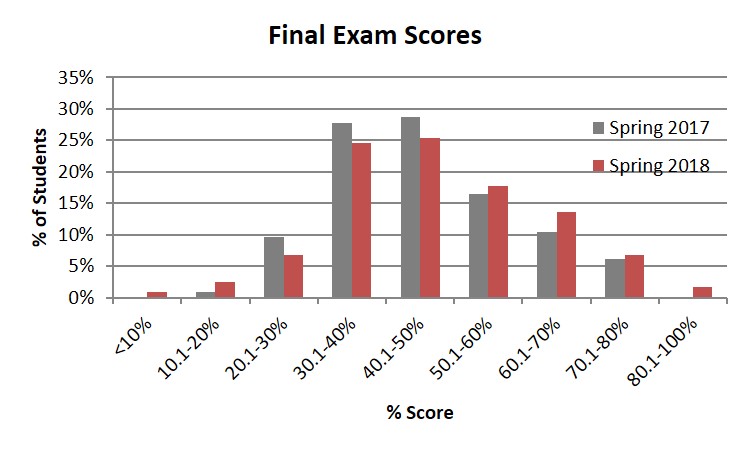
Student performance improved on the American Chemical Society’s standardized General Chemistry I Final Exam. A telling piece of evidence that conveys how well students mastered the learning outcomes of the course is their performance on the standardized multiple-choice final exam that many faculty in my department utilize. This exam is written by the American Chemical Society (ACS) and is used to assess General Chemistry learning outcomes all over the country. Gratifyingly, as shown in Figure 4.1, students this semester (during our redesign launch) performed better than previous: a smaller percentage of students scored less than 50% on the exam, and a larger percentage scored greater than 50%.
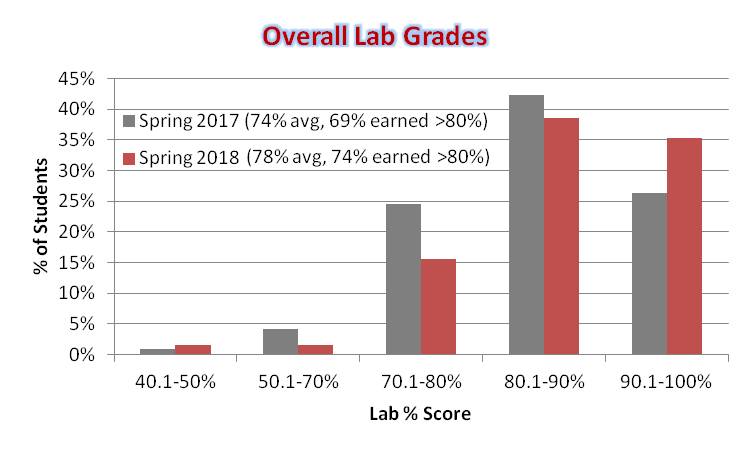
Overall lab grades improved. In comparing the overall lab grades that were collected at the end of the semester both pre- and post-redesign, students earned better lab grades this semester than previous. As Figure 4.2 shows, the percentage of students earning an 80% or lower decreased, while those earning higher than 80% increased. Additionally, the average grade pre-redesign was 74%, and post-redesign this average grade improved to 78%. Since our redesign focused on the laboratory experience for students, this data suggests that our changes were effective and did have an impact on students’ learning and performance in the lab.
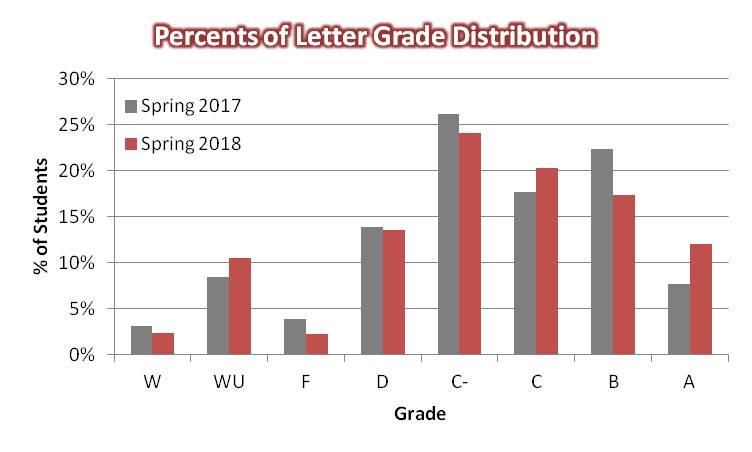
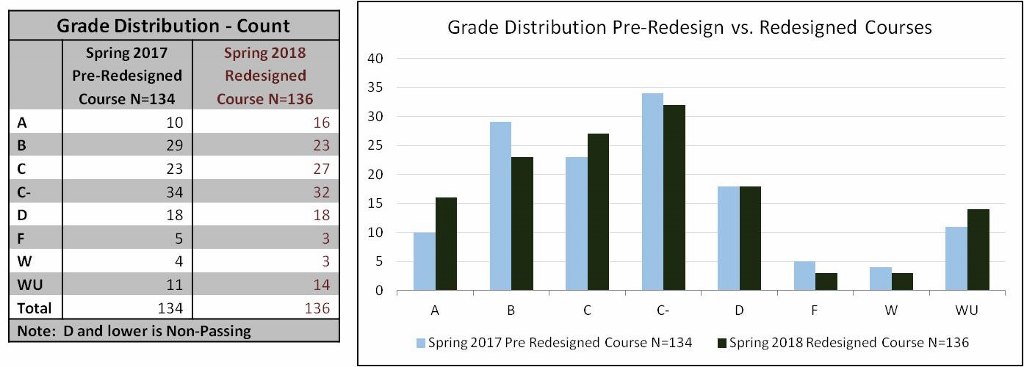
The passing rate for the course did not change. Unfortunately, as displayed in Figures 4.3 and 4.4 and Table 4.1, the same percentage of students (74%) earned a passing grade as in previous semesters. We had intended for this rate to increase, and are therefore disappointed with these findings. As Figure 4.3 also shows, somewhat reaffirming data is that the percentage of students who earned an A did increase, as did the percentage who earned a C; however, the percentage who earned a B decreased when compared to the pre-redesign semester. This consistent pre- and post-redesign non-passing rate of 26% suggests that our redesign elements did not have a significant impact on the students’ learning outside of the lab.
Unexpected Results
More obvious instances of plagiarism. Since students submitted their answers to the pre-lab questions through Bb, it was quite obvious when they simply copied-and-pasted an answer from the internet. It’s entirely possible that students were also doing this in previous semesters, but the online submission made it much easier for lab instructors to spot cheating. This could be seen as both a pro and con of online submissions since it made cheating easier to detect, however, lab instructors then had to confront the students and discuss plagiarism.
Students who presented the pre-lab lecture were NOT the most knowledgeable about the experiment. Due to the required level of preparation, one would expect the students who presented the pre-lab lecture to be local experts on the experiment. Unfortunately, this was not the case, and the presenting students often performed just as well or more poorly than the rest of the class on that experiment. Thus, although we had hoped that preparing to give a pre-lab lecture would require more knowledge of the experiment than non-presenting students, it became apparent that the presenting students either were not internalizing that knowledge, or simply did not acquire it in the first place.
Student and Lab Instructor Feedback
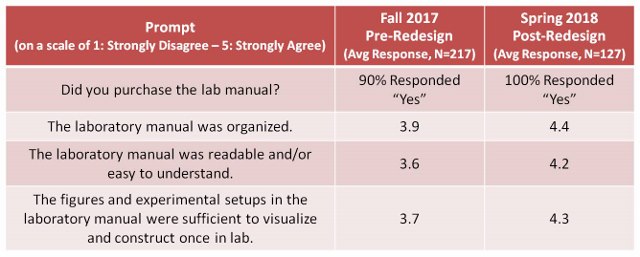
An increased number of students obtained the lab manual and found it more accessible. According to the end-of-semester survey given to students in the pre-redesign semester of Fall 2017, 90% of students reported that they had purchased the lab manual. In contrast, 100% of students reported that they bought the manual in the Spring 2018 semester (see Table 4.2). This is supported by the fact that we sold out of our newly-developed manuals. Additionally, when prompted with statements about the manual’s organization, readability, and quality of figures, students who used the new lab manual had stronger favorable responses (see Table 4.2). This data strongly suggests that our new manual was more affordable and more accessible to students.
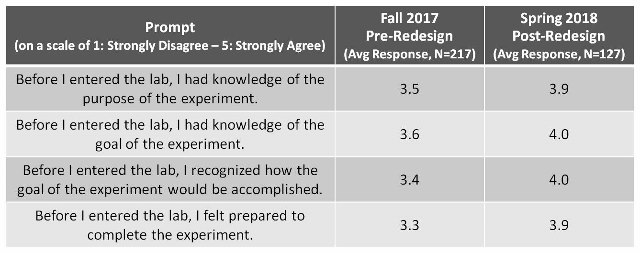
Students felt better prepared and felt they had an increased understanding of the experiment. The increased accessibility of the lab manual, combined with the new pre-lab preparatory virtual labs and instructional videos had definite impacts on how the students felt before walking into the lab and during lab. As shown in Table 4.3, students of the redesign launch expressed stronger feelings that they felt prepared for the lab and understood the lab as compared to students pre-redesign. Gratifyingly, this suggests that our redesign elements had a positive impact on the students’ comfort levels prior to and in the lab.
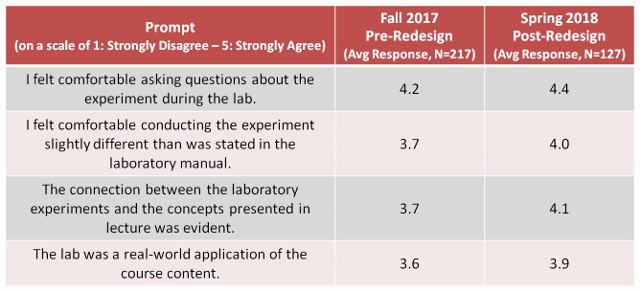
Students felt more exploratory and had stronger feelings of connection between the lab content and lecture and the real world. As we had hoped, our redesign elements also had an impact on how the students felt the lab content related to lecture and the real world. Compared to previous students, students of the redesign launch felt more comfortable students asking questions, conducting the experiment different than stated in the procedure, and they agreed more strongly with statements that connected the lab to lecture and real world material (see Table 4.4).
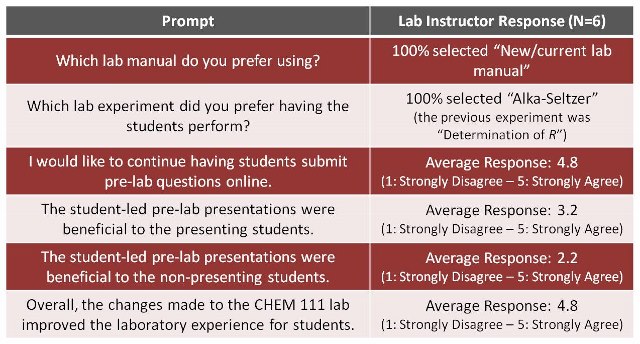
Lab instructors provided overwhelmingly positive feedback on nearly all redesign elements. As shown in Table 4.5, 100% of lab instructors reported that they prefer using the new manual as opposed to the previous one on an end-of-semester survey given after the redesign launch. Additionally, 100% of the lab instructors preferred the new experiment we implemented over the previous one; and one instructor stated that, “It worked better and [students] like doing ‘real-life’ experiments.” All of the instructors either agreed or strongly agreed that they would like to continue having students submit pre-lab questions online because they were “Easier to grade, and they had to do it more than 5 minutes before lab started.” Unfortunately, the instructors were more not as positive towards the student presentations of pre-lab content: when asked about the benefit of the presentations to the presenting students, instructors responses were generally neutral, and they were more negative when asked about the benefit for the non-presenting students. Extremely gratifying, however, was the instructors’ responses to all of the changes made to the lab course collectively — 100% of the instructors either agreed or strongly agreed that the changes improved the laboratory experience for students.
Please check-out the Post-Redesign Lab Attitude Survey that we distributed to our students, as well as the Google Form survey we asked our Lab Instructors to complete - links provided below.
Instructor Reflection
Sincere gratitude. This has undoubtedly been one of the most useful and relevant projects I’ve ever undertaken in my entire career; I am sincerely grateful for its products, and for the opportunity to participate in the CRT program. My entire department had been discussing a redesign of the lab portion for CHEM 111 for years; being able to follow-through with such a large task was extremely fulfilling and it is only the beginning. I have no doubt that these changes have and will continue to improve this foundational course for years to come.
Working with film-making students was a highlight. Most (if not all) of my job is interacting with students in the classroom, teaching lab, or research lab; working with students to create instructional videos was an aspect of this project (and my job) that was unexpectedly extremely fun and rewarding. The students and I all embraced our creative sides and found a lot of enjoyment in creating videos we were all very proud of. Even after we had finished our original set of videos, the students wanted to make more! Of course, who was I to stop them?!
A TREMENDOUS amount of work. Dr. Kendhammer and I began our redesign efforts shortly after we were notified of our CRT participation in the Spring of 2017, we continued to work throughout the year and throughout the launch in spring 2018, and — of course — our work is still continuing today. I would honestly say that we probably “bit off more than we could chew”, but we had determination and got it all done. I definitely would advise future redesigners to try and be aware and realistic about the amount of effort that will be required of them.
Mistakes were made. Our biggest mistake was attempting to ease the transition to the redesigned course for our lab instructors by not asking them to upload the new content each week to his/her Bb page. Consequently, Dr. Kendhammer and I had to perform this task for all 15 lab sections on a weekly basis. I spent way too many late nights making sure all pre-lab content was uploaded and launched correctly. Another mistake was not confirming that Late Nite Labs could seamlessly integrate with Bb.
The products made our efforts worthwhile. The first piece of evidence that suggested our immense efforts were worthwhile was the fact that we sold out of our newly developed lab manual. Notably, this meant that we saved students $100 each on their course materials! That likely meant that every CHEM 111 student purchased the manual, which we knew for previous semesters was not true. The overwhelmingly positive feedback from lab instructors regarding the online submission of pre-lab questions was very fulfilling, and made all those late nights worth the loss of sleep. Additionally, it was extremely gratifying to see that students felt as though they were better prepared and had a greater understanding for the lab as compared to the pre-redesign semester. Finally, acknowledgement for our work in the form of continued use of our redesign elements is probably the most rewarding of all.
The CRT program had unanticipated added value. Despite agreeing to complete and participate in all aspects of the CRT program, I did not expect the added value of these collective aspects. After attending several Professional Learning Community (PLC) webinars and obtaining invaluable knowledge, I found myself disappointed if I had to miss out on a webinar. In fact, I found these Zoom meetings so valuable that I wondered why only CRT participants were invited instead of all faculty. Relatively, however, I found even more relevance and enjoyment through interactions with my cohort either in person or through Zoom meetings. Networking, working with, and learning from others facing similar issues as me who are just as invested as I am in student success was arguably the most rewarding aspect of the entire program.
Dissemination of our work. The preliminary findings of our redesign have already been presented at two campus functions: as a poster our CRT Showcase (Mar 6, 2018, PDF of poster provided below) and as another poster at our Affordable Learning Solutions Jamboree (Apr 2, 2018, PDF of poster provided below). Other presentations and publications are planned.