Quantitative Analysis
Quantitative Analysis

Quantitative Analysis Virtual Prelab Course Redesign
"Increasing laboratory performance through better preparation"
Scott C. Russell, Department of Chemistry, CSU Stanislaus
(Phone: 209-664-6870, Email: srussell1@csustan.edu)
Course name: Quantitative Analysis and Basic Instrumental Techniques
Course description: Principles and practice of analytical chemistry. Topics include error analysis and statistical treatment of data, gravimetric and volumetric analysis, electroanalytical techniques, chromatography, and selected quantitative instrumental techniques.
Project Abstract
This course will be modified to include virtual prelabs and assessements. The virtual prelabs and online assessments will better prepare students for their lab work prior to starting each lab. The effectiveness of this course redesign will be assessed by comparison of average lab scores to those from prior semesters where no virtual prelabs were available.
GE Credit: This course does not count for GE credit.
Keywords/Tags: Virtual prelabs, online assessments.
Instructional Delivery: In-class
Pedagogical Approaches: This class is taught as a lecture course with a lab component in which the students put into practice the concepts developed in lecture.
Syllabus after redesign (Fall 2015)
Syllabus before redesign (Fall 2014)
Complete Project Description
This document provides a more thorough description of the redesign project.
CSU Course Redesign Website
Review the description of the CSU systemwide initiative supporting faculty redesigning their courses to improve student success.
MERLOT Digital Library
A free and open online library of online teaching and learning materials across a wide variety of disciplines and education levels. MERLOT provides you the link to the material as well as peer reviews, member comments, lesson plans, and other quality assurance information.
Why redesign your course?
I decided to add virtual prelabs to my Quantitative Analysis course because I've seen students routinely struggle with being fully prepared for each lab prior to starting them. I'm hoping the efforts put into redesigning this course will increase the likelihood of student success in this challenging course.
How will the "Redesign" lead to better learning?
After this redesign, each student will be required to complete a virtual pre-lab and demonstrate an understanding of the material associated with the lab by completing an online assessment. Failure to complete the online prelab and and assessment will result in the student not being able to begin that associated lab. This new requirement will likely increase each students understanding of the lab procedures and concepts associate with them. These changes will force the student to understand the logic behind each lab, which will lead to a deeper level of learning in the laboratory.
Project Redesign Objectives
- Determine whether or not requiring virtual prelabs and online assessments leads to greater success in the laboratory. (This will be measured by comparing average lab scores from the fall 2015 semester with lab scores from prior semesters)
- Characterize the correlation between increased lab success and success in lecture course componenets. This will be done by correlated lab scores with exam scores for the fall 2015 semester and compare those correlations with those from previous semesters.
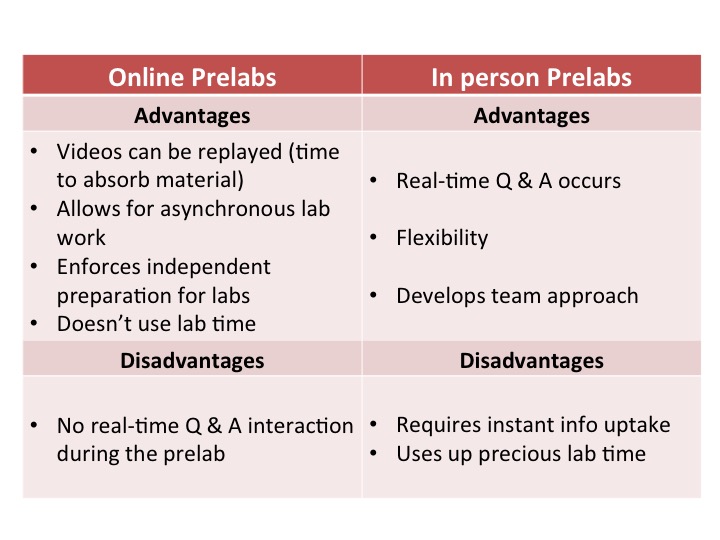
The use of online prelabs offers several advantages to contentional "In Person Prelabs". A comparison of these two approaches is outlined below.
About the students
The students who take this course are mostly Chemistry majors. Other students include Criminal Justice majors with an interest in Forensics, and Biology majors with an interest in Clinical Lab Sciences. All of the students are checked to have met the prerequisites. However, many of them lack the necessary skills needed to be fully succesful in this course and do not adequetely keep up with the material at a pace that is needed for success.
Advice I gave students to be successful
I emphasized the importance of staying up with the material and continuing to be prepared for each lab by completing the virtual pre-labs and online assessments prior to being able to start any associated lab. The students were reminded by email and in person when new virtual prelabs were available.
Challenges my students encountered
The students gave me feedback that they would like to see more laboratory techniques demonstrated in the virtual prelab videos. Additionally, they asked for more demonstrations on instrument operation. I plan on focusing on these areas for future redesign efforts.
Student Learning Outcomes
• To provide students with a comprehensive overview of the disciplines' basic principles, methodologies and perspectives.
• To introduce students to the disciplines' subject matter.
• To introduce students to cultural diversity as appropriate to the subject matter.
• To demonstrate to students a discipline's interrelationships with other disciplines.
• To require students to demonstrate clear communication and logical thinking skills.
About Me
I am an Associate Professor at California State University, Stanislaus. My area of expertise is in Analytical Chemistry. My research interests focus on the application of mass spectrometry to biological samples. I teach General Chemistry I & II, Quantitative Analysis, and Instrumental Analysis. My teaching emphasizes a focus on providing students with a foundation of concrete examples to help them understand and apply the material. I continually seek out new methods of teaching, but always retain a focus of providing them with concrete examples.
Learning Objectives and Redesign Activities
The redesigned activities were implemented for the first time during the Fall semester of 2015. The redesigned components were developed in July and August of 2015, prior to the start of the fall 2015 semester.
1. Virtual Pre-labs for each Quantitative Analysis Laboratory: The logic behind each lab was fully laid out in these virtual prelabs. Additionally, the data analysis and calculations as well as all related safety issues were addressed. These virtual prelabs allowed students to come to lab better prepared to conduct each experiment.
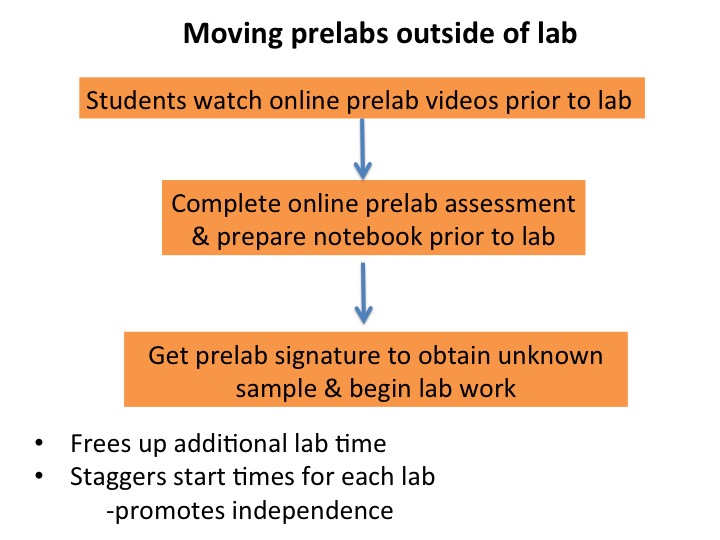
2. Online prelab assessments: These were created to assess whether or not the student had mastered the concepts and logic behind each procedure. Each student was required to complete each online assessment associated with each lab prior to being allowed to start that associate lab.
What's Special About Teaching with the Redesigned Activity?
Teaching with the virtual prelabs had two significant positive effects on the course. The first was that the students were held directly accountable for coming to each lab fully prepared to carry out each lab procedure. This independence allowed the students to stagger their lab start times. This asynchonous lab schedule further reinforced independent work in the lab. The second beneficial effect, was that more lab time was freed up to carry out lab work, rather than have students sit and listen to me deliver a prelab lecture in person. Overall, I found the use of online prelabs to be very effective and a positive change for the course. I plan on continuing to utilize them in future offerings of this course, with the caveat that they be further improved.
MERLOT Pedagogy Portal
MERLOT's Pedagogy Portal has a collection of online resources on over 25 types of pedagogical strategies. Explore what other faculty and higher ed institutions are doing and recommending for student engagement strategies.
Accessibility, Affordability, and Diversity
1. The virtual prelabs and online prelab assessments were posted online within our learning management system, Blackboard. Utilization of Blackboard provide the new content with no additional cost to the students.
2. The virtual prelabs and online assessments require a computer with an internet connection. Most students have access to this, but some may not. For those students who do not have access to a personal computer, they will have to rely on the computers available in on-campus computer labs.
3. The pedagogical strategies employed aim to address the many different learning styles and modalities by engaging students on multiple levels through various media. The virtual prelabs offer both visual and auditory engagement with the material.
NEXT STEP
Catalog This Webpage in MERLOT So Others Can Benefit
You can contribute this teaching resource as a material in the MERLOT collection. You can catalog it within the relevant discipline areas and in the ePortfolio category (which is under the main Academic Support Services category) and then in the "teaching-centered ePortfolio" category.
It only takes a few minutes and allows your work to benefit the entire MERLOT community!
Student Reactions to Learning with the Redesigned Activities & Impact on Teaching and Learning
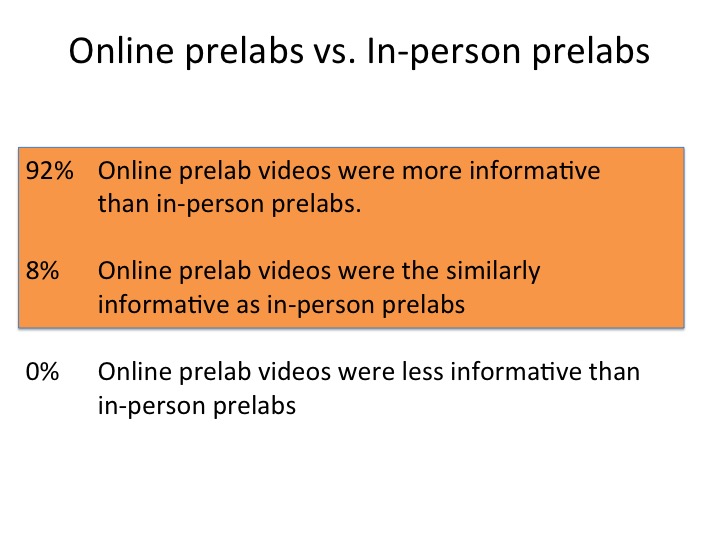
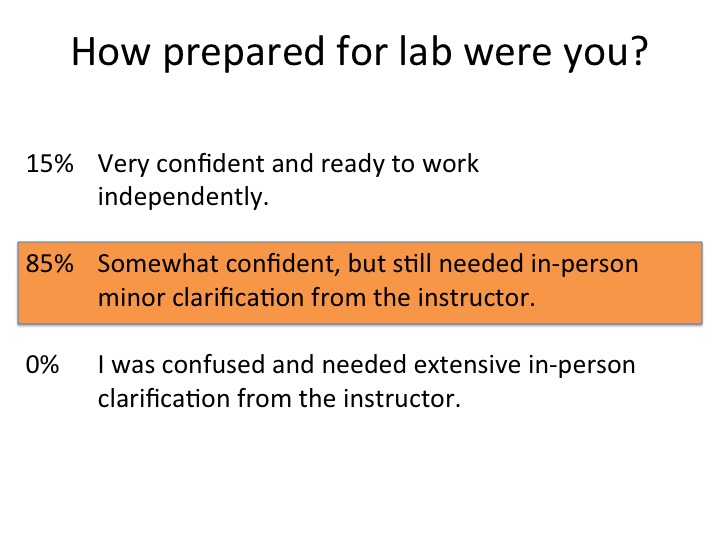
The students were surveyed anonymously regarding the use of online prelab videos in place of the in-person prelabs. Survey results from the two most telling questions are shown below. These results clearly show that the students perceive the use of online prelabs as a beneficial change.
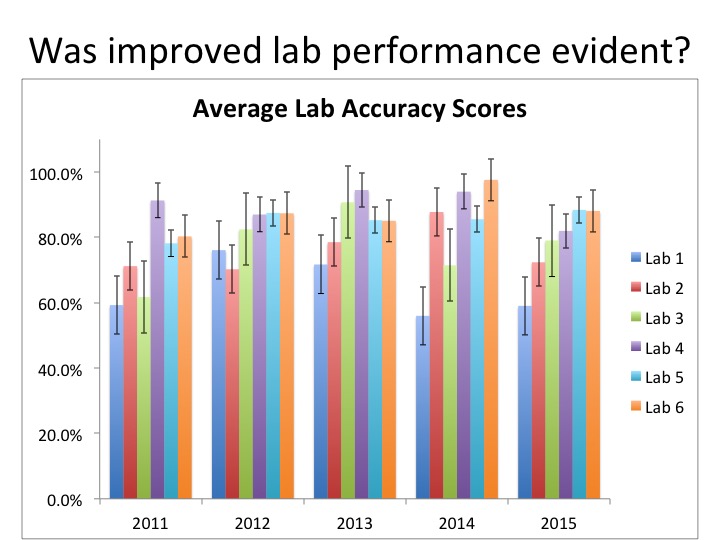
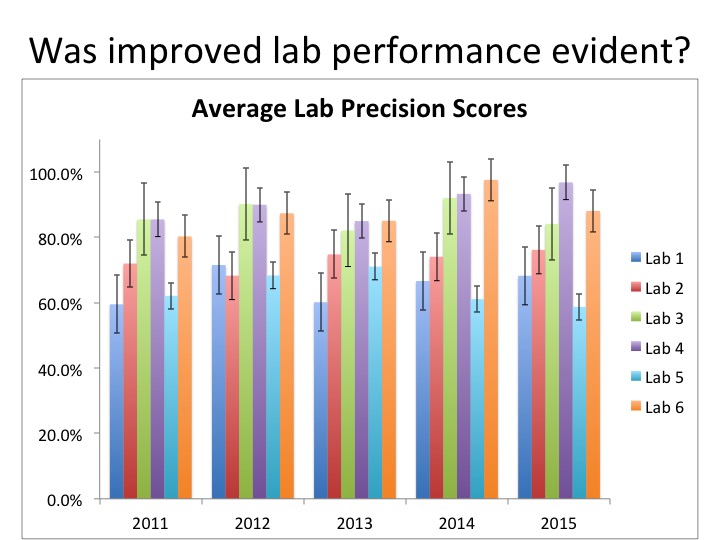
While student perception was positive, there was no stastically significant change in accuracy or precision lab score when compared to previous years. It should be noted that the six labs compared have been taught with consistent accuracy and precision scales since 2011.