POLSCI 421
POLSCI 421

Addressing Increasing Enrollment in POLS 421 through a Flipped Classroom
Dr. Lori M. Weber, Professor, Department of Political Science, CSU, Chico
LWEBER@csuchico.edu
Project Abstract
The redesign of POLS 421: Methods of Political Inquiry will be crucial in meeting the upcoming needs for an upper division social science statistics course. Currently the course is able to meet the needs of the approximate 25 Public Administration students in the fall semester who need the course for their major, but beginning in AY 2014-15 all Criminal Justice students (approx. 500 majors) will be required to take POLS 421 as well. POLS 421 will be redesigned using a ‘flipped’ model (e.g., primary instruction occurs online prior to class attendance).
Complete Project Description
This document provides a more thorough description of the redesign project.
CSU Course Redesign Website
Review the description of the CSU systemwide initiative supporting faculty redesigning their courses to improve student success.
MERLOT Digital Library
A free and open online library of online teaching and learning materials across a wide variety of disciplines and education levels. MERLOT provides you the link to the material as well as peer reviews, member comments, lesson plans, and other quality assurance information.
Course and Student Background
What course are you redesigning and who are your students? POLS 421: Methods of Political Inquiry is offered through the Department of Political Science. We require this course for our Public Administration majors (approx 50 students), and beginning in fall 2014, we will be requiring this course for all our Criminal Justice majors (approx 500 students).
The prerequisite for this course is POLS 331: Introduction to Political Inquiry, which is an introduction to social science research course whereby students learn to asess and construct research designs and write scholarly literature reviews. This prerequisite also serves as the upper division "writing proficiency" course. Consequently, students entering POLS 421 have some background that prepares them to begin to undertake applied quantitative social science resarch. However, only approximately one-third of these students have taken introductory statistics courses.
Why did you redesign your course?
Currently the course is able to meet the needs of the approximate 25 Public Administration students in the fall semester who need the course for their major, but beginning in AY 2014-15 all CJ students will be required to take POLS 421 as well. Given the approximately 500 majors in the CJ program, the influx of students into this class will necessitate serving more students in the most efficient manner to avoid creating a bottleneck.
What did you change through the redesign?
I used to teach this course in a once a week format (3 hour class period). I lectured for the first half of the class period and used the second half of the class period for applied social science statistics activities in the computer lab.
Now I "flipped" the classroom and have my students engage not only with reading but also with video lectures and web links prior to the class period. This allows me to use the entire class period devoted to the applied activities in the computer lab. Since I am limited to only 25 seats in the computer lab, I can now break the class into groups of 25, whereby they meet with me once a week and serve a greater number of students in the course, while still maining face-to-fact contact with the primary instructor while undertaking applied activities.
In addition, this course redesign includes utilizing a graduate teaching assistant that will allow me to serve the increasing numbers of students in the course. Currently, this graduate assistant is helping me with the design of the applied activities and video lectures for the course.
Why will the "redesign" lead to better learning?
In my over 15 years teaching this course, it is abundantly clear that students need one-on-one assistance during their applied activities in the computer lab. Otherwise, a course like this can easily digress into an exercise in frustration on behalf of the students--especially as they are likely to get hung up dealing with the statistical computer programs (e.g., SPSS). This redesign will allow me to incorporate a greater number of students into this important course, while still maintaining the small and interactive classroom environment.
Prior to the redesign, I also discovered the impactful use of video lectures on a variety of statistical concepts (e.g., many now proliferate the web, such as Khan Academy). Students can replay these videos over and over, and many students in the recent past have reported to me that they contributed greatly to their understanding, above and beyond the course texts. This redesign greatly expands upon my use of video lectures and informational materials, which provide an important supplement to the course text.
Syllabus BEFORE Redesign
This is my original syllabus before the redesign.
Syllabus AFTER Redesign
This is my revised syllabus after the redesign.
Teaching Tips
I have found the set of technological skills needed to produce video tutorials to be very time consuming. I encourage instructors to consider beginning these in the semester prior to the course. Since, I have taught using a flipped classroom for only 5 weeks now, I find that getting a sense of how it is working for the students is very much a "work in progress." So far, the main challenge has been what I have discussed above.
I have received positive feedback so far from students for the use of class time. Several students recently remarked that they look forward to coming to class since it goes so quickly with the hands-on activities. Indeed, teaching in this way has also been much more enjoyable for me as well. However, it is still too early to assess how well this translates in their abilities on upcoming exams and their applied research project for the course.
What's Special About Teaching with the Redesigned Activity?
As you can see in my example "workshop" assignment link above, using the flipped classroom means that I have to pay special attention to when it is acceptable for students to work collaboratively during class time--and when I am expecting them to perform the work on their own. I deal with this by providing explicit instructions to students on each workshop assignment.
MERLOT Pedagogy Portal
MERLOT's Pedagogy Portal has a collection of online resources on over 25 types of pedagogical strategies. Explore what other faculty and higher ed institutions are doing and recommending for student engagement strategies.
Accessibility, Affordability, and Diversity
Please provide your assessment of the following aspects of the redesign strategy so faculty and students can have greater confidence that the learning experience will be successful for all students.
1. Does the technologies used in the redesign meet section 508 accessibility requirements so students with disabilities can have an equally effective learning experience?
I am working closely with staff in our university's "Technology and Learning Program" to make my materials accessible to students with disabilities (e.g., incorporating close captioning into my video lectures when possible).
2. Are the technologies used readily available and affordable for your students?
The technologies are freely available through the course Blackboard Learn site.
3. Do the pedagogical strategies support students' learning with their diverse cultural, ethnic, and gender backgrounds?
The redesign of this course allows the Department of Political Science to extend this course offering to the large number of criminal justice majors. There are a greater percentage of students of color, first-generation college students, and English language learners in the major.
This course provides students with the skills to actually analyze key social disparities for themselves (e.g., students examine gender and race disparities in crime vicitimization in the United States using the National Crime Victimization Survey series).
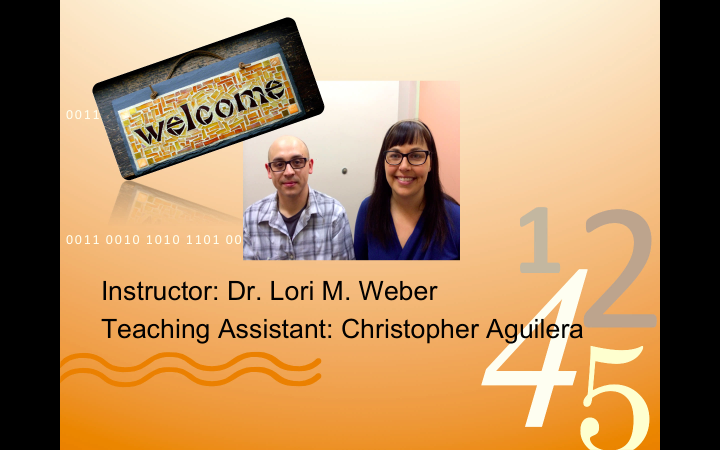
"Welcome Sign Mosaic in Warm Tones" by Margaet Almon is licensed under Creative Commons.
Learning Outcomes and Redesign Activities
Introduction and Goals
I have redesigned POLS 421: Methods of Political Inquiry using a “flipped” model (e.g., primary instruction occurs online prior to class attendance).
1) The primary impetus for this redesign is prepare for increased future demand placed upon this course.
2) Another curriculum goal for this course is to take advantage of the flipped model.
3) A final curriculum goal for this course is to utilize research that is currently being undertaken by scholars at our institution, so that students may be directly involved in the research experiences.
Future Courses–Goal 1 Alignment
Currently the course is a 3-unit class that meets once a week, but in the future we plan to meet either two or three times a week (with different groups of students for each meeting) as the size of the course grows.
Spring 2014 Course–Goal 2 & 3 Alignment
Goal 2
Since the current spring 2014 course is a pilot, there are only 15 students enrolled. We meet once a week in a computer lab classroom. In addition to the primary instructor, the graduate teaching assistant is also present at all of the class meetings to assist students as they work through the applied activities on the computer.
Students complete a set of “comprehension” questions based upon the weekly modules, which consist of videos, web links, and readings. Students submit answers to these questions via the course learning software (Blackboard Learn) and are then asked after the class meeting to self-grade their answers based upon a key and resubmit the self-graded answers one week later. This provides students with the opportunity to review the module materials once more after they have applied them in the flipped classroom environment. It also emphasizes engagement with the learning materials rather the regurgitating “right or wrong” answers, as I feel would be the case with more traditional weekly quizzes.
During the class meeting time, I provide students with a “workshop” assignment that applies the concepts from the weekly modules that students complete on their own prior to attending the weekly class periods. Consequently, the in-class meetings focus upon reviewing and bringing the module materials “to life” in the flipped classroom setting.
Goal 3
Starting in late March, students’ work during the in-class meetings will focus exclusively upon applying all the skills they have learned so far in the course to produce reports using original and timely data. Several criminal justice faculty in the CSUC Department of Political Science are currently collecting recidivism data from Butte County, California on offenders who were released under the California AB109 prison realignment reform legislation.
Student Learning Outcomes
Upon completing the course, students will be able to undertake the following:
- Identify the appropriate statistic for a given situation.
- Calculate appropriate statistics using statistical programs–e.g., Statistical Package for the Social Sciences.
- Hand-calculate appropriate statistics.
- Explain the results of their statistical analyses to the general public.
- Explain graphs and tables of statistical results.
- Write an empirical research report from the results of their statistical analyses.
- Make and present a poster explaining results of their statistical analyses.
Below are links to an example comprehension assignment (to be completed before class) and an example workshop assignment (to be completed in class). These two assignments address the second, third, and fifth learning outcomes listed above. Also attached (instead of a rubric) is the key for the comprehension assignment for students to self-grade their answers and post the self-graded copy one week later.
How To Make Redesigned Activities Work
The main challenge of this redesigned course is to get the students to engage with the videos, web links, and readings on their own, prior to coming to class. I am experimenting with using weekly, self-graded "comprehension" assignments (example posted below) to incentivize their engagement, in order to get away from the more traditional "quiz" method. It has taken students a few weeks to adjust to the self-grading, and I have found it important to address this in class and provide examples of what constitutes exemplary work on behalf of their fellow peers. Moreover, a few students have fallen behind on this work. I find that individualized contact (e.g., via brief meeting and follow-up email) with these students has had positive results in turning around their engagement.
Example "Comprehension" Assignment
Impact on Teaching and Learning
- The main purpose of this redesign is to build a course that will prevent a future bottleneck, when the class doubles to triples in size this coming spring 2015. Hence, I will re-evaluate its formal impact at this time.
- An unintended result of this redesign the challenge of getting students to perform additional weekly assignments as a result of the redesign. In particular, the students who are struggling with the material were also the least likely to complete the weekly assignments, despite continued contact by the instructor and teaching assistant to encourage.
- On the positive side, another unintended result of this redesign has been building a collaborative student research experience into the course. And, the students who were falling behind on weekly assignments were motivated after this public research experience (poster presentation). The students' reflections on this experience are noted in the box above.
Sample Video Clip
This is an example of video lecture created by the instructor using Camtasia and Microsoft Powerpoint.
If you are unable to view the video by selecting the icon above, go directly to the following:
Student Reactions to Learning with the Redesigned Activities
Student Research Experience
· Students prepared group posters for a research symposium that involved over 100 students from the university's College of Social and Behavioral Sciences.
· Posters included research questions/hypotheses, literature review, and graphically presented statistical analysis
· Students’ individually prepared reports on research were required at the end of the semester
· Utilized research examples from other scholars on campus
· Utilized a full two weeks of in-class time for preparation of group posters and held additional drop-in hours for groups to complete posters in the two days prior to the symposium
Written reflections on redesigned research experience administered through Bb Learn. Response rate was 80% (students received extra credit).
· I really enjoyed the poster preparation experience, this was actually a good way to do such a thing as preparing the information step by step so it all makes sense.
· This was a great experience and I really enjoyed it. I think that trying to apply all the skills that we have been learning throughout the semester to use. This project really means a lot because we really tried our hardest in order to make a good poster as well as a good presentation.
· This poster preparation experience gave me insight to using and playing with SPSS data. I was able to find useful information about the incarceration in Butte County and the number of people that failed and passed the program.
· I wished there was more time to talk about my poster at the BSS Symposium. I had a scheduled class to attend to during the BSS Symposium and I couldn’t get out of it. So I ended up showing up 45 minutes before the BSS Symposium ended. However, I did get to speak to 3 people about the poster.
· The preparation experience was an interesting one, and tested the class's ability to think on our feet quickly. At first, our group did not know where to start. The task was completed after splitting up the roles for the poster, collaborating our work and then physically getting it on to the poster. The timing at first seemed to be too little to prepare, but it actually ended up being just enough time to make a successful poster.
· The poster presentation was the first experience I have had like that in a long time (6th grade science fair.) I felt that it was a great experience to be among peers at the same educational level, and felt that it was nice to have people come by interested in our work. The poster presentation is definitely an experience to where I can post pictures to my Linkedin account!
· The poster preparation was a break up from the norm of the class and gave us a chance to work together on something. However, not all of us were involved in every aspect, and were not able to gain experience with some aspects of the project.
· The presentation was an opportunity to show our faces in the community and put our hard work on display to be proud of.
· It was a way to gain practical experience doing professional research.
· The presentation was more like a meet and greet for me, not so much about a work environment where information would be presented to your coworkers or peers for judgement.
· It was fun to work with the data, and it made it easier that we were working with others to break the work up.
· Work, but no, it was a fun experience, it was a little stressful getting ready for it but once it was half way through all of that was gone.
· I enjoyed it. I must admit that I could not contribute to the group as much as I wanted to.
· I could not able to participate in the Symposium due to the childcare of my daughter.
· It meant a lot to me actually. I just wish it meant the same thing to everyone else. I don’t think people understood that this was an experience you could take with you even to job interviews. I was lucky to have a group that did their part and wanted to make the poster look good, but to actually understand the material even myself I did try to better understand it. I think the final research paper should be due before the BSS Symposium,
· The experience was nice, and I didn’t realize how fancy or big deal it was till we were there. I think all teachers should express higher expectations from their students for this symposium. I’ve applied for jobs that relate to police records, and I’ve helped other students with SPSS so it was nice to have that knowledge.
· I enjoyed it quite a bit. I was different and challenging and made you learn how to work properly in a group. I felt like we were though squeezed for time. I would have liked to spend more time on it in class with more discussion. It will be a challenge with a 50 person class.
· Once again it meant a lot. It was a cool and interesting experience and was even better that we got recognition for it. It made the class exciting and a bit nerve racking but it’s much better than sitting in class and getting power pointed to death.
· It was nice using the power of team work to get something done.
· I felt good about actually presenting work and it having a real-world impact instead of just being hypothetical or work for the sake of work.
Bio
Dr. Lori M. Weber is a professor of political science at California State University, Chico, where she teaches undergraduate and graduate political methods and public opinion courses. She received her Ph.D. from the University of Colorado at Boulder in 2001. She has authored and coauthored publications on political participation, democratic deliberation, electronic democracy, and social capital. She is an independent film, music, food, cycling, and travel aficionado, and a social capitalist.
Curriculum Vitae
My C.V. with the details of my background and interests.
My MERLOT Member Profile
This URL shows my interests, learning objects, and other materials in my MERLOT profile.