
College Trigonometry
College Trigonometry
College Trigonometry
Common Course ID: MATH 851
CCC Instructor Open Textbook Adoption Portrait
Abstract: This open textbook was used in a trigonometry course for undergraduate community college students by a professor of mathematics at College of the Redwoods. This textbook provides trigonometry content completely free online (with a hyperlinked Table of Contents). A reasonably-priced, printed, bound version is also available. The main motivation to use this textbook was cost. Most students accessed the open textbook PDF online.
About the Textbook
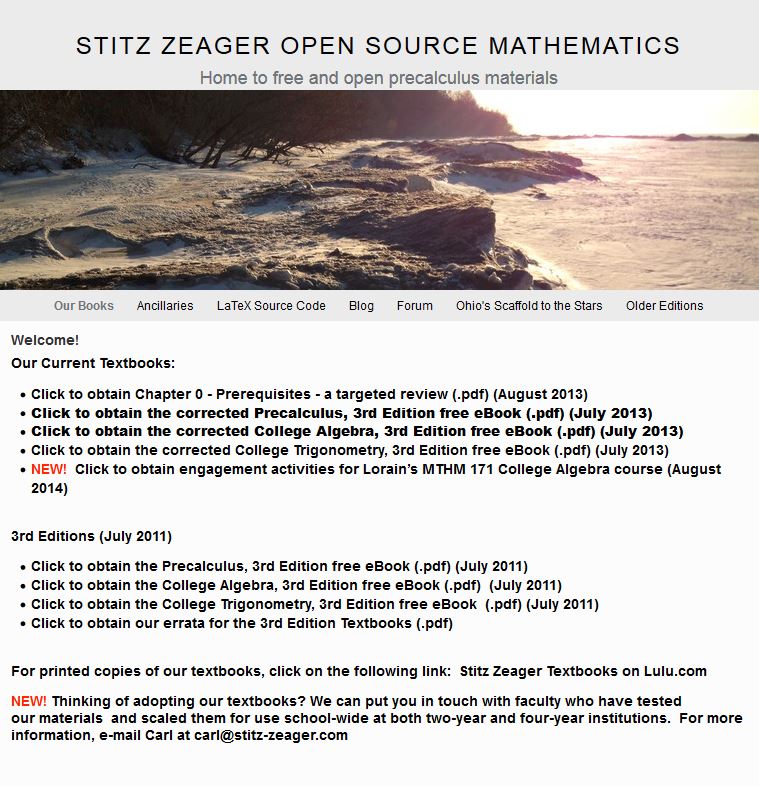
Description:
The content for a one-semester college trigonometry course is in two chapters of this book: Chapters 10 and 11 of the corresponding Precalculus text (Chapters 1-9 are available separately as College Algebra). The content is much the same as other Trigonometry textbooks; I found no significant differences.
Chapter 10 Foundations of Trigonometry has 7 sections, and covers fundamentals: angles, angle measure, Unit Circle, function definitions, identities, graphs, inverse functions, and equations and inequalities.
Chapter 11 Applications of Trigonometry has 10 sections, and includes Law of Sines, Law of Cosines, polar coordinates and equations, conic sections, polar form of complex numbers, parametric functions, and vectors. (Our Trigonometry course covers content in 7 of those 10 sections.)
Each Chapter has several sections; each section has sub-sections. Some sub-sections separate the content into cohesive chunks. Each section has one sub-section of homework exercises and another sub-section of answers. Some sections have as many as three or four content sub-sections in addition to the two sub-sections for exercises and answers.
I did not see any multimedia elements in this text. It may as well have been printed, except for the hyperlinks in the Table of Contents. So other than that, the only advantages to having it online are that it is free and, as a book, it weighs nothing.
Authors:
- Carl Stitz, Ph.D. - Lakeland Community College
- Jeff Zeager, Ph.D. - Lorain County Community College
Formats:
Four separate associated PDF files are available for free download at stitz-zeager.com:
- The entire Precalculus textbook can be downloaded in one PDF file (Chapters 1-11). [1094 pp, 11.2MB]
- College Algebra (Chapters 1-9). [716 pp, 5.8MB]
- Trigonometry (Chapters 10-11). [398 pp, 5.8MB]
- Chapter 0 Prerequisites -- a targeted review. [146 pp, 1.2MB]
Each textbook PDF file is an entire book and is very large. Each Table of Contents has hyperlinks which are helpful. The PDF files are searchable electronically.
A bound paperback print version of this text is available for $11.36 from lulu.com. This version is currently unavailable at Amazon.com; the original 3rd edition (2011) is for sale for $39.95 on Amazon.com.
The LaTeX source code for the entire Precalculus textbook is available along with video tutorials on compiling the source code.
Supplemental resources:
The textbook website has links to ancillaries:
- Short video Checkpoint Quizzes, from Carl Stitz, accompanying the main text are available on YouTube.
- Checkpoint Quizzes (PDF) and the Source Code (LaTeX)
- Most 3rd Edition Homework Questions are available in WebAssign.
- Other ancillaries (PowerPoint files, summary sheet) are available for the College Algebra text (Chapters 1-9).
- Typos are listed in the forum website.
Peer reviews:
There are no peer reviews from the California higher education faculty for this book.
Cost savings:
The Stitz-Zeager textbook is free. Compared to $262 for a comparable Algebra & Trigonometry text by Michael Sullivan (Pearson), this is a potential savings of $78,600 per year (for 300 students). Even at $180 for the a la carte version, students save $54,000 per year. A bound paperback print version of this text is available for $11.36 from lulu.com; use link at bottom of Stitz-Zeager webpage.
Accessibility and diversity statement:
No particular accessibility information is known about the different formats of the textbook. The book is entirely black-and-white-and-gray so there are no problems for students with color-blindness. Many pages are very densely packed with text, which could create problems for some students.
License:
This book has a Creative Commons Attribution-NonCommercial-ShareAlike 3.0 Unported license. This means you are able to copy and redistribute the material in any medium or format and remix, transform, and build upon the material. However, you may not use the material for commercial purposes. You must give appropriate credit, provide a link to the license and indicate if changes were made.

About the Course
Math 25: College Trigonometry
Description: A study of trigonometric functions, radian measure, solution of right triangles, graphs of the trigonometric functions, inverse trigonometric functions, trigonometric identities and equations, laws of sines and cosines, solution of oblique triangles, polar coordinates, complex numbers in trigonometric form, De Moivre’s theorem, and conic sections. Note: A graphing calculator is required.
Prerequisites: Math 120 Intermediate Algebra (or equivalent) with a grade of "C" or better or appropriate score on the math placement exam.
GE credit: 4.0 units, CR GE D3 Analytical Thinking; CSU GE B4 Mathematics/Quantitative Reasoning. Restricted Elective for FNR.AS.FOR.TECH, SCI.LA.AA, SCIEX.LA.AA
Learning outcomes:
1. Analyze and solve problems involving trigonometric functions or analytic geometry.
2. Apply the mathematics of trigonometric functions and analytic geometry to real-world problems and applications.
3. Use graphing technology to visualize trigonometric and polar curves, explore mathematical concepts, and verify results.
4. Write solutions to mathematical exercises in trigonometry and analytic geometry using sound mathematical reasoning with appropriate use of numerical, graphical, and symbolic representations.
Curricular changes:
The Stitz-Zeager Trigonometry text has just two chapters (Chapter 10 and Chapter 11), with 14 sections that correspond to our Trigonometry course.
Materials needed for the course.
Teaching and learning impacts:
Collaborate more with other faculty: No
Use wider range of teaching materials: Yes
Student learning improved: Unsure
Student retention improved: Unsure
Any unexpected results: Yes.
Many students chose not to read the OER; instead, they read the pages in the regular textbook that seemed to cover the same material.
Sample assignments and syllabus:
Handout for HW#7 assignment
This is an assignment on Sine and Cosine
Handout for HW#8 assignment
This assignment concerns the Six Circular Functions
Syllabus
This is the syllabus I used for the Fall 2015 class
Textbook Adoption
OER Adoption Process
The primary motivation for adopting an open textbook is to save students money. Other advantages include ease of access, and eliminating hurdles related to acquiring an actual book (such as going to the bookstore or library, or awaiting a book that has been shipped).
College of the Redwoods Department of Mathematics faculty have been working for years to reduce textbook expenses, using three main strategies. For some courses, textbook copies were purchased for the library; students check out the text just once for the whole term. For many classes, we use old editions of the text, which are available for under $20 (some are less than $5) when the current edition is over $200. For three courses, we use online textbooks that were written by members of the department (primarily David Arnold and Bruce Wagner).
In Trigonometry, I normally allow students to use any of three old editions (6th, 7th, or 8th) of the same text -- see Textbook information for Math 25 Trigonometry. These are available for under $10, and we have several copies of the 7th edition for term-checkout in our library. So an additional interest in finding an online trigonometry textbook is to have everyone using the same book, thereby eliminating the need for three different sets of reading and homework assignments.
What I used in the Stitz-Zeager textbook:
- I used 4 sections of Chapter 10; I assigned reading and homework problems.
- Chapter 10 Foundations of Trigonometry
- 10.2 The Unit Circle: Cosine and Sine
- 10.3 The Six Circular Functions and Fundamental Identities
- 10.5 Graphs of the Trigonometric Functions
- 10.5.1 Graphs of the Cosine and Sine Functions
- 10.5.2 Graphs of the Secant and Cosecant Functions
- 10.5.3 Graphs of the Tangent and Cotangent Functions
- 10.6 Trigonometric Equations and Inequalities
- Chapter 10 Foundations of Trigonometry
Section 10.5 was quite long (40 pages), with three distinct sub-sections, which we did separately, over 3 class periods.
Outside of this textbook, I used our regular textbook (Algebra & Trigonometry, by Michael Sullivan; 6th, 7th, and 8th editions), online practice and testing system (OPTIMATH), online examples and graphing programs, learning management system (Canvas).
One huge advantage to online materials is the ability to have interactive activities, if there were some linked into the text, it would be much more enticing. The treatment of math content and the exercises are pretty standard, as in most trigonometry textbooks. Opportunities for students to do more online would improve the experience. Examples of things that could be included: Links to practice problems within the text (every page or so) -- to test if students are "following along" when new things are introduced; interactive examples (such as graphs the reader can change easily and see corresponding changes immediately); links to some (optional) "baby step" problems for students who are stuck; links to "hints" for problems (not every problem, but a few, especially ones that have new twists or turns).
Student access:
Students were provided the direct link to the textbook website. I also uploaded the textbook PDF file into our learning management system (Canvas), along with selected sections and sub-sections of the text in smaller PDF files. Students had the option of purchasing a print copy via links on the textbook website.
All of those options required students to use technology with online access. None of my students complained to me specifically, but based on past experiences, I imagine that may have been an inconvenience for some. Many students at our school live in very rural areas and do not have regular internet access. They can use computers in the Learning Resource Center, but that requires them to spend additional time on campus when they are not in class (not necessarily easy for working students with family demands), and resources are limited at our school.
General observations regarding the textbook include:
· Many students enjoyed the ease of the online textbook; they did not have to carry around an actual (heavy) textbook, and they could easily scroll through pages and search electronically.
· Some students were reluctant to use the online textbook, partly because it was a departure from what we had done in class already, and partly because it required extra (different) effort to pull it up on a computer. In fact, many never "opened" the online book; they simply read corresponding content in the "regular" textbook on their own. I am sure there would have been less resistance if I had used this book from Day 1 of class.
· An online book is harder for some students to study; they can not highlight/annotate, and copying formulas/theorems is more difficult.
· With homework exercises, students found it easier to work with problems on paper; they could circle problems, underline, and mark the spot with a finger while copying the problem which is not easy to do on a computer monitor. Because of this, I also separated out just the pages with exercises and made those available for download.
· It would be helpful if a small printed book were available for student purchase at a nominal price that consisted of only the pages with exercises. This might be able to be handled locally with a "course packet" in the bookstore if it does not become available on the textbook website.
· Most pages are densely packed with text. Even with figures interspersed, there is very little white space. This overwhelmed some students, whereas others were not at all bothered by it. Significant parts, such as definitions and theorems, are visually separated by boxes and gray shading, so it was not confusing to read, just densely-packed.
· There was a dichotomous reaction to the writing style: some students felt that the examples were clear and everything was explained quite well, while other students felt the text was nearly incomprehensible and extremely dense and hard to get through. So this text does not suit all learning styles. This is not unique to this text; I have noticed the same dichotomous reactions to many "regular" print textbooks, too, even among mathematics faculty.
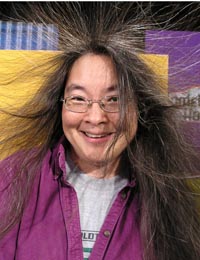
Tami Matsumoto
As a Professor of Mathematics at College of the Redwoods, I teach Arithmetic, Prealgebra, Elementary Algebra, Contemporary Mathematics, Elementary Statistics, Trigonometry, College Algebra, and Calculus. I also teach Mathematics for Elementary Education at nearby Humboldt State University.
I consider myself a "Math Ambassador" ... a representative of the realm of mathematics. I believe that every person deserves to have mathematics in their lives and deserves to not be afraid of it (TEDx talk “Every Person Deserves Math”).
As a mathematician, my teaching career began with Project SEED in Berkeley, teaching high-school level mathematics to elementary school students using an interactive Socratic method. I have continued to learn about math education over the decades through professional development such as Project PROMPT (Professors Researching Options in Mathematics for Prospective Teachers), and projects with the Mathematical Association of America: PRofessional Enhancement Program (PREP) and Preparing Mathematicians to Educate Teachers (PMET).
Locally, I collaborate with K-14 teachers through organizations such as California Math Council Far North Chapter (CMCFN). Past collaborations include our local Cal-PASS Math Articulation Council, Eel River Valley Math Vertical Team, and for seven years I was producer and mathematics content advisor for "HomeWork Hotline," a live, local, on-air television show. Nationally, I serve on the Committee for Two-Year Colleges for the Mathematical Association of America.
I regularly educate and entertain local students and teachers through various events, such as the Humboldt Math Festival, Redwood Environmental Education Fair (REEF), and Science Night at College of the Redwoods.