
Soil Health and Plant Nutrition (SS221)
Soil Health and Plant Nutrition (SS221)
Purpose: to help other instructors teaching the same course
Common Course ID: Soil Health and Plant Nutrition (SS 221)
CSU Instructor Open Textbook Adoption Portrait
Abstract: This open textbook is being utilized in a Environmental Earth and Soil Science course for undergraduate students by Charlotte Decock, California Polytechnic State University San Luis Obispo (Cal Poly). The resources provide information for students to interpret soil test reports, analyze data from a fertilizer rate trial, and integrate the results into a recommendation for the use of nutrient sources to satisfy crop requirements in a manner that is environmentally, socially, and economically sound
Soil Health and Plant Nutrition (SS 221)
Brief Description of course highlights: Soil Health and Plant Nutrition (SS 221) is offered at Cal Poly every quarter, with over 100 students taking this course every year. SS 221 is a required course for students majoring in Environmental Earth and Soil Science, Agricultural and Environmental Plant Protection, and Wine and Viticulture with a concentration in viticulture. Several in Environmental Management and Protection and Agricultural Sciences commonly choose SS 221 as an elective. The only prerequisite for SS 221 is Introductory Soil Science (SS 120).
Student population: Students in the Environmental Earth and Soil Science major come into the course with a broader knowledge on soil science and environmental issues related to land-use management, while students in the Agricultural and Environmental Plant Sciences come in with a stronger background in agronomy and crop production, providing a synergistic dynamic among in the classroom. The majority of students are sophomores and juniors, although there are often seniors as well, because SS 221 is not a prerequisite for other courses in their program.
Learning Outcomes:
In this course, students learn about the major nutrient cycles and crop nutrient requirements in the context of soil health. The course covers the principles of nutrient stewardship for sustainable crop production and protection of environmental quality. 3 lectures, 1 laboratory. Upon completion of this course, students will be able to:
- Describe basic concepts of plant nutrition (including plant nutritional requirements, nutrient absorption and translocation, and diagnosis of plant nutritional status)
- Explain how basic soil properties and processes affect availability of essential nutrients to crop plants
- Discuss the sources, properties, and uses of common fertilizer materials
- Demonstrate an awareness of the environmental impacts of fertilization practices
- Describe and discuss the laboratory analyses used to evaluate the fertility status of a soil sample obtained from an agricultural field
Key challenges faced and how resolved: I did not experience any challenges in developing and adopting this OER for SS 221. Everything has been different for students as we have transitioned to emergency online education, so it is hard to identify what students are responding to. I was able to teach SS 221 in a hybrid format, with field labs where students had the options to join via zoom or participate in person. Students appreciated the opportunity to join in person. Because they don’t know what the course would be like with the paper lab manual, there is nothing for them to compare the delivery to. One comment that came up several times was there concern to not be able to access the Canvas materials once the course was over. This is why I published the lab manual in MERLOT.
Textbook or OER/Low cost Title:
Brief Description: For the lab of SS 221, students have typically purchased a lab manual. The lab manual included assignments that students were asked to submit for grading every week. During the emergency transition to online instruction at the start of the COVID-19 pandemic, I set up the lab assignments using the ‘new quizzes’ feature in Canvas. Going paperless made the grading a lot easier and added flexibility in teaching, because I could make small changes to the assignments as the quarter went on. While there are a lot of gains in efficiency using the Canvas assignments, students do not longer have access to the lab materials in this format once the course is over. In response to various student requests on if and how they could access the learning materials included in the lab manual after the course has ended, I decided to publish the lab manual as an Open Educational Resource. Now, students will have a reference to go back to if they need to use learning materials from the course as they are moving through their careers.
Student access: Students complete the lab assignments on Canvas, where the lab manual is set up using the ‘new quizzes’ tool. The same content is available as an OER through MERLOT (https://www.merlot.org/merlot/viewSite.htm?id=9162715). The format in Merlot is a bit easier to navigate and serves as a reference that students can consult long after they have completed the course.
Cost Savings: Students save the cost of the printed lab manual, which they used to buy at the Cal Poly book store for ca. $15.
OER/Low Cost Adoption Process
Provide an explanation of the OER adoption. I changed various of the activities in the lab to promote experiential learning. Prior to the OER adoption, students would just go through the soil analyses as they would be performed in a standard soil testing lab and discuss the data. In the new OER, there are several new activities to help students experience first-hand the complex and dynamic nature of soil and think about how biological, chemical and physical process are manifested in the soil.
How did you find and select the open textbook for this course? I learned about OER from Anne Regan in the context of an effort to encourage faculty to develop OER for their courses at Cal Poly.
Sharing Best Practices: I just completed developing the OER. Next Fall will be the first time I co-teach the labs with another instructor using this resource. I am looking forward to my colleagues feedback and plan to share the link to the OER broadly with faculty within and outside of Cal Poly that teach soil fertility. It is very easy to make edits to the OER using Merlot content builder. I plan to edit and update the OER as I receive feedback from students and faculty using the resource.
Teaching and Learning Impact While I did not collect any data on student learning, I have witnessed many more ‘aha’ moments since implementing the new activities aimed to demonstrate soil processes using experiential learning. Having the students complete lab assignments on Canvas has made grading much faster, and also provides for an accessible track record to evaluate how students are doing over the course of the quarter. When students have questions about their grade, it is very easy to access the assignment and clarify what they had wrong.
Charlotte Decock
California Polytechnic State University, San Luis Obispo
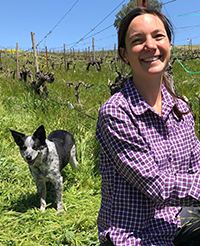 Charlotte Decock is an assistant professor of soil health and fertility at Cal Poly. Her teaching and research focus on sustainable plant nutrition and soil conservation management. Her work at Cal Poly aims to contribute to the development and assessment of soil and nutrient management practices that protect soil, water and air resources, while maintaining agronomic productivity and economic viability in California’s cropping systems. She is also interested in the evaluation of novel indicators for the assessments of soil health and nutrient availability in arable soil. She earned a Ph.D. in Soils and Biogeochemistry from UC Davis and a M.Sc. and B.Sc. in Environment Engineering from Ghent University (Belgium). During the last 10 years, her research has focused on nutrient cycles and greenhouse gas emissions in agroecosystems around the world; and how they are affected by management practices and climate change.