
Geography Faculty Showcase
Geography Faculty Showcase
Purpose: to help other instructors teaching the same course
Common Course ID: Geography of California (GEO 3510)
CSU Instructor Open Textbook Adoption Portrait
Abstract: This open textbook is being utilized in a Geography course for graduate students by Nikita Prajapati at Cal Poly Pomona. The open textbook provides a majority of my students the appreciation of a zero-cost textbook and their ability to access it from their devices. . The main motivation to adopt an open textbook was to save students money, immediate and easy access to course materials, and less waste with OER versus traditional textbooks. Most student access the open textbook in Learning management system, device, and syllabus.
Geography of California (GEO 3510)
Brief Description of course highlights:
Geography of California (GEO 3510), GE
This course is a topical and regional coverage of California's physical and cultural resources. In this class we examine the influence of physical features upon the cultural and economic activities of people living in California, with particular attention to the relationship of current California problems to their geographical causes.
This is an upper division synthesis class that satisfies Area B5 or D4. Students must have completed their lower division work in these areas to take this class.
SLO 1 - Students will be able to use written text, speech, maps, graphics, and other devices to identify and describe spatial characteristics, patterns and processes at a variety of scales in physical, human, and social economic environment, including themes in atmosphere, biosphere, lithosphere, hydrosphere, population, culture, economics, settlements, and policies. (Knowledge)
SLO 2 - Students will be able to communicate their understanding and analysis results by making maps, writing papers and technical reports, and developing presentations. (Communication skills)
Learning or student outcomes: A majority of my students appreciated the zero-cost textbook for all my classes and their ability to access it from their devices. Describe effects on teaching and learning that resulted from adopting OER e.g.
- I collaborated with faculty more and got new ideas of creating equitable learning materials and lessons.
- I am not sure if student grades have improved, I have not compared the grades pre and post OER. But, I’ve also became a better educator since using OER.
- Student retention is difficult to compare as the pandemic impacted all my classes and the order the class was listed mattered more.
- The only unintended results from using OER was that a few of my students did not like the online resource due to preferred learning method or their vision impairment.
Key challenges faced and how resolved: Syllabus and/or Sample assignment from the course or the adoption [optional]: Incomplete OER, missing ancillary materials, articulation requirements, quality OER.
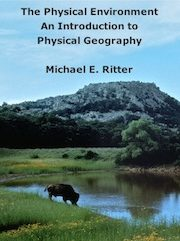 Textbook: The Physical Environment: An Introduction to Physical Geography
Brief Description: This textbook focuses on physical geography and can answer many questions that you might have about the natural world and how it relates to your life. Ever wondered why present-day volcanoes occur on the west coast of the United States but not on the east coast? Why tornadoes seem to be unique to the United States? Why palm trees are found in Florida and pine trees in Maine? Where to go for a break from cold winter weather, or to escape a hot summer day? Physical geography can answer these questions, and more. https://www.thephysicalenvironment.com/
Authors: Michael E. Ritter
Student access:
1. What did you change as part of the OER adoption? textbook, syllabus, learning activities, and developed additional materials
2. How and where do students access materials? Learning management system, device, and syllabus. https://www.thephysicalenvironment.com/contents
Cost Savings: This is difficult to quantify as I can’t remember how long I’ve been using OER but about $3,000 per class at least with a full class of 48 students and their original textbook costing about $65-70.
OER/Low Cost Adoption Process
Provide an explanation or what motivated you to use this textbook or OER/Low Cost option. Save students money, immediate and easy access to course materials, and less waste with OER versus traditional textbooks
How did you find and select the open textbook for this course? Other faculty members from a community college I teach at as well.
Sharing Best Practices: Please give suggestions for faculty who are just getting started with OER or Low Cost options. How do you plan to share this OER experience with other faculty, staff, etc. who develop curriculum and teach?
- Do not rely on OER alone, I also use supplemental material when OER falls short.
- Read the OER material yourself and select the sections relevant to the lesson only for the students to read or watch. I try not to overwhelm students with a long list of items to read.
- Sometimes I use two different OER textbooks so I can pick the best chapters to present to students.
- Make sure your courses are listed as “Zero-Cost Textbook” if possible so students know and can be an important factor in their decision.

Nikita Prajapati
Cal Poly Pomona
Discipline: Geography
Teaching philosophy: progressive education of learn by doing
Briefly describe the population of students who take the course:
My courses are GEs and I have a wide range of students from freshmen, sophomores, juniors, seniors, and transfer students with diverse majors as well. My students come with little knowledge for my physical geography classes to more knowledge for my geography of California. There is an issue with a sense of belonging on campus. I have very few geography major students.
Interests: listening to books, walking my dogs, & spending time with friends and family