
Topic 4: UDL and Assessment
Topic 4: UDL and Assessment
Ongoing assessment is an essential part of education at every level. Because of learner variability, it is important to consider where there might be barriers that would impact one’s ability to demonstrate what they are learning. The three primary networks can be applied to help identify unnecessary barriers in assessments without lessening the rigor of the assessment. When assessments are designed using UDL, the learner outcomes are the focus.
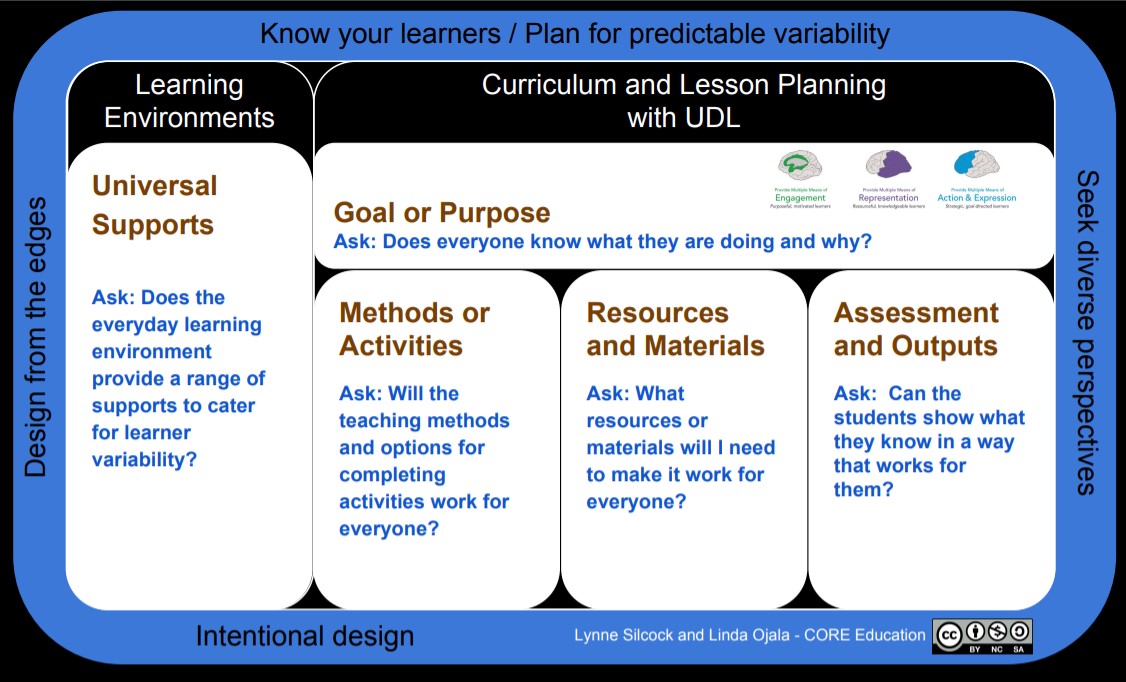 Planning with UDL
Topic Learner Outcomes:
- Explain how assessment is interrelated to instructional goals, materials, and methods.
- Apply the UDL perspective to effective assessments.
- Determine and evaluate the ways to gather information about a learner's performance to improve the curriculum.
- Identify the ways to gather information about a learner’s performance to improve the curriculum.
Topic Learner Outcomes:
- Explain how assessment is interrelated to instructional goals, materials, and methods.
- Apply the UDL perspective to effective assessments.
- Determine and evaluate the ways to gather information about a learner's performance to improve the curriculum.
- Identify the ways to gather information about a learner’s performance to improve the curriculum.
 eBook Reading
- Read in Ch. 6:
- Assessment
- Methods
- Materials
- Conclusion
 Universal Design for Learning: Principles, Framework, and Practice
- Pages 71-80
 Reevaluating Your Approach to Grading Episode 5: The Balance Podcast with Dr. Caitlin Tucker (11:30 minutes)
 Tucker Grading Flowchart (Resource noted in above Podcast)
 Intro to Assessments (12:42 minutes)
Watch the video below that correlates to the grade(s) you plan to teach:
 Assessments for Grades K-2 (11:56 minutes)
 Assessments for Grades 3-5 (13:11 minutes)
 Assessments for Grades 6-8 (11:40 minutes)
 Assessments for Grades 9-12 (13:25 minutes)
 Topic 4 Collaborative PowerPoint Presentation.pptx
 Topic 4 Learner Agency Reflection.docx