
Adopting free e-books for Digital Media and Society (COMM 3305)
Adopting free e-books for Digital Media and Society (COMM 3305)
Purpose: to help other instructors teaching the same course
Common Course ID: Digital Media and Society COMM 3305
CSU Instructor Open Textbook Adoption Portrait
Abstract: These e-books are being utilized in a Communication Studies course for undergraduate students by Dr. Thomas Corrigan at California State University, San Bernardino. These e-books provide students with fast, easy access to course materials without imposing direct, out-of-pockets costs for the student (indirect costs are incurred, though, as these e-books require licensing via the university library). The main motivation to adopt these open textbooks was to reduce the cost of course texts for students and to make those texts easily accessible during Covid-19. Most students access these texts as e-books through the University’s Pfau Library website.
Course Title and Number
Digital Media and Society (COMM 3305)
Link to Course in University Bulletin
Brief Description of course highlights: The overarching goal of the course is to get students to think critically about the role of digital media in socio-cultural, political, and economic life. By “think critically,” I mean that we work to “denaturalize” key aspects of our contemporary digital lives, such as smartphones, search engines, social media, and streaming video. Then, we consider how these technologies and our uses of them relate to broader, historical struggles around democratic participation and issues of social and economic justice.
To do this, we read and evaluate critical social scientific scholarship concerning these processes, and we engage in hands-on activities that illuminate the workings and social implications of digital media use. In the end, students should come away with a richer, more nuanced understanding of how digital media and society are shaping one another (for better or for worse), and how they can play an active role in determining the course of both. Because, as the scholar-activist Howard Zinn said, “You can’t stand still on a moving train.”
Student population: As an upper-level undergraduate course, 70% of students in Digital Media and Communication (COMM 3305) during Spring 2021 were juniors or seniors; the remaining 30% were sophomores.
With respect to major, COMM 3305 is required course for students in the Media Studies concentration (part of the BA in Communication Studies), and it is an elective for other Communication Studies major and minors. So, a plurality of students were Communication Studies majors or minors (26%). However, the course also satisfies the Category D4 requirement (Upper Division Social Sciences) in the university’s General Education program. So, the class also included students from a range of other undergraduate programs.
While the class does address the social implications of new technologies, students are not required or expected to come into the class with any particular technical or disciplinary knowledge or skills.
Learning or student outcomes: Upon successful completion of this course, students will be able to:
- Articulate key implications of digital media and their uses for democratic practice and issues of social justice
- Evaluate critical social scientific research into the role of digital media use in political, economic, and socio-cultural life
- Relate the concerns of critical digital media scholarship to your life
- Develop strategies for intervening in digital media and social life to create a better socio-technical world for you and others
Key challenges faced and how resolved: The key challenge I confronted this term, with respect to the e-books used, was in helping students use Shore’s text to complete their first major course component – a critique of Chapter 6 from McChesney’s book. I think Shore’s book does an excellent job explaining how to read, “dissect,” and critique a scholarly text. However, I knew students would still need guidance putting Shore’s techniques into practice. So, I developed a series of worksheets aimed at walking students through each step of the process. For instance, here is a worksheet I had students use to begin organizing and making sense of Chapter 6 from McChesney’s book.
Sample assignments: In addition to weekly readings and learning modules, the two major graded course components are the Chapter Critique and the Culture Jamming project.
For their mid-term paper, students completed a critique of one key chapter from McChesney’s text, Digital Disconnect. Specifically, they critiqued a chapter titled, “Journalism is Dead! Long live Journalism?” For the chapter critique, students drew on Chapters 1, 2, & 3 from Zachary Shore’s book Grad School Essentials. Those chapters usefully explain how to read a scholarly text and craft a powerful critique of it. Specifically, they worked to identify the chapter’s thesis and evaluate the author’s defense of that thesis, including whether the argument is sound and the evidence is compelling. Directions for the Chapter Critique assignment are available here.
Then, for their final project, students work in groups of 3-4 students to complete a a “culture jamming” project. A culture jam is a media/cultural creation that creatively and subversively critiques some aspect of social life using a familiar cultural genre. For our class, students’ culture jams critiqued some troubling digital social process, such as: representations of women on social media; racial and socio-economic inequities in advertisers’ behavioral targeting practices; and the NSA’s warrantless wiretapping program. Each group developed an annotated bibliography of academic and popular literature on their topics, they crafted a position statement and 1-page brief based on what they’d learned, and, finally, they produced a culture jam that creatively and subversively critiqued that troubling digital social process. Directions for the Culture Jamming project are available here.
Share any curricular or pedagogical changes: The major curricular/pedagogical changes associated with this course for the 2020-2021 AY were:
- the inclusion of the course in the university’s General Education (GE) structure, including the Digital Life and Social Justice GE pathways;
- the change in format from a 40-student in-person course to a 180+ student online course (a product of both the quarter-to-semester conversion and Covid-19); and
- the development of the Chapter Critique assignment as a means of satisfying the course objectives
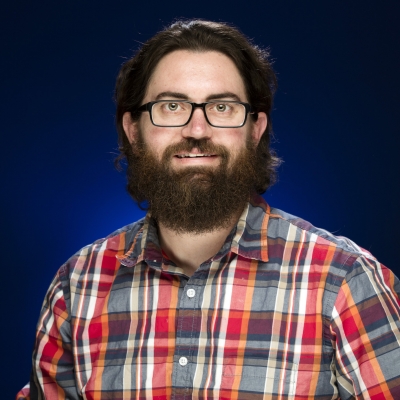 Dr. Thomas F. Corrigan
Associate Professor
Dept of Communication Studies
California State University, San Bernardino
https://www.csusb.edu/profile/corrigan
Please provide a link to your university page.
Describe your teaching philosophy and any research interests related to your discipline or teaching.
My teaching philosophy assumes that students learn best when they’re actively involved in processes of creative production. Of course, exposure to key concepts and existing research is crucial. However, developing a command of theory and research requires actually using theses in practice. So, I have students put these understandings together with skills and judgment they’ve acquired in my course, other courses, or lived experience, to create original creative works. In the present course, this is best illustrated in the chapter critique and the culture jamming project, which were the major graded components for this course.
Other communication studies courses I teach include: Media Institutions in Context (COMM 3101), Introduction to Graduate Study (COMM 6000), and
Qualitative Research Methods (COMM 6003).
I also supervise Graduate Internships, Independent Studies, Theses, Projects, and Comprehensive Examinations.
Please explain your motivation to use this textbook or OER/Low-cost adoption. When Covid-19 unfolded, I considered a range of alternative formats for facilitating my now-online courses. Texts were, of course, one important consideration. I think it can be very useful for students to work from a physical copy of a text. However, I understand students’ attraction to e-books – particularly free ones. And, given the increasing costs of textbooks, and the challenging economic circumstances many of our students face, it was important to me to provide cost-effective options for quickly and easily accessing course materials.
How did you find and select the open textbook for this course? I was familiar with each text in their traditional formats, and had informed the campus bookstore that I would be requiring them for the course. Our university library then acquired e-book licenses for the texts, and I worked with our librarian, Lisa Bartle, to ensure that both would be accessible for unlimited users, as the class is a large one (180+ students).
Sharing best practices: Probably the most important thing to ensure in adopting a free e-book as a course text is that the license is available for unlimited users. Some licenses only make the text available for one user at a time. This might be suitable for small classes. But for a large lecture like mine, it was important that unlimited users be able to simultaneously access the text.
Describe any challenges you experienced, and lessons learned. The permalink to these texts on the university library’s website provides information for students to access the free e-book. However, it also includes information on all other versions of the text, including physical copies and other e-book licenses, such as those that are available for only one user at a time. This confused some students. So, it was important to specify how, exactly, students were to navigate to the free e-book that was available to an unlimited number of users.
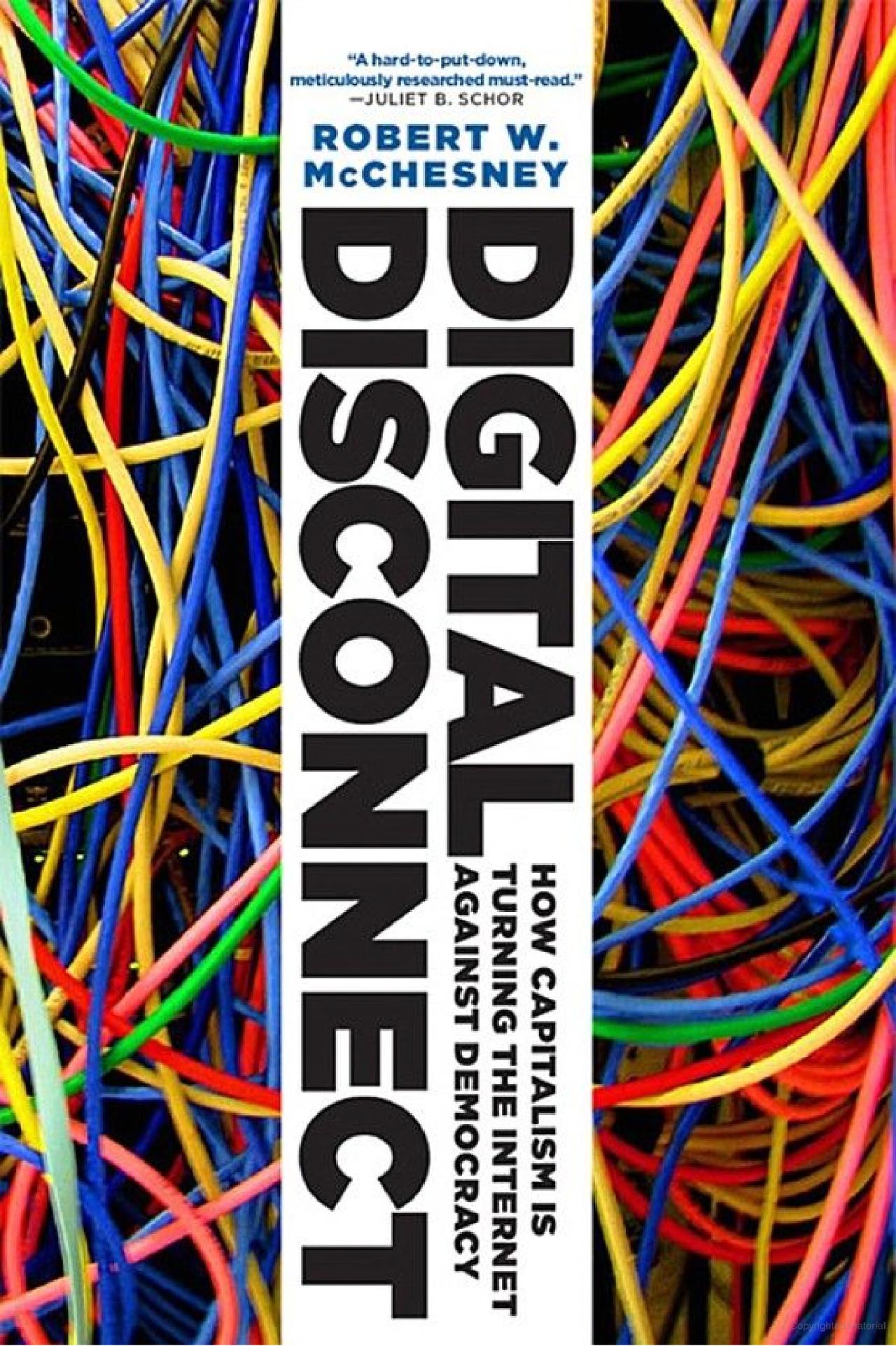 Brief Description: Digital disconnect: How capitalism is turning the Internet against democracy
Texts on digital technologies (e.g., smartphones, streaming video, social media, and the Internet) and their social implications date themselves rather quickly. But by looking at digital media from a political-economic perspective, Robert McChesney’s (2013) text, Digital Disconnect provides students with powerful conceptual tools for making sense of how these dynamic technological processes relate to democratic participation and struggles for social justice. Specifically, McChesney argues that by highlighting the role of capitalism in digital media’s uses and development, we can better understand why these technologies have not lived up to their democratic potential. All hope is not lost, though. McChesney argues that we’re living through a “critical juncture” – a moment when digital media and other social arrangements are increasingly up for debate. Amid this critical juncture, he points to organized engagement with media policy, in conjunction with broader movements for social justice, as a means of creating a more just and democratic society.
Grad school essentials
As the title suggests, this text provides a guide for navigating graduate school. However, the text is particularly useful for upper-level undergraduates, as it provides detailed guidance on: how to read and “dissect” a scholarly text; how to formulate powerful critique; and how to present your work – both in writing and orally.
- Digital disconnect: How capitalism is turning the Internet against democracy
- Grad school essentials: A crash course in scholarly skills
Authors: Robert W. McChesney (Digital Disconnect) & Zachary Shore (Grad School Essentials)
Student access: How and where do students access materials? Students accessed both texts as full-text e-books via CSUSB’s Pfau Library website. Permalinks to each text (see here and here) provided fast, easy access to the Library’s online holdings for each text. From there, students accessed could read or download chapters via EBSCOhost Ebooks (Digital Disconnect) and JSTOR Books (Grad School Essentials).
Cost Savings: The last time I taught this course (Spring 2019), students were required to purchase Lindgren’s text, Digital Media & Society, which lists at $38 according to the publisher.
This academic year, the two required texts would have cost almost exactly the same ($38); Digital Disconnect and Grad School Essentials each list at $18.95, according to the publishers.
So, at a cost of $0 to students this AY, the free e-books produced a total, out-of-pocket cost savings of ~$12.7k for the 366 students that enrolled in the course in Fall 2020 and Spring 2021.
License: Both texts are copyrighted. The University’s Pfau Library acquired multiple-user, full-text licenses from EBSCOhost Ebooks (Digital Disconnect) and JSTOR Books (Grad School Essentials).