Implementation Study
Implementation Study
Name(s):
Anne Kuwabara MD1, Christina Giacomazzi DO2, Sharlene Su MD3, Nolan Gall MD1, Anita Lowe MD1, Paige Dyrek DO1, David Bakal MD1, Emily Miller Olson MD 4
Campus:
1Resident, Department of Physical Medicine and Rehabilitation, Stanford University
2Sports Medicine Fellow, Department of Rehabilitation Medicine, University of Washington
3Pain Medicine Fellow, Department of Anesthesiology, Washington University in St. Louis
4Sports Medicine Fellow, Department of Physical Medicine and Rehabilitation, Stanford University
Course Name & Description: Novel Musculoskeletal Ultrasound Curriculum for Physical Medicine & Rehabilitation Resident Physicians
Project Abstract:
Introduction: There is a rapidly growing interest in the teaching of musculoskeletal ultrasound (MSKUS) in Physical Medicine and Rehabilitation (PM&R) residencies. However, there are no current guidelines for a formalized ultrasound curriculum. At our institution, we created a longitudinal curriculum resource for musculoskeletal ultrasound training.
Methods: Core MSKUS topics were separated into nine units and arranged in order of difficulty. Appropriate supplemental learning resources were identified. A knowledge quiz and a thorough scanning checklist was developed and approved by multiple providers. In spring 2020, the 21 current residents were invited to participate on a voluntary basis. All participants were asked to complete a pre and post curriculum survey.
Results: 18 residents completed at least 1 session. 13 residents completed both the pre and post curriculum surveys. Survey results indicated that the majority of residents did not have any formal diagnostic or interventional ultrasound education prior to the rollout of the program and were interested in incorporating ultrasound in their practice. After implementation of a formal ultrasound curriculum, residents reported improved proficiency and confidence in using ultrasound for diagnostic and therapeutic interventional management of common musculoskeletal injuries.
Discussion: Ultrasound diagnostics and interventions are becoming increasingly prevalent in musculoskeletal medicine and literature supports its use for both diagnostic purposes and procedural guidance. We found that implementing a formal MSKUS curriculum improved resident proficiency and confidence with the use of ultrasound. This program may provide a structure for other PM&R residency programs to implement a MSKUS education curriculum that ultimately leads to improved musculoskeletal patient care.
GE Credit: None
Keywords/Tags: Musculoskeletal Ultrasound, Physical Medicine and Rehabilitation Residency
Instructional Delivery: In-class, Hybrid, Online
Pedagogical Approaches: Faculty and Peer Instruction
Class Size: 25
Introduction
Previously limited to radiology, musculoskeletal ultrasound (MSKUS) is an exponentially growing field that has substantially increased use in orthopedics, podiatry, rheumatology, sports medicine, and physical medicine and rehabilitation (PM&R).1 Medicare and Medicaid volume of billed MSKUS examinations increased from 56,254 examinations in 2000 to 233,964 examinations in 2009. Formal education has not kept up with demand. A survey of PM&R physicians in 2010 at the International Congress of PM&R found that only 18% use MSKUS in practice, but 92.7% believe education should be mandatory, and only 41% received any MSKUS education at all.2
MSKUS has now become a mandatory Accreditation Council for Graduate Medical Education (ACGME) requirement for PM&R residency training. Specifically, it is stipulated that residents must gain experience in “acute and chronic musculoskeletal syndromes, including sports-related injuries, occupational injuries, rheumatologic disorders, and use of musculoskeletal ultrasound.” 3 However, no formal curriculum guidelines exist, and many residency training programs still have not adopted a formal educational curriculum.
To meet this demand for improved MSKUS education in PM&R, we developed a musculoskeletal ultrasound training curriculum and assessed its efficacy in improving resident MSKUS knowledge and confidence. Our goal is for this to be widely available and then instituted at different PM&R residency programs. It outlines a longitudinal curriculum including nine units designed to teach residents basic musculoskeletal ultrasound evaluation. Each unit consists of recommended pre-reading and a short quiz to assess understanding followed by a hands-on practical scanning session guided by checklists to identify and evaluate.
Methods
With a working group of residents interested in incorporating ultrasound into their practice, we generated a curriculum topic outline. For each topic, we curated assigned reading material accompanied by quizzes and checklists to use during the in-person session.
Units are arranged in approximate level of difficulty and teach comprehensive musculoskeletal evaluations including preparation for common interventions.
- Unit 1: Fundamentals of Musculoskeletal Ultrasound
- Unit 2: Knee and Lower Leg
- Unit 3: Shoulder and Arm
- Unit 4: Elbow and Forearm
- Unit 5: Wrist and Hand
- Unit 6: Hip and Thigh
- Unit 7: Foot and Ankle
- Unit 8A: Upper Extremity Nerves
- Unit 8B: Lower Extremity Nerves
Contained in this resource are the following:
- 1 Quiz for each of the 9 units with an associated Answer Key
- Checklists for each unit
We utilized the following suggested pre-reading materials:
- Jacobson JA. Fundamentals of Musculoskeletal Ultrasound, 3rd Edition. Elsevier, September 11 2017.
- Malanga G, Mautner K. Atlas of Ultrasound-Guided Musculoskeletal Injections. McGraw-Hill Education. March 22 2014.
- European Society of Musculoskeletal Radiology (ESSR) Guidelines
- American Medical Society for Sports Medicine (AMSSM) Online Ultrasound Videos and Fellow Case Series
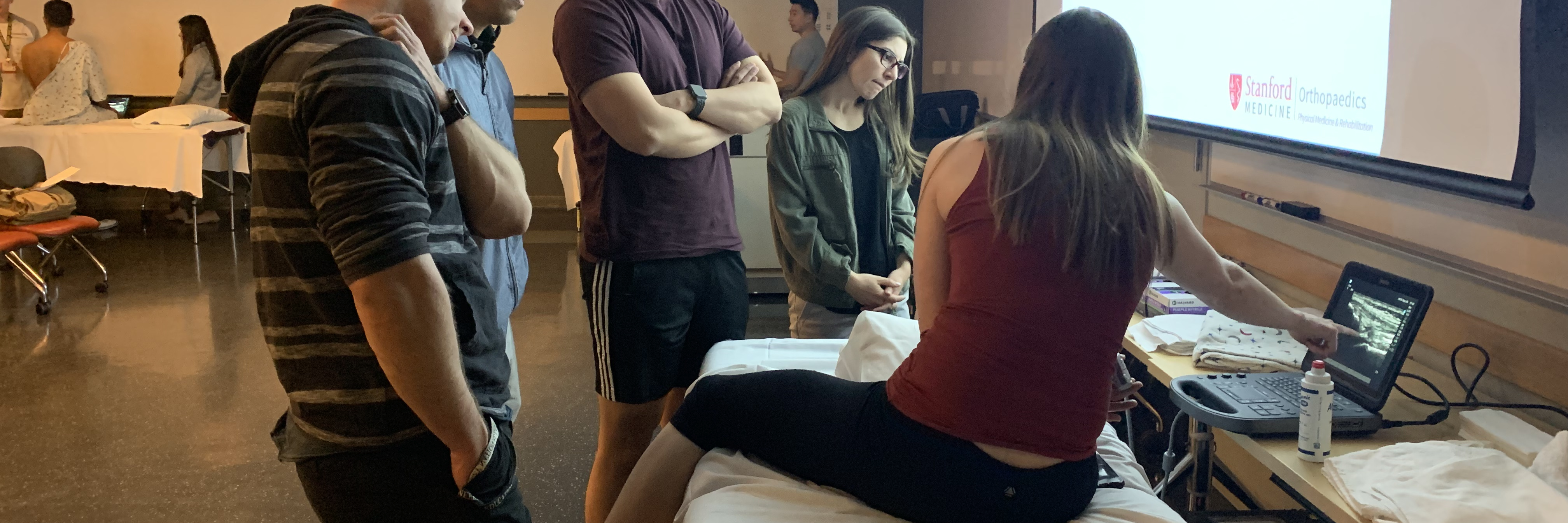
The hands-on sessions each lasted approximately 2 hours. Residents were divided into small groups (approximately 3-5 residents per ultrasound machine) to maximize hands on scanning time. Groups included both junior and senior residents to enable the senior residents to assist with teaching the junior residents, which makes the sessions easy to facilitate with minimal faculty involvement.
Results
In total, 18 of 21 residents participated during the 2019-2020 academic year. Thirteen residents in the initial cohort of 18 residents completed pre-intervention and post-intervention surveys. Survey questions are included in Table 2. Due to the low number of total survey respondents (n=13), statistical analysis was not performed, and the following represents descriptive data.
The percentage of participants who considered themselves proficient in MSKUS (either agreed or strongly agreed to question 3) increased from 7.7% (n=1) to 61.5% (n=8) after completion of the program. The percentage of participants who were confident they could perform MSKUS evaluations for common injuries increased from 15.4% (n=2) to 61.5% (n=8), while those confident in evaluating less common or technically challenging injuries increased from 0% to 30.8% (n=4). The percentage of participants who felt confident that they could safely and effectively perform interventional ultrasound techniques increased from 15.4% (n=2) to 84.6% (n=11). More residents planned to obtain musculoskeletal ultrasonography certification from a recognized accrediting organization during their career (53.9% pre-program to 76.9% post-program). More residents planned to use interventional MSKUS as attendings, (61.5% pre-program to 92.3% post-program), while fewer planned to use diagnostic MSKUS (61.6% pre-program to 38.5% post-program).
Discussion
We successfully developed a longitudinal MSKUS curriculum that improved resident proficiency and confidence with using ultrasound for diagnostic and interventional purposes. Given successful implementation in this initial voluntary cohort, the curriculum is now an established part of the required didactic curriculum and our institution is currently being implemented with the 22 residents in the 2020-2021 academic year. Furthermore, we have created a structured curriculum that can be utilized by other institutions as part of their didactic curriculum. The ESSR Guidelines and the AMSSM Online Ultrasound Videos are available for free online and would be a reasonable supplemental training reference for any programs that do not have access to the two recommended books by Jacobson and Malanga. In our survey, the majority of residents did not have any formal diagnostic or interventional ultrasound education prior to the rollout of the program and were interested in incorporating ultrasound in their practice. On the Best Evidence in Medical Education Scale, this data provides Level 2a-b support, with learners demonstrating changes in attitude towards the intervention and self-reported acquisition of skills and knowledge.4 Given the lack of formal ultrasound assessment at our institution prior to implementation, Level 3 data or assessment for behavioral change was difficult to obtain.
Recent literature has found a lack of formal MSKUS education and assessment in PM&R residency programs despite very high interest among residents. Amatto et al. published an evaluation of MSKUS in PM&R residency programs.5 The vast majority (97%) of current PM&R residents are interested in using ultrasound clinically, with 73% reporting having had “none” to “limited exposure” in MSKUS. Raja et al.6 published results from a multi-center survey demonstrating that MSKUS is a critical factor for choosing a residency program according to PM&R residency applicants. When asked if MSKUS presence within a program had an effect during the interview-selection process, 71% responded with "very important" or "absolutely essential" (p<0.001). For 74% of applicants, exposure to MSKUS in residency was an important factor when creating their rank order list (p<0.001). Greater than 92% of applicants stated that they are "likely" or "very likely" to use MSKUS in their future practice and 83% would recommend a program with MSKUS to future candidates (p<0.001).
Siddiqui et al. queried 78 PM&R residency programs. Of the 36 residency programs that responded, 97.2% provide exposure to MSKUS, 61% had mandatory MKSUS training, and only 44.4% had a formal curriculum.7 The most common MSKUS educational tools used were lecture (88.9%), outpatient clinic (86.1%), and hands-on workshops (86.1%). Sixty-one percent of responding programs evaluate residents’ ultrasound proficiency with either formal or informal assessment tools. Formal assessment tools included procedure logs, oral or written exam, global rating of performance, and Objective Structured Clinical Examination (OSCE). Overall, faculty at only 38.8% and 44.4% of programs believed that at least 50% of residents who graduate are competent in diagnostic and interventional MSUS, respectively. These rates were significantly associated with the use of formal ultrasound assessment as a part of residency training. In our survey, after implementation of a formal ultrasound curriculum and self-assessments, residents reported improved proficiency and confidence of major, common injury diagnoses and interventions. The program also improved residents’ knowledge of resources and enhanced plans for achieving ultrasonography certification.
Amatto’s study demonstrated four major aims for improving ultrasound training: (1) appropriate training is dependent on access, (2) MSKUS represents an emerging standard of care, (3) a minimal baseline level of competence should be expected, and (4) various strategies may be used to integrate basic MSKUS into existing residency curriculums. Through obtaining continuous feedback through quizzes and feedback forms, we plan to continue to improve educational materials.
Limitations to implementing this resource may include not having faculty with MSKUS experience to lead sessions or adequate amount of ultrasound machines to disperse amongst participants for timely use. With the increased use of digital technology, programs may be able to recruit faculty from other programs to assist with teaching or potentially using recorded lectures. Programs without available ultrasound machines but looking to incorporate MSKUS education could consider providing access to formal ultrasound workshops offered throughout medical societies.
We hope this program provides a structure for other PM&R residency programs to implement a formal MSKUS curriculum for resident trainees that will ultimately lead to improved MSKUS education and musculoskeletal patient care. If resources allow, it would be beneficial to conduct a formal ultrasound assessment of residents pre and post implementation in order to assess efficacy of the intervention.
Tables
Ultrasound Curriculum_Tables.docx
References
1. Sharpe RE, Nazarian LN, Parker L, Rao VM, Levin DC. Dramatically increased musculoskeletal ultrasound utilization from 2000 to 2009, especially by podiatrists in private offices. J Am Coll Radiol. 2012;9:141-146.
2. Ozcakar L, Tok F, Kesikburun S, et al. Musculoskeletal sonography in physical and rehabilitation medicine: Results of the first worldwide survey study. Arch Phys Med Rehabil. 2010;91:326-331.
3. Accreditation Council for Graduate Medical Education. ACGME pro- gram requirements for graduate medical education in physical medicine and rehabilitation July 1, 2014. Available at https://www. acgme.org/acgmeweb/Portals/0/PFAssets/ProgramRequirements/ 340_physical_medicine_rehabilitation_07012014.pdf. Accessed February 19.2021
4. Sullivan GM. Deconstructing Quality in Education Research. J Grad Med Educ. 2011;3(2):121-124. doi:10.4300/jgme-d-11-00083.1.
5. Amatto MD, Rambaransingh B, Yu JC. An Evaluation of Musculoskeletal Interventional Ultrasound Training in Canadian Physical Medicine and Rehabilitation Residency Programs. PM R. 2021: 1–9.
6. Raja AE, Shustorovich A, Robinson D, Alfonso K, Meyer R, Roemmich RT, Eng C, Wisniewski SJ, Cabahug P. Musculoskeletal Ultrasound as a Motivator for Selecting a Physical Medicine and Rehabilitation Residency Program in the United States of America - A Multi-Center Survey Study. Am J Phys Med Rehabil. 2021 Feb 18. doi: 10.1097/PHM.0000000000001719.
7. Siddiqui IJ, Luz J, Borg-Stein J, O’Connor K, Bockbrader M, Rainey H, Way D, Colachis S, Bahner DP, Kohler MJ. The Current State of Musculoskeletal Ultrasound Education in Physical Medicine and Rehabilitation Residency Programs. PM R. 2016;8: 660-666.
and  are providing a free and open teaching-ePortfolio for you to capture and share your expertise and experiences in redesign your teaching to improve student success. The template provides you scaffolding questions that we hope will make it easier for you to share your "know how" for innovating your instruction.
Your ePortfolio is hosted for free and your can share it, invite collaborators, and much more with MERLOT's Content Builder.
MERLOT-SkillsCommons Open Educational Practices Portal
Explore over 1,000 teaching and institutional ePortfolios and case studies capturing innovative educational practices and openly publishing them for you to reuse, revise, remix, retain, and redistribute.
MERLOT Pedagogy Portal
This Portal is designed to help you learn the variety of instructional strategies and issues helping you become a better teacher. The resources you'll find here should apply to teaching a variety of disciplines.
MERLOT
MERLOT is a collection of free and open online teaching, learning and faculty development services contributed and used by an international education community. The collection of open resources spans across a wide variety of disciplines and education levels. What sets MERLOT apart is a combination of peer reviews, member comments, learning exercises and other valuable information and metadata associated with the materials.