Home
Home

Fostering Student Engagement and Community in a Fully Online Asynchronous Course Environment
Melisa C. Galván, Assistant Professor, Department of Chicana/o Studies
May 20, 2020
California State University, Northridge
Project Summary: Having taught CHS 245OL (History of the Americas) fully online for 3 years now, my goal (prior to COVID-19) was to receive feedback on ways to incorporate more active student engagement activities within my asynchronous online learning environment. As a lower division General Education course, I am required to include writing intensive assignments that adhere to state curriculum guidelines, which makes grading burdensome. My student population is primarily students outside my field and college, and as such, many are taking the course only to fulfill a requirement, not because they are particularly excited about the material. By rethinking ways that students interact with the course material -- both at a macro and micro level -- I hope that this eLearning project will translate into a teaching and learning experience that is more exciting for both myself and my students with the added benefits of improving student engagement and performance in all my (now fully online) courses.
eLearning Project Background |
Course Description
A comparative analysis of significant and social events in the United States from its earliest beginnings to the present. Emphasis will be placed upon the historical development of American institutions and ideals as they have been affected by regional dynamics within the United States and by international, socio-political and economic relationships particularly with Mexico and Latin America.
Learning Outcomes
Upon completion of this course, students will be able to:
- Provide a comparative analysis of national belonging by racialized/ethnic communities, including indigenous peoples, Chicana/os, African Americans, Asian Americans, and Euro Americans.
- Develop critical thinking skills in examining the strategies of resistance and adaptation of non-white populations in the United States, as well as provide a historical analysis of Social Justice movements, geographical variations, and the politics of citizenship in U.S. history.
- Obtain an understanding of the continuity of the American experience and the relationship of the United States to external regions and powers such as Mexico and Latin America.
I hope that the eLearning Project will enhance student learning by providing online tools that facilitate effective asynchronous learning.
Student Characteristics
- This course is a requirement for Title V General Education and the majority of students who take this course are non-majors.
- Many of the students who elect to take this course come from diverse cultural backgrounds, including a number of international students. For many, English is not their first language.
- A large number of the students who enroll in this course are working full-time and not on campus regularly.



Technology Tools
- Canvas: to send out announcements to students that remind and provide tips on how to approach upcoming assignments.
- Camtasia: to record short video lectures.
- Zoom: to hold online office hours.
Instructional Strategies
- Fostering a more inclusive environment (and make the instructor more accessible) through the creation of a "welcome" video and introductory assignment (cover letter)
- Peer to peer interaction through two peer review activities that required students to give feedback on each other's papers prior to their final submission.
- Utilized Canvas Announcements features that helped foster open communication and guidance. These messages were also used to "check in," send out words of encouragement, reminders, and gentle hints about how to approach major writing assignments.
Professional Development
The eLearning peer review process was extremely helpful in identifying ways that my course could better address QLT objectives. While there is no perfection, I was able to identify a number of ways that the course could be improved over time to help facilitate smoother student learning in a fully online environment. My goal is to keep these objectives in mind as I continue to refine content in not just this one course, but all my courses.
Biography
I am a historian of Mexico in the late colonial and early republican periods, and my research interests center around illicit contraband trade in Mexico's Northeastern borderlands. I have also co-authored a couple of textbooks for Routledge on research methods, and primarily teach large GE courses on the history of Mexico and the Americas, as well as a graduate seminar in research methods.
eLearning Project Reflection |
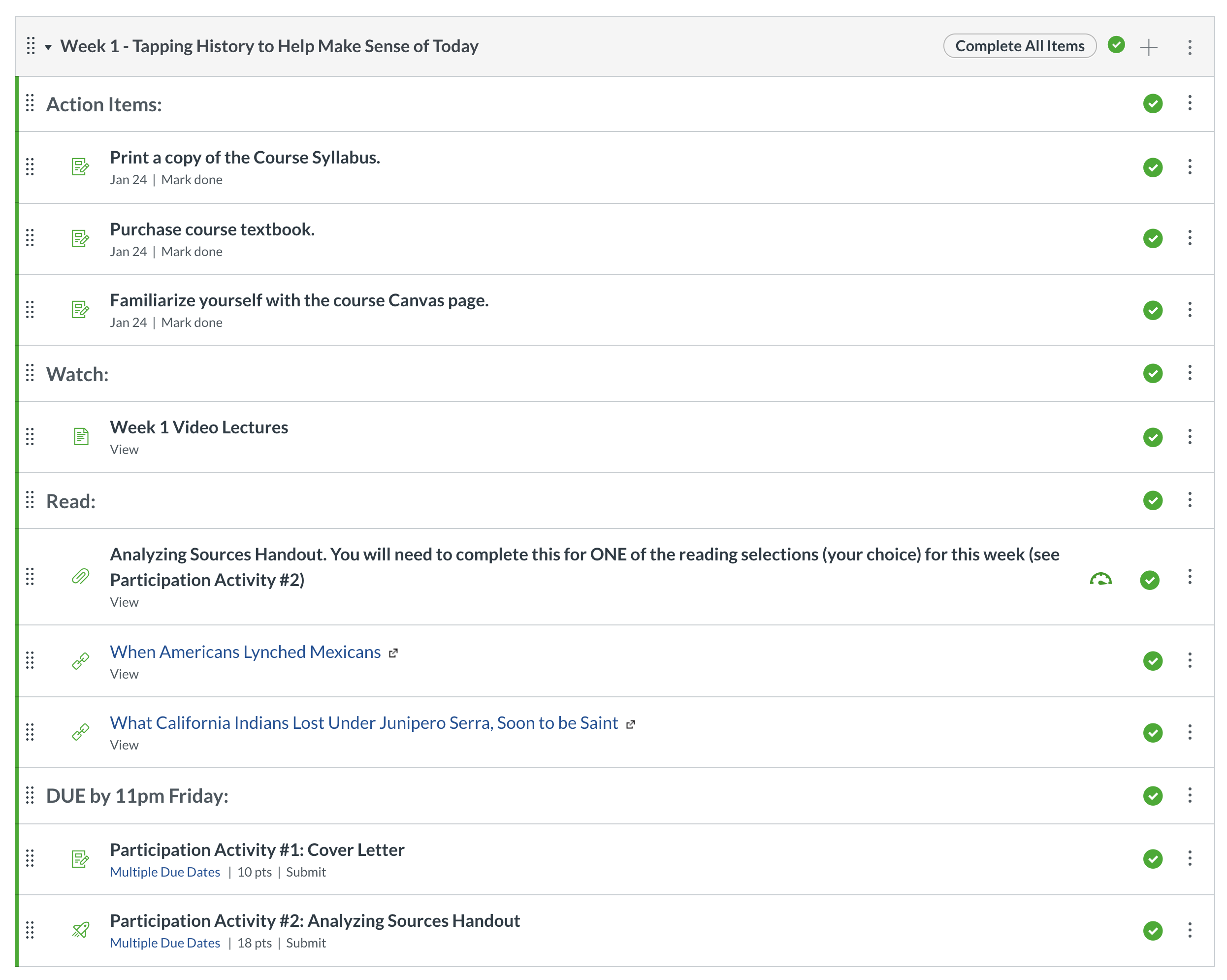 Sample Weekly Module-- tasks are divided into "Action Items," what they need to watch and read, and then what assignments are due for that week.
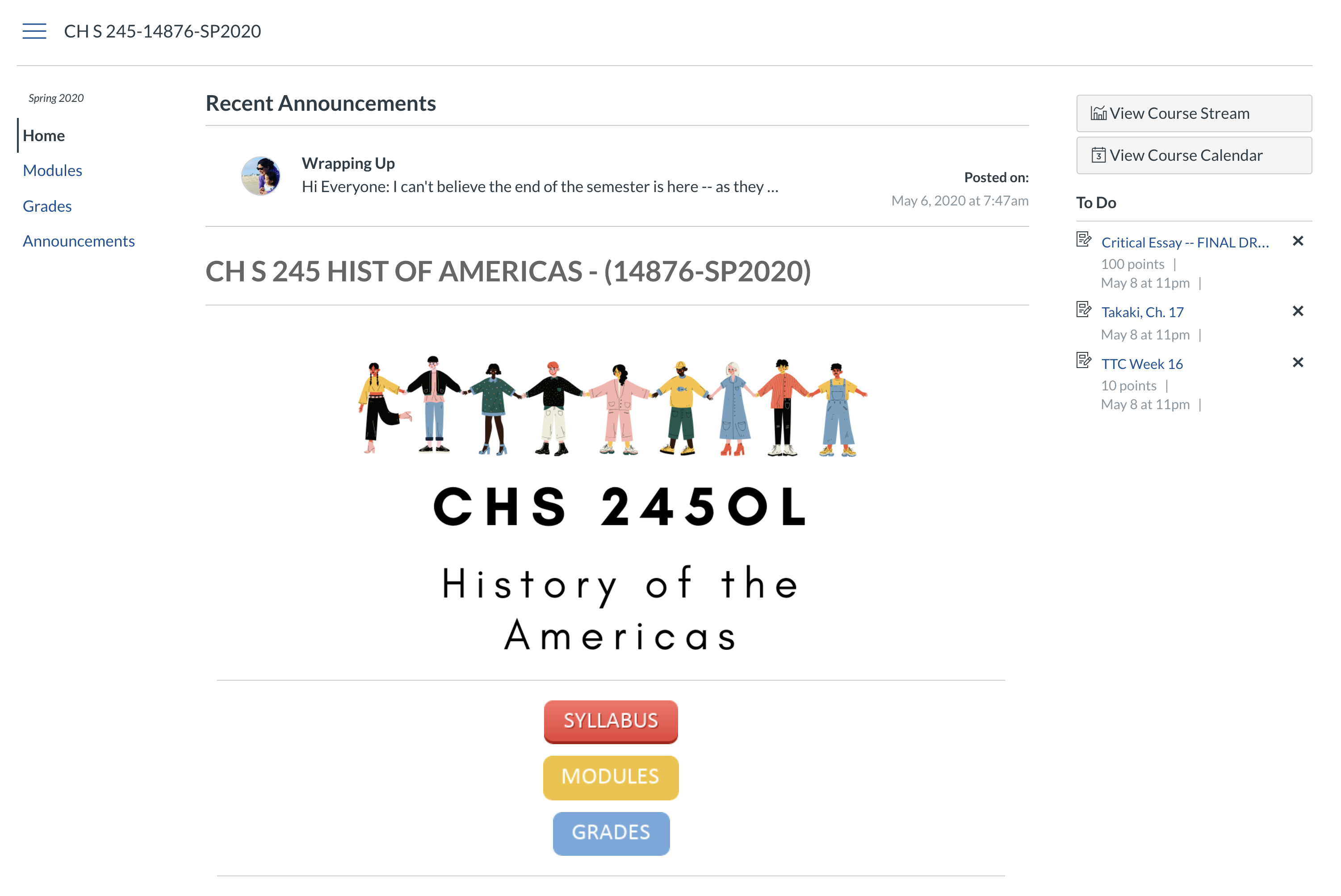 Course Home Page -- Created streamlined buttons that guided students to important pages for the course. For next semester, I intend to create a "Zoom Office Hours" button as well.
Sample Video -- guided students on how to navigate the first week's assignments as they were getting acclimated to the course.
Quality Learning & Teaching (QLT) Reflection
Keeping the QLT framework in mind throughout the semester, I made an active effort to find ways to maintain steady and open communication with my students. Rather than send a written email wishing them well as we all adapted to the stay at home orders, I recorded a short video which I sent out using the Canvas Announcements feature. Amidst my attempts to engage student interaction more, I was also deliberate to use equity minded wording to communicate with students.
- Strength: Organized presentation of module material with guiding headers, a separation between readings and actual assignments, as well as completion check marks (
 ) to keep students on track.
 - Area of Improvement: Find further ways to foster student-to-student engagement beyond just peer reviews. I intend to address this by incorporating discussion forums in the future.
- Strength: Course utilizes a variety of materials that suit different learning styles (short lectures, readings, newspaper articles, longer documentaries, traditional textbook readings).
Some impressions/comments from the QLT Student Survey:
- "Some things that I found useful were the video lectures that were provided for us weekly, the peer reviews we received when we submitted a draft, and the study guide that the professor provided for exams"
- "I believe that this class is one of the most organized classes I have ever taken and for that I am grateful because I always knew what there was to do and when it was due rather than looking for it everywhere"
- "My favorite part of this course compare to others are the organization, the ways that information is presented. For instance, videos, documentaries, readings etc. I like how we did not have multiple choice quizzes and instead we had essays and projects."
"Honestly I feel like everything posted on Canvas for this course served its purpose at some point in the semester."
"What could have been improved was interaction with peers."
Successes
- I think that my use of Canvas Announcements (rather than just traditional email) and Zoom made students feel like I was accessible to them.
- Revamping some of the video lectures to incorporate common questions that I would historically get made things run a lot smoother.
- Sending out equity-minded messages that made students feel supported as they were completing major assignments resulted in a higher number reaching out for help when they were struggling than I had ever had in past semesters.
Ideas/Lessons Learned
- Make sure you develop a clear organizational structure to your Modules. Indent files so that the information is scaffolded!
- Be consistent with due dates/times (i.e. every Friday at 11pm) -- it really helps the students to avoid a lot of confusion and allows them to plan their time accordingly.
- As time consuming as it is to make them, students seem to appreciate the short videos. It makes them feel like they can see you as they are working through the course materials.
Next Steps
- I hope to incorporate more ways to foster community building through student-to-student interactive activities (i.e. discussion forums).
- Create more instructional videos that help guide students through the navigation of key course elements (i.e. how to view instructor's paper feedback in Canvas, avoiding plagiarism, etc).
- Continue to update video lectures to keep content current.