GWS351ol Gender, Race, Class and Sexuality
GWS351ol Gender, Race, Class and Sexuality

GWS351ol Gender, Race, Class and Sexuality
R. Dianne Bartlow, Professor, Gender and Women's Studies
May 31, 2020
California State University, Northridge
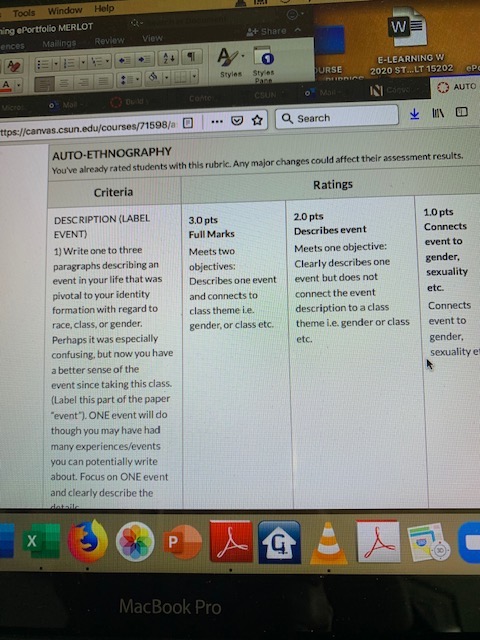
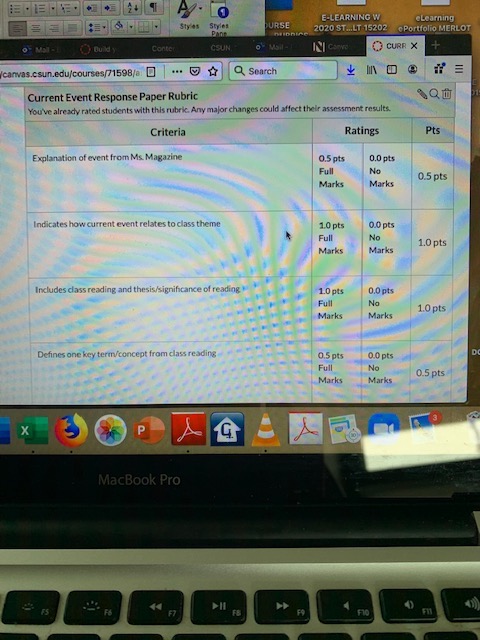
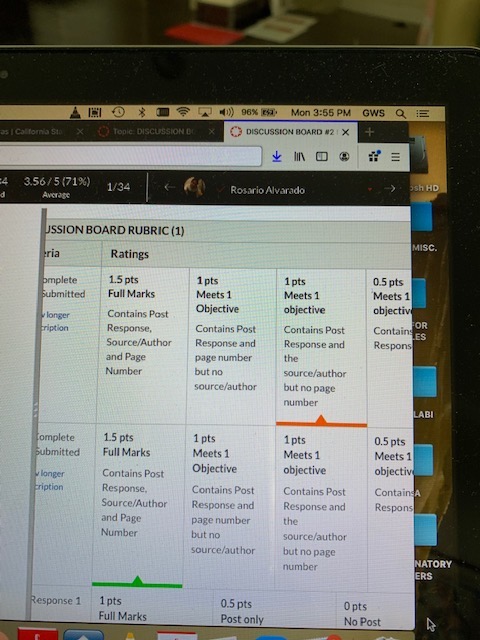
Project Summary: The primary objective for the Winter 2020 E-Learning Cohort session was to create rubrics for each of the writing assignments in the GWS351 online course. These rubrics were designed for the Discussion Boards, Current Event and Auto-Ethnography papers. The hope in designing the rubrics was to provide more transparency so students could see how many points were attached to each section of the assignments. I also wanted to incorporate more announcements to help students keep pace with upcoming assignments and zoom chats. Additionally, for the first time I incorporated the Two Truths/One Lie Icebreaker exercise at the beginning of the course.
eLearning Project Background |
Course Description “Intersections of Gender, Race, Class and Sexuality” examines race, class, gender and sexuality as social constructions that are negotiated within specific historical and material locations. We will study the connections between images in popular culture, history, and social practices in our daily lives. From this perspective, we will explore how the social roles we perform and consume every day produce and sustain uneven social relations between and among differently situated people and groups. Of particular interest is the way in which gender intersects with other social categories such as race, class, sexuality, and national origin in our daily lives and popular images. By studying these intersections from the perspective of women living them, we move marginalized women and some men from their typically marginal position to the center of the curriculum.
The central aim of the course is to understand gender not as a singular category, but to see the ways in which gender intersects with other axes of power within specific historical contexts to interrogate the complexities of the social forces that shape our lives in contradictory ways. For instance, how does class privilege relate to gender oppression? How does gender privilege and intersect with racial oppression? Upon which axis of power are you privileged and/or marginalized? How are we empowered and/or marginalized by social systems that go beyond our immediate lives and yet influence them so deeply? These considerations take place within the material and historical contexts that shape the possibilities of experience that social groups may have.
Learning Outcomes Upon completion of this course, students will be able to:
*The hope is that students will be able to build community using the two truths and a lie introductory exercise as an ice breaker.
*The other hope is for students to be introduced to transparency for the course grading processes via rubrics provided for the written assignment.
*The other hope is for students be better able to evaluate their progress and transgression through the course via periodic announcements signaling when assignments are due.
Course Outcomes:
- Outcome 1Students will be able to analyze gendered identity formations and the political significance of social categories.
- Outcome 2 Students will be able to write about gendered identity formations and the political significance of social categories with a goal to increase students’ sensitivity towards societal issues relating to discrimination, exploitation, and domination.
Student Characteristics
- Characteristic 1There were 33 students enrolled in the 15202 section.
- Characteristic 2 There were 10 sophomores, 15 juniors and 8 seniors
- Characteristic 3 The overwhelming majority of students were female.
Technology Tools
- Tool 1 The key tool created for the eLearning Project was a rubric for three assignments which included the Discussion Boards, and Current Event and Auto-Ethnography papers. This was done to provide more transparency for students so they could see how many points were attached to each section of the assignments.
- Tool 2 Used more announcements to help students keep pace with upcoming assignments and zoom sessions.
- Tool 3 While not an explicit goal for the eLearning Project, I was able to update the Final Exam Quiz to reflect some of the new readings in the latest edition of the text.
Instructional Strategies
- Strategy 1 Created rubrics for the assignments in the class
- Strategy 2 Incorporated more announcements to help students keep pace with the upcoming assignment deadlines and zoom sessions.
- Strategy 3 Continued to provide the Discussion Boards for peer to peer interaction.
Professional Development Creating the rubrics for this course was a major goal for the eLearning Project. I will continue to use them moving forward in all of my classes. I incorporated more announcements this time as well, and moving forward, will attempt to include even more of them. Students seem to think both are helpful.
 Biography
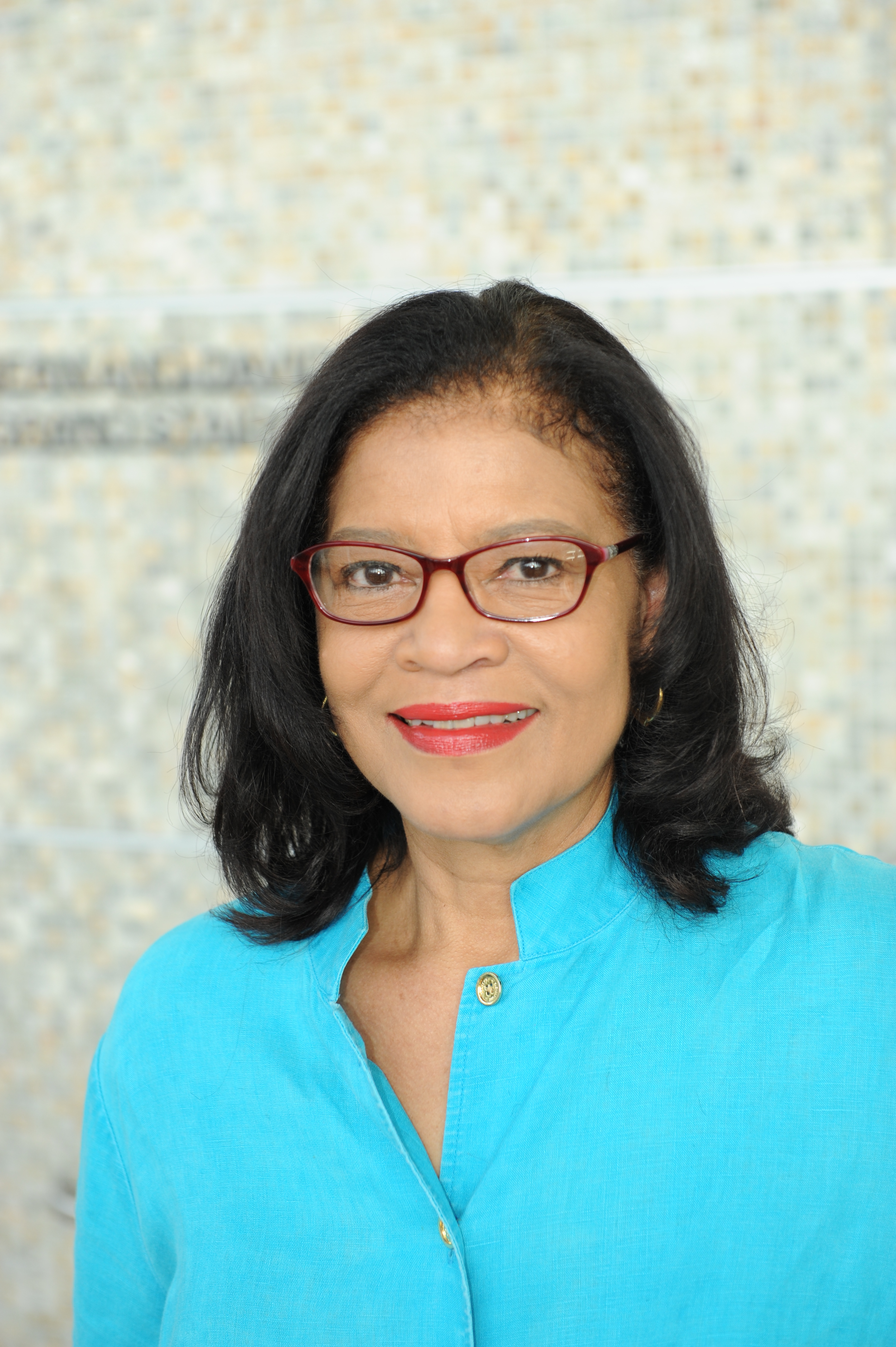
R. Dianne Bartlow is a Professor in the Department of Gender and Women's Studies at California State University, Northridge. Her research focuses the intersection of domestic violence, family courts and child custody, representations of African-American women in popular music, culture, and film, 19th century Black Feminism, pedagogy and diversity, and mothering studies. Bartlow has also worked extensively in television production and is a multiple Emmy Award winning director/writer/producer. She teaches courses on Women and Violence, Men and Masculinity, Gender, Race, Class and Sexuality and Women and Entertainment.
eLearning Project Reflection |

Quality Learning & Teaching (QLT) Reflection
- Example 1Objective 2.3--Creating rubrics for the key writing assignments helped to provide transparency for students to see exactly how many points were associated with the different parts of the papers. The QLT Student surveys seemed to indicate students appreciate this.
- Example 2 Objective 2.4--Again, here the incorporation of the rubrics I created were designed to aid with transparency in how they would be graded on the writing assignments including the Discussion Boards, and Current Event and Auto-Ethnography papers.
- Example Objective 3.6 Attempted to model academic integrity by responding to the first student who responded to the Discussion Boards. I included the required citations needed with author and page number so students could see exactly how to complete their discussion posts successfully. One student pointed this out as a helpful measure in the QLT Student Survey.
- Example 1 (2.3) One student quote from the QLT Student Survey suggested that they liked the class a lot "and was happy to have taken Professor Bartlow again because she is clear on what she expects of you and as long as you follow instructions you are guaranteed to pass." I believe this student's comments reflects the clarity provided by the rubric and syllabus to enhance their success in the course.
- Yet another comment that illuminates this objective was from a student who said the reading materials enhanced learning and helped students "to be better citizens of the world, with a more informed lens to navigate with."
- Example 2 (2.4) A student indicated: "I found the rubric for the discussion posts to be helpful because I could just look at it and know what my professor expected. It was easy to access and following it led to a good grade."
- Example 3 (3.6) One student quote from the QLT Student Survey reflects this modeling I provided: "I was very hesitant to take another online class this semester but this class changed my mind. The teacher checked in with us via Zoom, participated in the early discussions by give us examples, provided a detailed grading rubric with comments, asked for student feedback and encouraged different opinions/ perspectives. I loved this class."
One student in the 15202 section of the course who took the QLT Survey said she took an online class in another department where they felt there was no interaction with the teacher, minimal feedback on assignments and no other forum for support. This student said of my class: "I was very hesitant to take another online class this semester but this class changed my mind. The teacher checked in with us via Zoom, participated in the early discussions by give us examples, provided a detailed grading rubric with comments, asked for student feedback and encouraged different opinions/perspectives. I loved this class."
Another student said "I found the rubric for the discussion posts to be helpful because I could could just look at it and know what my professor expected. It was easy to access and following it led to a good grade."
In reviewing the statistics from QLT Student Survey, it appeared the majority of students strongly agreed or agreed I'd met the different components they were asked about.
Some areas of improvement students suggested from the survey were to record the zoom chats for those who could not attend and a few suggested one required reading source was not as helpful because they felt it wasn't used enough in the course. Still, a few others said they enjoyed this additional reading material. So, will have to think about continuing to include it. It does have current event articles pertaining to women specifically working in many institutions and from many cultures so I do think it's a valuable resource. Will have to reflect further moving forward.
Successes
- Success 1 The project was successful through creating the rubrics. This helped students with the clarity on assignments and cut down grading time for me in having to endlessly make comments which in the past took up a considerable amount of time.
- Success 2 The project was also successful in that I was able to incorporate more announcements to help students keep pace with upcoming assignments and zoom sessions.
- Success 3 The project was also successful in providing me with an array of pedagogical tools that can enhance my teaching in the future.
- The combination of the rubrics and increased announcements being added this time I believe helped many more students earn A's and B's in the course.
Ideas/Lessons Learned
- Idea 1 Do include rubrics accessible for students. As one of my course peers from the cohort suggested, "it's a game changer." I would add, this helps to enhance student learning and is helpful for the instructor as well.
- Idea 2 Include periodic announcements to help students stay the course throughout the semester.
- Idea 3 Include an icebreaker survey at the top of the semester like the two truths/one lie example.
- Idea 4 Attempt to model success for students. My participation in the first discussion board helped students to see what they would need to do in order to be successful for this assignment.
Next Steps
- Step 1 Will work on refining my rubrics to make sure they provide as much clarity as possible. I'm pleased with what I created, but think I can improve upon them.
- Step 2 Will be working on being even more consistent with my announcements to help students keep pace.
- Step 3 I want to also be more effective with my zoom sessions in creating power points on the reading material and screen sharing. Also, have to work on recording these sessions for students who can't attend. For the most part, the zoom sessions are used as an introduction to the course on the first day of class and then periodically as a check in with students and to clarify what's needed for the various assignments and exams.
- It was also suggested by my cohort administrator to hide the links on my main canvas page that do not pertain to students. This will make for a cleaner look.
- I want to create a welcoming video or one using words with music. Ran into a snag on trying to download one of the tools for doing the latter, so could not include this for this semester (Spring 2020).
- Will also have to figure out a way to provide streaming of the films for this course that I usually have on reserve for students in the Oviatt Library. Since the upcoming semester is going to be fully online, will need to figure this out.