
Sycorax as subject & agent
Sycorax as subject & agent
This course was taught on occupied Waccamaw territory. We thank Chief Harold Hatcher and Chairwoman of the SC Native Women's Alliance Kathleen Hays, both of the Waccamaw Indian People, for helping us work toward a more complete understanding of colonialism's past and presence, and to make more sound contributions to a truly post-colonial future.
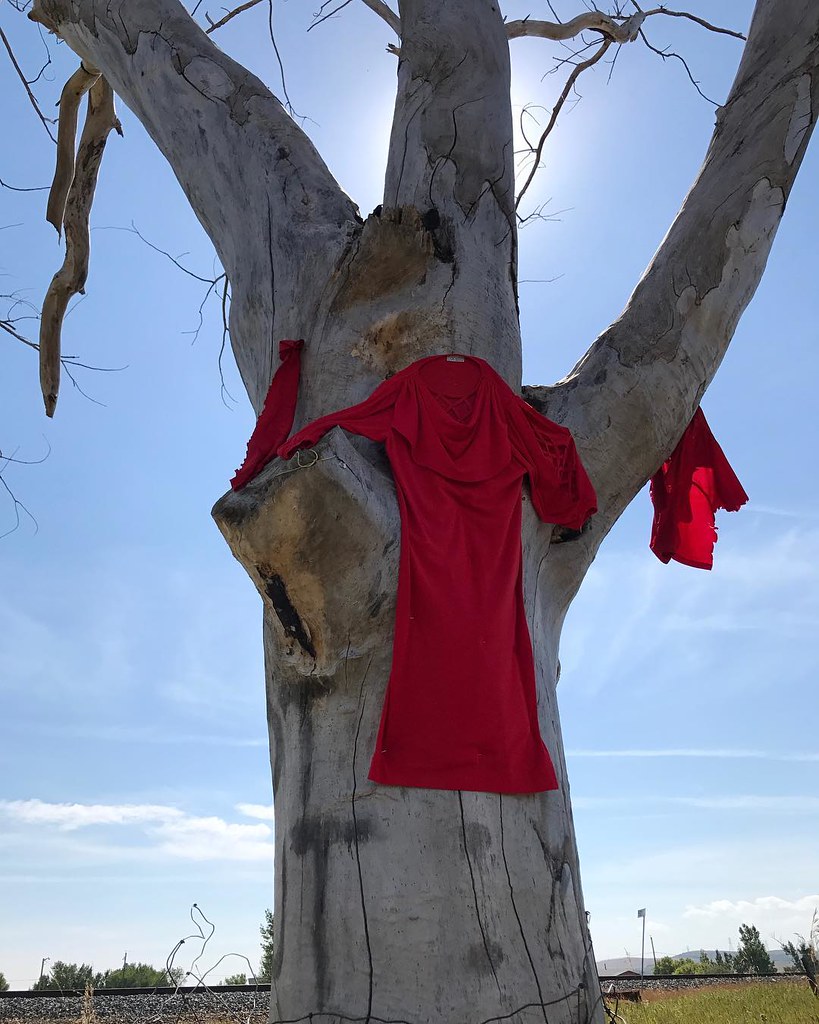 Artist Jaime Black (Métis) started the REDress Project to raise awareness of missing and murdered Indigenous women and girls. Image source here.
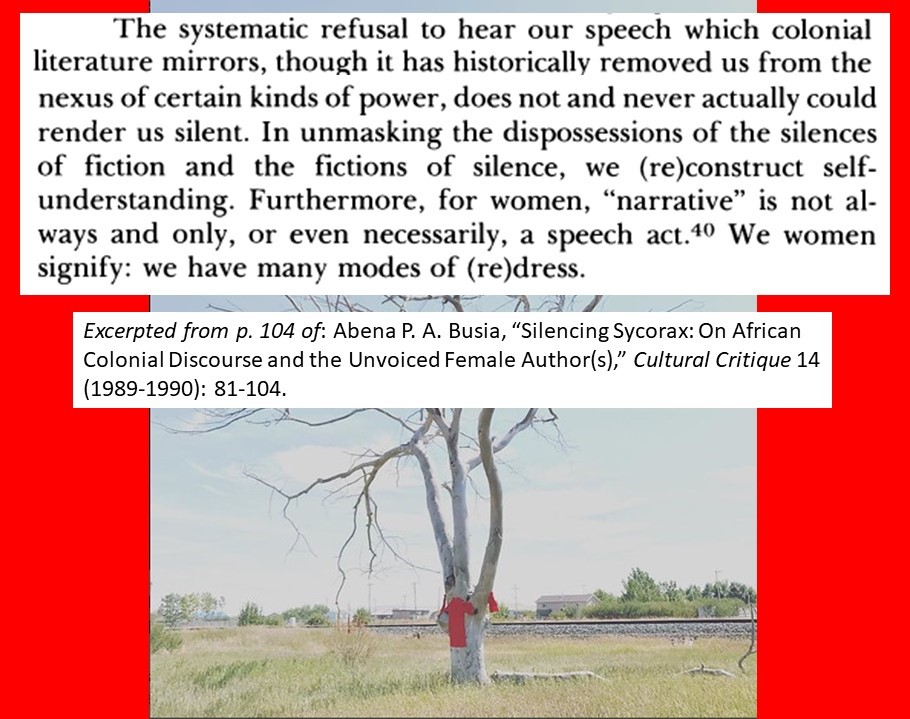
A consonance was found between a course reading by Ghanian scholar Abena Busia and Black's REDress Project that featured so prominently in the acts of solidarity with the Wet’suwet’en people, British Columbia, who fought all winter and spring to protect their unceded territory from the encroachment of the Coastal GasLinks pipeline. Click here for more information.
Our course, Honors 201 (Colonialism) at Coastal Carolina University, had four primary goals: 1) to understand broadly the avenues and effects of colonialism; 2) to learn how critical and creative thinking can work together in anti-colonial endeavors; 3) to analyze the intersections of colonialism and patriarchy, and 4) to creatively communicate the continued struggle against these forms of oppression.
To achieve these ends, Sycorax was our means. In Shakespeare's The Tempest, Sycorax is the characterless character. Prospero calls her a witch and a hag; Caliban calls her his mother. Prospero tells us that she used black magic to imprison Ariel in a tree before Prospero freed him, only to enslave him again. But Sycorax never speaks for herself because she is dead before Act I begins. Her reputation, formed by Prospero the colonizer, not only precedes her, it supersedes her.
In post-colonial literature, Sycorax has become a figurehead for Indigenous women, demonized and dismissed, if not altogether silenced. It was our task this semester to help give her her voice back.
We began by scrutinizing Aimé Césaire's play, A Tempest, the anti-colonial retelling of Shakespeare's original. Césaire's 1969 adaptation twists into the perspective of Caliban, who is cast as Malcolm X struggling for freedom against Prospero's white supremacy. Prospero calls Sycorax a witch, and is grateful for her death, and Caliban rises to defend his mother, claiming that Prospero only thinks she is dead because he thinks the earth itself is dead, which makes it all the easier to exploit. While Césaire's Caliban does not elaborate much further on his mother -- her personality, her past, her possibilities -- this short passage in Act I, Scene II was our springboard for re-imagining Sycorax. We were further aided by Marina Warner's efforts in her novel Indigo to complete a post-colonial pivot toward The Tempest's female characters, namely Miranda and Sycorax.
And so, despite the chaos of globalization effecting a pandemic in mid-semester, the class created an array of possibilities for Sycorax, and in the process, experienced empathy of sorts for one of Western literature's most despicable, yet most invisible, characters. This exercise in empathy, it is hoped, may translate into reasoned compassion and better allyship. Our imaginative efforts to decolonize Sycorax may be found here: Amplifying Sycorax - Our Projects.
We encourage the reader to be inspired into action. Learn more about Missing and Murdered Indigenous Women and Girls, and advocate for safety and justice for all people - humans, Other animals, and our living Earth.