
Marriner David Merrill has contributed to the evolution of instructional design and technology with his three known theories : The Component Display Theory, Instructional Transaction Theory and the First Principles of Instruction.
The First Principles of Instruction are simple and delineated in simple 5 principles:
1. Learning is promoted when learners are engaged in solving real-world problems.
2. Learning is promoted when existing knowledge is activated as a foundation for new knowledge.
3. Learning is promoted when new knowledge is demonstrated to the learner.
4. Learning is promoted when new knowledge is applied by the learner.
5. Learning is promoted when new knowledge is integrated into the learner’s world.
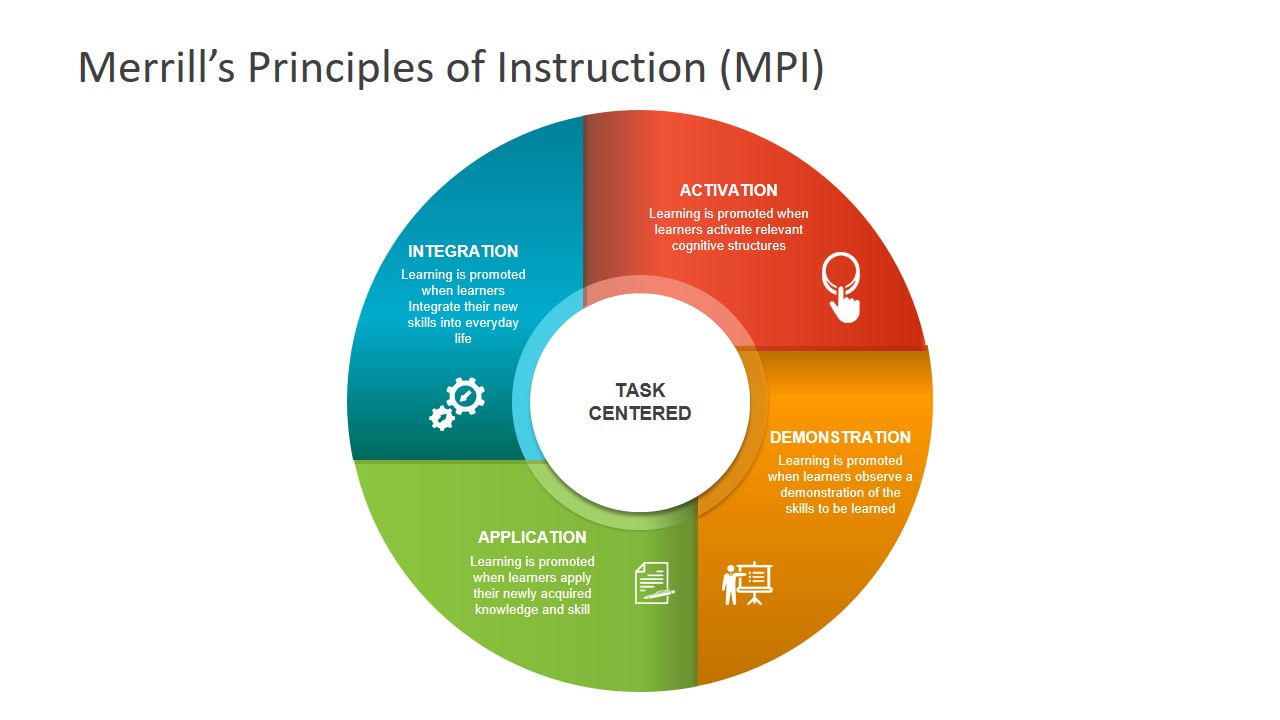
Merrills published his First Principles in 2002, and he specifically goes into detail about each of these principles with supporting theoretical concepts used in the design of strategies and activities for instruction. His most popular principle is the first principle, which denotes :
Principle 1—Problem-centered: Learning is promoted when learners are engaged in solving real-world problems.
• Corollary—Show task: Learning is promoted when learners are shown the task that they will be able to do or the problem they will be able to solve as a result of completing a module or course.
• Corollary—Task level: Learning is promoted when learners are engaged at the problem or task level, not just the operation or action level.
• Corollary—Problem progression: Learning is promoted when learners solve a progression of problems that are explicitly compared to one another.
Show Task : This strategy asks the instructor demonstrate how to approach a problem based activity. For example, creating a video tutorial explaining step by step how to use a code editor before beginning to learn to code.
Problem progression: This strategy builds upon prior background knowledge and deepens a learner's understanding by going beyond the initial problem. For example, once a learner is comfortable with a code editor, he / she may proceed to learn how to use HTML in order to begin creating websites.

I had this burning question, which after 50 years I still have, and that is, "How do we make instruction effective, efficient, and engaging?" I've spent my entire career studying that question, one way or another. Do I think I have the answer? No, but I'm a lot closer than I was. And I've had a wonderful time for 50 years trying to figure it out, and somehow I can't quit.
M. David Merrill Interview for Association for Talent Development 2014.
For a Show Task instructional strategy it is best to ask that a beginner complete a series of steps using key information presented. For example, asking a learner to introduce the first lines of HTML code to create a webpage.