Stephen Krashen's Input Hypothesis
Stephen Krashen's Input Hypothesis
Dr. Stephen Krashen specializes in Second Language Acquisition. His Monitor Model is a learning theory composed of five hypotheses. The Acquisition-Learning Hypothesis underlines the difference between conscious learning and unconscious acquisition of a second language. Jarvis and Krashen (2014) state that:
Subconscious language acquisition has been shown to be more powerful than conscious learning. […] Consciously learned knowledge about language has only limited functions – its primary function is as a Monitor to edit language we produce, either before it is spoken or written, or after […]. (p. 1)
Traditional language teaching that focuses on the practice and memorization of grammatical structures would be considered conscious learning in this case, because students are learning about the language instead of learning the language itself. Subconscious learning occurs through a steady dose of comprehensible input.
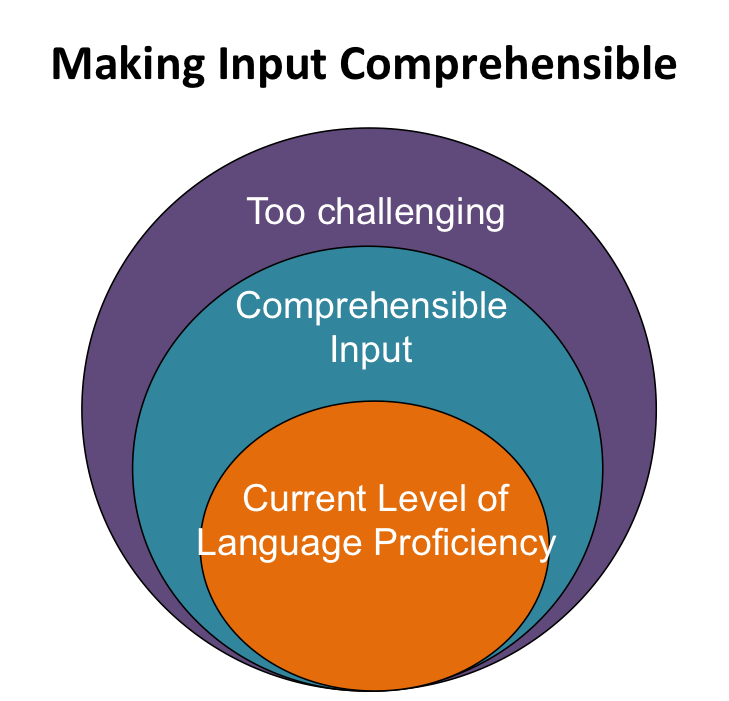
The Input Hypothesis focuses on comprehensible language or input that learners receive through listening or reading in the second language. Wen (2019) explains the Input Hypothesis quite succinctly: Krashen has pointed that “humans acquire language in only one way---by understanding messages or by receiving ‘comprehensible input’” , that is, by receiving input slightly higher than the current language skills of the learner […] This is his famous formula of “i+ 1”, where “i” stands for the current level of the learner and “1” refers to the language materials that are slightly higher than the current level of the learners. (p.1460)
As the teacher, I provide the input in my classroom by facilitating small talk between myself and the learners. This small talk, which is not unlike small talk in the first language, consists of discussing hobbies, sports, favorite things, friends, family, and weather. I make the language comprehensible through gestures, drawings, visuals, and sounds. The “i” here is that which the learners already know or understand and the “+1” is any new vocabulary that may come up during our discussions.