Constructivist Theory
Constructivist Theory
Constructivist Theory believes that learning is an active process where learners build knowledge based on past experiences and knowledge. This theory focuses on the learner and the best ways for the learner to construct knowledge. Constructivism is based on the idea that all learners are unique, and therefore learn in unique ways. Learners come with predispositions, various background knowledge, individual learning styles, and different cognitive structures (i.e. schema and mental models).
For more information about Constructivist Theory, click here.
1. Teacher-as-facilitator:
Learners learn best by doing, by constructing knowledge for themselves. This is at the heart of Bruner’s theory. When a teacher works as a facilitator, learners are front and center, actually doing the work, problem-solving, critical-thinking, designing, etc. Meanwhile, the teacher guides, questions, and facilitates as needed. This enables teachers to give more support when needed, or to challenge learners who are in need of it.
2. Chunking
Chunking, or presenting material in small concepts that can be stored and processed by learners. This relates to Bruner’s spiral organization of information. Learners will become cognitively overloaded if given too much information too soon, and will not accurately learn the material. This is especially important in 21st century learning, where a lot of information is available and is often shared through online mediums. Headings, subheadings, careful planning, and learning cues are all very important as learners dissect and internalize new material.
Gagne’s Nine Events of Instruction is a framework for instructors to use as they develop lesson plans and instructional strategies. The basis of Gagne’s model is founded on the Cognitive Information Processing Theory. “When followed, these events are intended to promote the transfer of knowledge or information from perception through the stages of memory” (Corry, 1996).
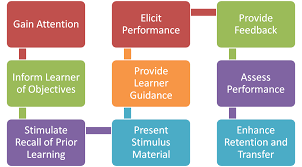
Gagne’s Nine Events model provides an appropriate framework for Bruner’s Constructivist Theory. First of all, Bruner’s theory focuses on the learner’s predisposition toward the information. Gagne’s model addresses this same idea in the recognition of learning conditions, and the first event, which requires instructors to gain the attention of the learner. Secondly, Bruner’s theory relies on the spiral organization of material so that it can be effectively processed by learners. This idea of spiral organization is found in Gagne’s events, as the events should guide instructors to present information in a way that builds upon each other. Lastly, Bruner’s theory is concerned with learner readiness, meaning that instruction must be focused on the experiences and context that will make the learner willing and reading to learn (Culatta, n.d.). This coincides with Gagne’s Events because his learning conditions are focused on internal stimuli (what learners already know-experiences) and external stimuli (the instruction that will be provided- context).
“Think of yourself less as a teacher and more as a designer of meaningful experiences.”
I feel like this quote summarizes my philosophy as an instructional designer. I hope through my design of instruction, I will help to create meaningful experiences for my learners.
I have dreams to become a technology coach, to utilize instructional design in my blended learning classroom, to assess effectively, to focus on the individual learner, and to promote 21st century learning.
I hope to design all lessons with the individual learners in mind. I must focus on the context and the experiences that will make sure my learners are willing and able to learn. This is called the learner readiness. I hope to design activities that are student-centered in order to promote problem-solving and critical thinking.

1. Literature Circles
Literature circles can be conducted in many ways, but the foundation of the activity is that learners read a common book in a group, and then work together to discuss and understanding the reading. Literature circles were designed to be student-led with the teacher serving to facilitate groups as needed.
2. Digital Escape Rooms
In these escape rooms, learners are tasked with a series of activities that must be completed in order to “escape.” These activities are usually a scenario set up; for example, students, after completing the novel The Maze Runner, may need to work together to escape from a maze by solving a variety of tasks that deal with characterization, setting, plot, theme, and summary. While students work together or independently to solve the problems, the instructor facilitates by guiding, questioning, and answering questions as needed.
Click here to see an example of an escape room.
3. Guided notes
Chunk information for students as they are learning new material. The guided notes should contain headings, subheadings, and blank spaces for students to fill in newly-acquired information.
For more information on ways to use guided notes, click here.
4. Concept mapping
At the end of a lesson or unit, students can map out the concepts they've recently studied. Concept maps help learners synthesize new information and helps with memory recall, along with several other benefits (Bradley, n.d.).
For more information on concept mapping, click here.
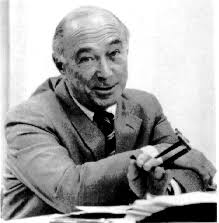
Jerome Bruner was born in New York City in 1915. He attended school at Duke University and Harvard, from which he received his Ph.D. in 1947. Bruner worked as a social psychologist during World War II, and later worked at Harvard as a member of the faculty. He was a professor of psychology and also the co-founder and director of the Center for Cognitive Study. It was his concern for cognitive study that led Bruner to become interested in the cognitive development of children and the state of the educational system in America.
Bruner served on The President’s Advisory Panel of Education. In 1963, Bruner received the Distinguished Scientific Award from the American Psychological Association, and served as the President of the association in 1965. Bruner also became involved in the creation of the MACOs project, which served to create a comprehensive curriculum based on behavioral science. In the early 1980's, Bruner “became critical of the ‘cognitive revolution’ and began to argue for the building of a cultural psychology. This ‘cultural turn’ was then reflected in his work on education – most especially in his 1996 book: The Culture of Education” (Smith, 2002).
Formative: As students complete literature circles, the teacher should grade as each learner presents. Using a rubric to grade the literature circle is a good idea to be sure that all aspects of the discussion are covered. A great general rubric can be found here.
Summative: Instead of giving a summative test over the material, ask students to design a presentation over Constructivist Theory and Jerome Bruner. In the presentation, they must include guided notes to chunk the material as well as a concept map. This assessment asks students to apply the information they have learned.
In summary, Bruner’s Constructivist Theory is focused on how individual learners construct knowledge in meaningful ways in order to connect new learning to previously held concepts and beliefs. This coincides with Gagne’s Nine Events of Instruction in several ways. The events are organized to address individual learning and to promote learning construction in each learner. This theory and model can work together to address 21st century learners through teacher-as-facilitator and chunking information. All of these educational approaches can help learners learn to effectively communicate, problem-solve, think critically and creatively in the modern world in which we live.
(Guest), eA. E. (2016, January 20). Constructivism in Modern Day Education: Foundations and Pros and Cons. Retrieved from https://hrdevelopmentinfo.com/pros-cons-constructivism-modern-day-education/
Bohonos, M. (n.d.). How to Participate in Literature Circles . Retrieved from https://www.youtube.com/watch?v=yVK9ZV-AinA
Bradley, B. (n.d.). Concept Mapping. Retrieved January 12, 2020, from
https://ctl.byu.edu/tip/concept-mapping.
Concept Mapping Tools. (2016, November 10). Retrieved from https://uwaterloo.ca/centre-for-teaching-excellence/teaching-resources/teaching-tips/educational-technologies/all/concept-mapping-tools
Corry, M. (1996). Gagne's Theory of Instruction. Retrieved January 12, 2020, from
https://home.gwu.edu/~mcorry/corry1.htm.
Culatta , R. (n.d.). Constructivist Theory (Jerome Bruner). Retrieved January 12, 2020, from
http://www.instructionaldesign.org/theories/constructivist/.
Guided notes. (n.d.). Retrieved from https://ahrc.eq.edu.au/services/fba-tool/help/guided-notes
Jerome Bruner. (2010, October 17). Retrieved from https://team2developmental.wordpress.com/jerome-bruner/
Smith, M. K. (2002). Jerome Bruner and the process of education. Retrieved January 12, 2020,
from http://infed.org/mobi/jerome-bruner-and-the-process-of-education/.
Study Guides and Strategies. (n.d.). Retrieved from https://www.studygs.net/guidednotes.htm
ThingLink. (n.d.). Gagne's nine events of instruction by izzaty zabri. Retrieved from https://www.thinglink.com/scene/762257705690726400