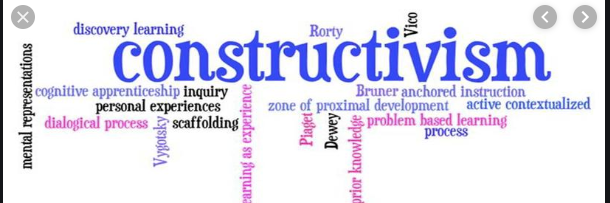
TECHNOLOGY INCORPORATED 21st CENTURY(Constructivism)
TECHNOLOGY INCORPORATED 21st CENTURY(Constructivism)
AMERICAN COLLEGE OF EDUCATION
MERLOT Web Page Preparation
Blaise Nkutie
This web page will explain my philosophy of instructional design, the constructivist learning theory and how it is related to the Integral ASIE ID in teaching and learning in the 21st century.
The constructivist learning theory and the Integral ASIE instructional learning model are very essential and valuable for the teaching and learning process in this 21st century. We live in a century where things are changing at the speed of light thanks to the evolution of technology. The teaching learning process hasn’t been indifference. The constructivist learning theory is a student-centered learning approach in which the learners are responsible to construct knowledge for themselves and create meaning of their own learning based on experience or previous knowledge while the teacher has role of a facilitator.
In the process of constructing knowledge and understanding (learning) for themselves, they have to analyze, Strategize, Implement and Evaluate the information and resources they have at hand making the constructivist learning theory very compatible to the Integral ASIE instructional model which according to (Ismail Zain & Balakrishnan, M. 2014) stands for Analyze, Strategize, Implement and Evaluate.
The main theorists for the constructivist learning theory are John Dewey (1933/1998), who is known as the philosophical founder of constructivism. Bruner (1990) and Piaget (1972) are recognized the chief theorists among the cognitive constructivists, while Vygotsky (1978) is the major theorist among the social constructivist. John Dewey rejected the notion of schools focusing on rote memorization and repetitions and emphasized that students should all be provided with the opportunities to create thoughts and think for themselves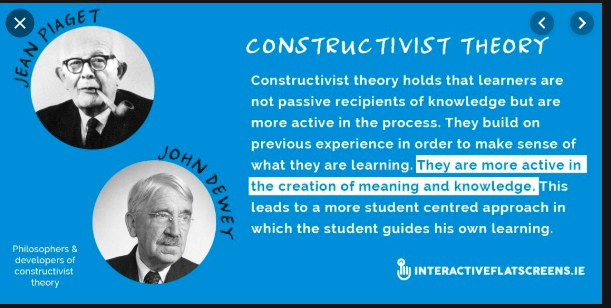
The two main theoretical concepts that are applicable to learners of this 21st century that I will use in my instructional design model are Peer collaboration and Problem-based instruction. The world needs engaged, fully developed, well-equipped and confident individuals or learners. This can only be possible if the collaborate with the right peers and are constantly challenged to go beyond their limits by solving real life complex problems.
Collaboration among learners. Nobody knows everything. Learning from each other at anytime, anywhere and when we want to is the best feeling that will help to advance our world. In order words, diversity is what makes the world beautiful, we all have different talents, kinds and potentials and (Duffy and Jonassen 1992)
Engaging and challenging the learners (problems based instructions). In order to grow and be best version of yourself, you need to be constantly challenged to go beyond your limits. So therefore, learners will constantly be exposed to tasks that will develop the best in them so that they don’t only have ownership of their learning or problem solving process but ownership of the problem itself (Derry 1999).
Constructivist learning theory fosters critical thinking, flexibility, creativity, active learning, and ownership. These are the standards reflected in the 21st century classroom coupled with the evolution of technology. when a platform is given to learners to construct knowledge for themselves in order to be best versions of themselves , self confidence is develop and that's the main goal of the 21st century in the teaching and learning process.
The strategies I will use for this lesson will be online grouping on Google classroom. Learners will collaborate with their peer following the objectives of this lesson and will solve real life problem as an application of constructivism in Mathematics.
Others strategies orActivities will be
-Hands-on, creative activities – One way to initiate these will be for me to pose an open-ended question on how to solve a particular problem
-Role playing
Real-life simulations
my philosophy of instructional design is to create technology incorporated students’ centered courses for everyone for the teaching learning interaction in which students will be able to construct knowledge for themselves anytime and everywhere.
In conclusion, life will be much better and learning will be very active, engaging and fun if instructional designers were creating technology incorporated courses and having students take ownership of their own learning. That’s my religion and philosophy.
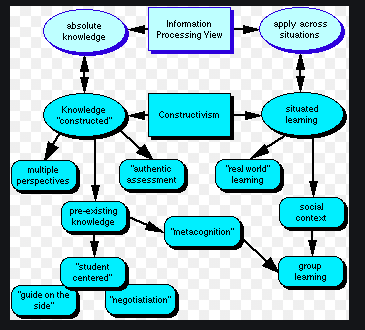
The central premise of Constructivism is that learners create (or construct) new understanding by actively building upon previous knowledge and experiences (Schunk, 2012). Learners are said to create meaning as internal representations based upon their experiences, rather than acquiring meaning directly from external sources. Below is a graph organizer illustrating the central premise of the constructivist learning theory.
VIDEO: Constructivism
Parallel Paths to Constructivism: Jean Piaget and Lev Vygotsky (NA)
No two people were more responsible for the current way lessons are taught worldwide than Jean Piaget and Lev Vygotsky. Both men had an important impact worldwide on how a person should be taught--starting in the last century and continuing today. Jean Piaget's Genetic Epistemology concentrated on the individual in learning. Lev Vygotsky's CulturalHistorical Theory concentrated on the social in learning. 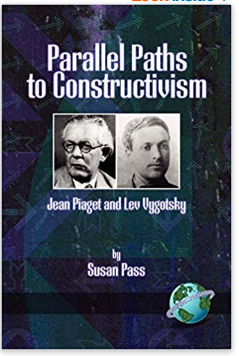
VIDEO: INTEGRAL ASIE MODEL The constructivist learning theory is a student-centered learning approach in which the learners are responsible to construct knowledge for themselves and create meaning of their own learning based on experience or previous knowledge while the teacher has role of a facilitator.
In the process of constructing knowledge and understanding (learning) for themselves, they have to analyze, Strategize, Implement and Evaluate the information and resources they have at hand making the constructivist learning theory very compatible to the Integral ASIE instructional model which according to (Ismail Zain & Balakrishnan, M. 2014) stands for Analyze, Strategize, Implement and Evaluate.
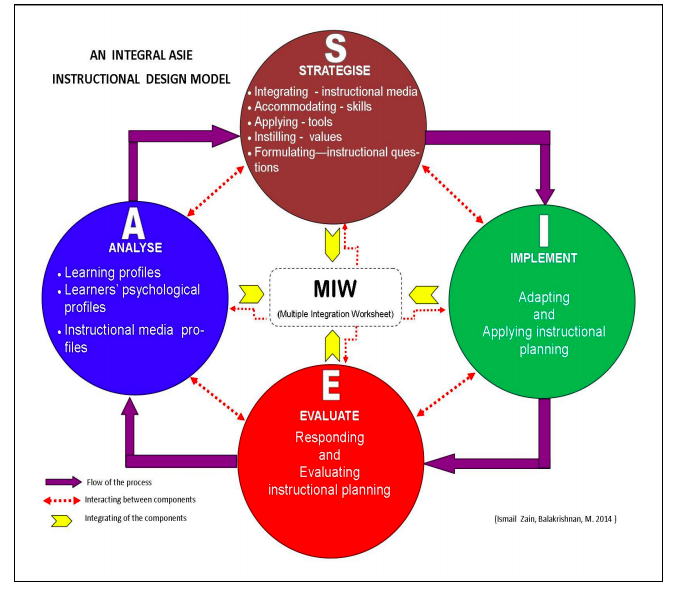
Learner’s understanding will be assessed as described in the integral ASIE model using both formative and summative evaluations. Formative evaluation occurs throughout the entire process where summative evaluation occurs after instruction is complete.
Bada (2015): Constructivism learning theory: a paradigm for teaching and Learning, e-ISSN: 2320–7388, Volume 5,PP 66-70
Ertmer & Newby (1993).:IT 570 Instructional Design: Lesson 5 Assignment Worksheet
Weebly (2018): Instructional design philosophy; retrieved from http://hramseyistportfolio.weebly.com/instructional-design-philosophy.html
Schunk (2012). Learning theories: An educational perspective (. Boston, MA: Pearson Education.
Samuel, Y. (2014): Constructivism theory and use from a 21st century Perspective; journal of applied learning technology vol 4 (3).