
Experiential Theory
Experiential Theory
"Learning is the process whereby knowledge is created through the transformation of experience. Knowledge results from the combination of grasping experience and transforming it. " - Kolb (1984, 41)
There are many different theories, models, and people who have made tracks in the world of education. Generations of content designers and educators have hung on the words of Piaget, Vygotsky, and Bruner. They have formed their own opinions of learning based on some of these great leaders in educational psychology. Learning and experimenting with these different theories and instructional design models allows designers to fine tune their approaches which results in students getting the best possible learning experiences we have to offer.
On this page, you will get a snapshot of David Kolb’s Experiential Learning theory and how it can pair with David Merrill’s Principles of Instruction to create an engaging course.
David Kolb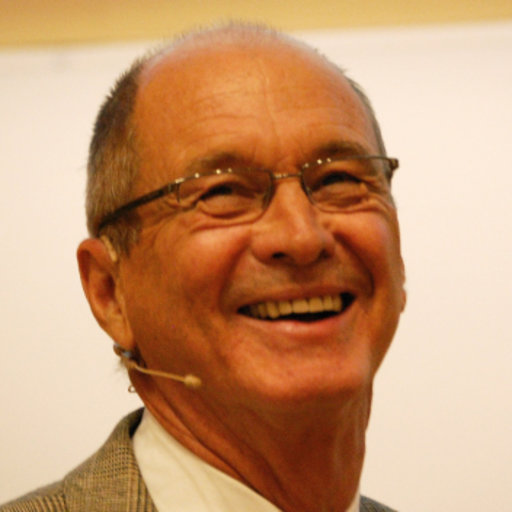
David Kolb is an american psychologist and educational theorist from Illinois. He was born in 1939 and earned his Ph. D. in social psychology from Harvard University in 1967. He is best known for his experiential learning theory and his learning style inventory. Kolb believes that learning is an active process of reacting to your experiences. In addition to his experiential learning theory, Kolb also published a learning styles inventory which is still widely popular amongst educators. Currently, he is the founder and chairman of Experience Based Learning Systems, Inc and working as a Professor of Organizational Behavior at Case Western Reserve University.
David Kolb has continued his work in psychology through contributing to many publications dating back as far as 1976 and as recent as 2019. There have been many books, articles, and journals written by others about his theory and learning styles.
David Kolb’s first book was published in 1984 and is shown below.
A list of David Kolb's other books can be found HERE and a list of Kolb's other publications can be found HERE.
David Kolb and I have a lot in common. Like Kolb, I believe that the best learning comes from experiencing. I think that, as humans, we are lifelong learners. Learning is not linear and and does not only happen within the four walls of a classroom. You are constantly learning in your day to day life. Go too fast on the highway and have to slam on your brakes? You learned not to go so fast next time. Burn your casserole? You learned not to turn the oven so high or keep it in so long. I also think that the best learning happens when what you are learning has value in your life. You are more ept to learn if you care about what you are learning about. I would not enjoy learning chemistry because it has minimal value in my life, while content about learning disabilities would resonate with me.
I was recently asked what I thought was important to me in regards to learning. Over the course of my life, specifically in my adult years, which observing both my students and my peers, I have found that the ability to problem solve is critical. If you are ever faced with the task of completing something you can not do on your own but possess the ability to problem solve, there is nothing you can not accomplish. Problem solving is important to not only live an independent and educated life but to also helps you to feel confident. Experiential theory and Merrill’s Principles, both, aim to create learners that are able to perform in real world situations.
Through this project I have made many revelations about my beliefs as well as how different learning theories and models can be used to enhance learning. I chose to use Experiential Learning Theory because my school recently started using the theory as supplemental to traditional therapy. In the experiential learning course, the students do things such as build walking paths, shovel snow, and talk about social media. All their lessons have them learning through experience. I also chose to use Merrill’s because I feel it really speaks to my educational philosophy and how I function as a teacher. From discussion post to now, I strengthened my philosophy to talk more about what I find important, added 21st century applications, furthered my talk about activities, and added more content to other areas as suggested to me by peers. I believe through my content and media, anyone viewing my webpage will get a good understanding of my chosen theory.
Experiential Theory is the idea that you learn through experience. This theory was made popular by David Kolb with the help of Ron Fry. Their work was loosely based off the ideas of John Dewey, Kurt Lewin, and Jean Piaget; who have made their place in history with their own educational theories.
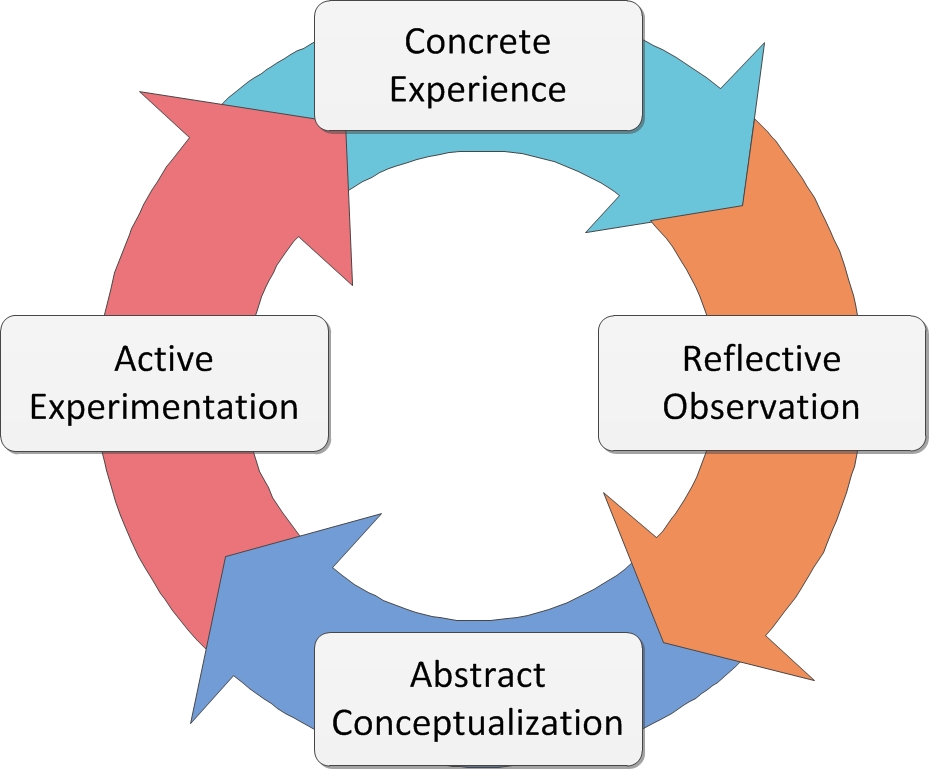
Experiential theory is said to be a holistic approach to education as it incorporates the natural process of doing something, succeeding or failing, thinking about it, and then doing it again.
It is broken up into four stages, which are often portrayed in a circle as it is a continuous cycle. The stages are as followed:
1. Concrete Experience
2. Reflection
3. Conceptualization
4. Application
1. Concrete Experience: Simply put; doing something. At this stage, a learner is experiencing something for the first time or revisiting an old situation.
2. Reflection: At this stage, the learner is processing their interaction with said experience. This can involve reflection on failure, success, feelings, or solutions.
3. Conceptualization: “The big idea.” This stage happens after reflection and includes some sort of modification to the situation in response to what the learner experienced.
4. Application: This is where the learner “tries again”. They take their new ideas and try them out, making way for the cycle to begin again.
For a more in-depth run down of Kolb's experiential theory, please feel free to watch the video below!
Although the idea of what 21st century learning is is controversial, more often than not 21st century learning “is generally used to refer to certain core competencies such as collaboration, digital literacy, critical thinking, and problem-solving that advocates believe schools need to teach to help students thrive in today's world.” (Rich, 2010) Being that the premise of experiential theory and Merrill’s Principles are that learning is relevant to the real world, problem based, and learning for your experiences, they have many applications to 21st century learning.
"I Remember When..."
In the video above, students engage in a hands on activity about population density. The teacher refers to activities like this as “I Remember When..” because how often and long students will remember and talk about the activity. This is because it was fun for them, it made sense, engaged their whole bodies, and they had to make split second decisions. While this activity was in person, it can be accomodated to an online format. Something like a survey, simulation game, even a group video chat can be the outlet for this kind of activity.
Ted Talk
Jess Lambrecht held a TED Talk at Lakeland University about the implications of engaged experiential learning in education.
Simulations
Below is a website that lists 10 websites that offer science simulations for teachers. Simulations are a major part of Experiential Theory as it helps students apply their knowledge in real time.
Kolb’s theory is a four stage cycle. Within this cycle, he tells us that there are two phases of learning. As a reminder, a learner can jump into the cycle at any stage but learning does not happen until all four stages are complete.
He outlines these parts of learning as grasping and transforming.
Take a look at the model below in which Kolb’s theory is based off. There are two continuum.
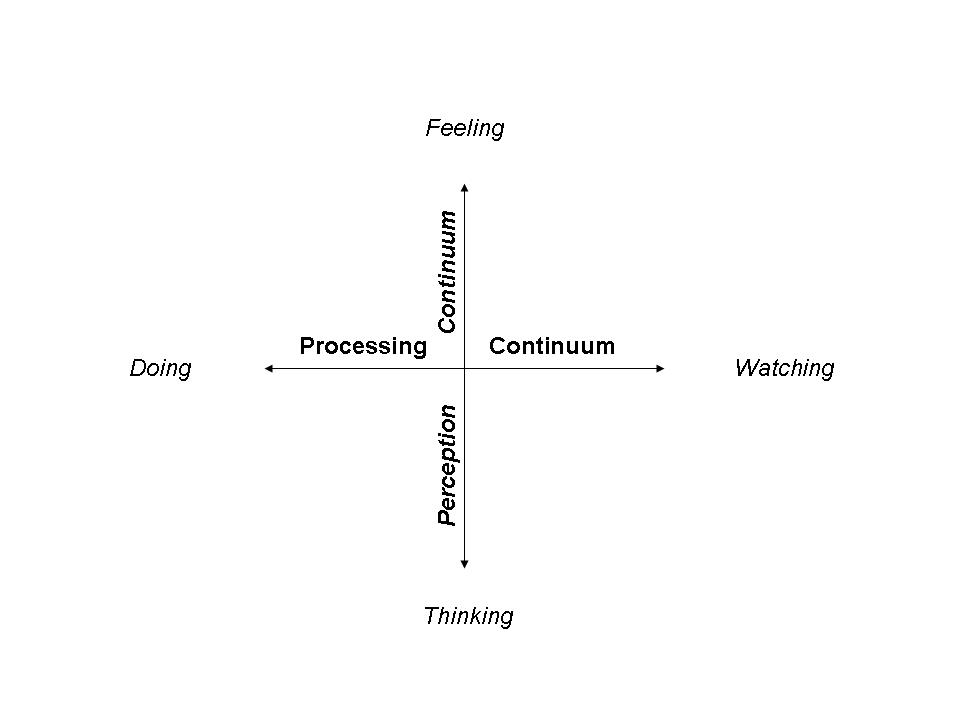
Grasping: Perception Continuum
In this phase, learners are having an emotional response to the experience.
Concrete Experience
Conceptualization
Transforming: Processing Continuum
In this phase, learners are interacting with the experience.
Reflection
Observation
Activities
If you are wanting to incorporate experimental theory into your classroom you may include field trips, experiments, role playing, simulations, repetition, and always leave room for reflection.
In my specific course I would incorporate a combination of experiments and reflection.
Experiment: Learners would be tasked with creating a simple lesson but rooted in two different theories/ID models (i.e: behaviorism and cognitivism or brain based learning and Nine Events of Instruction). They would pick a group of people to sample their lessons and then analyze which group of people learned more and why.
Reflection: In the beginning of the course, students will outline their beliefs and philosophies. Considering students in this course will be experimenting with different theories and models, at the end, they will reflect on their learning philosophies, how they have changed over the course, and their plans moving forward with their careers.
Keeping in mind that experiential theory is all about hands-on, real world, and relevant instruction… the assessments given must follow suit.
In a course teaching about Merrill’s Principles of Instruction, ideas for assessments are as follows:
Formative assessments:
Engage the students in a course that is rooted in Merrill’s and then have them reflect on their experience
Students design a lesson based on Merrill’s Principles
Summative assessments:
Making improvements and tweaks to the lesson made during their formative assessment including a reflection of the process
A simulation involving the student to embody one of Merrill’s Principles
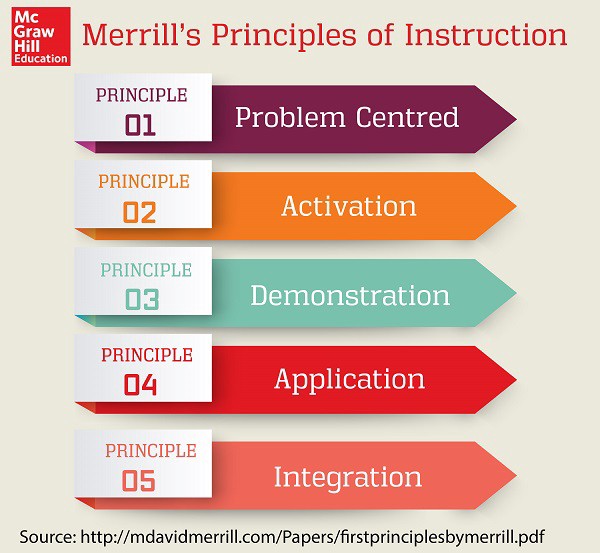
Merrill's Principles of Instruction is a problem based learning model while experiential theory is real world and based upon experiences. Both of these require the learner to be an active participant in their learning; involving themselves in problem solving, critical thinking, and reflection.
Clark, D. (2011, July 13). Kolb's Learning Styles and Experiential Learning Model. Retrieved from http://www.nwlink.com/~donclark/hrd/styles/kolb.html
Kolb, D. A. (1984). Experiential learning: Experience as the source of learning and development (Vol. 1). Englewood Cliffs, NJ: Prentice-Hall.
Teaching and Learning Services (2014). Guidelines for assessment of experiential learning. Montreal: Teaching and Learning Services, McGill University.
http://www.nwlink.com/~donclark/hrd/styles/kolb.html