Multiple Intelligence Theory & ARCS
Multiple Intelligence Theory & ARCS
Theories and instructional design models have gone together since they have been developed and popularized. Differentiated instruction has become a practice in education where teachers do their best to adapt instruction to the academic achievement level for each student in the classroom. As educators, we are all well aware that not all students learn or like the learn in the same way, but having motivation to learn can go a long way. With that knowledge, using Howard Gardner’s Multiple Intelligence Theory (MIT) paired with John Keller’s ARCS Model creates a great combination that allows for students to engage with relevant material in many different ways.
By using Gardner’s MIT you can tap into each students preferred intelligence to make sure they are using their favorite and preferred way to learn. As teachers we need to be aware and know each of our students' strengths and what motivates them. Keller’s ARCS Model allows us to take those strengths and add an element of excitement to those lessons. To begin the four step model, we need to grab their attention by doing an ice breaker, or adding an element of humor (David, 2014). Then, make sure the information is relevant and provide feedback to build confidence and allow students to leave with some sort of satisfaction.
Gardner’s Multiple Intelligence Theory states that there are different ways in which individuals process and learn information and therefore we as people do not all learn the same way (David, 2014). According to David (2014) currently the theory has 7 defined intelligences:
Linguistic - learning from spoken or written word. These people learn best from lectures and reading, they are your writers, poets, lawyers and public speakers.
Logical-Mathematical - learning with logic, numbers and abstract. These people use inductive and deductive thinking and are good at pattern recognition and are often your mathematicians and scientists.
Visual-Spatial - learners that are good at visualizing and dimensions, your architects and designers.
Body-Kinesthetic - learning from body movement and physical movements. They like to be active and moving during their learning like your martial arts masters, dancers and gymnasts.
Musical-Rhythmic - learning through music, rhythms and beats. These people can master music, play instruments and write lyrics, they are your composers, instrumentalists and songwriters.
Interpersonal - learns in a group via relationships. These people communicate well and understand others. They are your educators, salespeople, counselors and politicians.
Intrapersonal - learns within themselves. These people understand themselves and one’s own emotions, they like to self-reflect.
People possess certain intelligences that they should be encouraged to develop their abilities within (“Multiple Intelligences,” n.d.). The web article goes onto say that this theory has been focused primarily on child development, but seems to be able to be applied to all ages. Gardner himself claims that these seven intelligences rarely operate independent of each other.

Howard Gardner was born in Scranton, Pennsylvania in 1943. After attending a preparatory school in nearby Kingston, PA, he went to Harvard to study a career in law (Smith, 2008). Smith then discusses that Gardner’s love for psychology grew and under the guidance of multiple tutors and professors he graduated from Harvard in 1965. Gardner then went onto to work with Jerome Bruner and entered Harvard's doctoral program in 1966. That same year he began working with Project Zero to which has remained involved in until present day.
Gardner finished his doctorate in 1971 and became a lecturer, then a professor at the university in 1986. He authored multiple books, his first widely accepted book titled The Shattered Man was published in 1975 about a patient who died of brain damage and was the cadaver for a brain study. Frames of Mind in 1983 introduced the world to his Multiple Intelligence Theory. Gardner is currently Hobbs Professor of Cognition and Education at the Harvard Graduate School of Education. He is also an adjunct professor of neurology at Boston University.
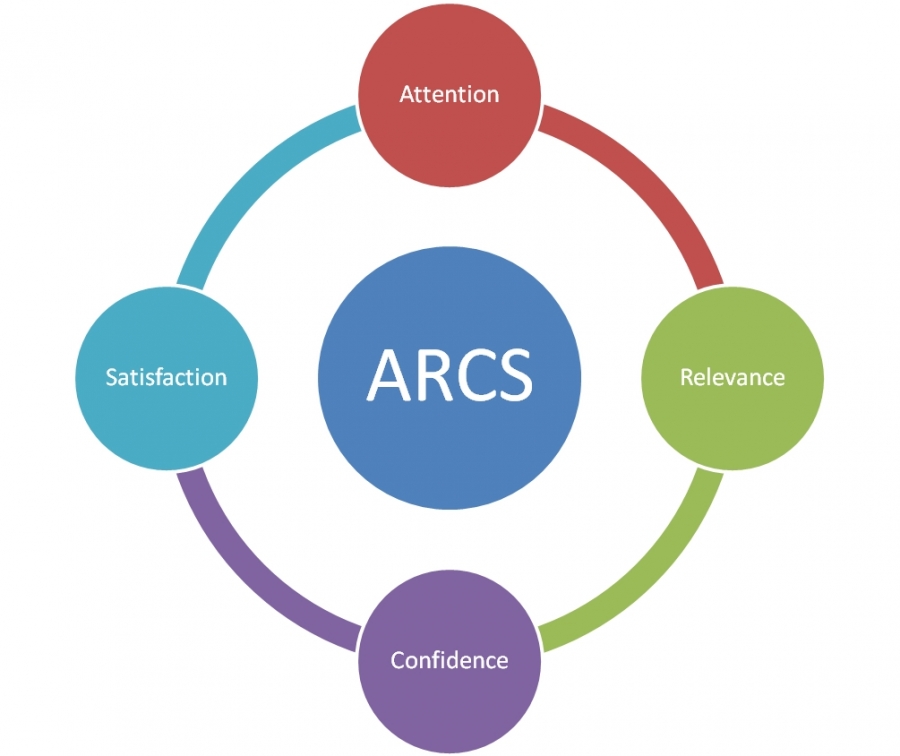 Karageorgakis, T. (2019). ARCS motivation model. What should be included in an a learning activity to make it more appealing? Retrieved from http://educraft.tech/arcs.
Relevant by definition is something that is closely connected to what is being done. The use of technology and device integration is essential in preparing these students for the 21st century (even though we are already a quarter of the way through it).
John Keller’s ARCS Model of Motivational Design Theories is a four-step process that strongly promotes the use of motivation to be embedded in the planning and learning process. ARCS is an acronym for attention, relevance, satisfaction and confidence. Keller feels that motivation is an essential part of the learning process (David, 2014). In the attention step, the presenter uses an ice-breaker or humor to gain the attention of the learner and draw them in. It is followed by relevance, tell the learner why they want to know this information and how they will be able to utilize it later in life. In the confidence step, you provide feedback and allow the learner to grow before lastly rewarding the learner and leaving them satisfied and that they benefited from the learning that just occurred.
Technology components really work for today’s learners. There are many software programs that allow for students to take benchmark tests to place them on a continuum. Then that program uses an algorithm to create a personalized pathway to get the student to a defined end goal. Students can use programs like Edmentum for mathematics or NEWSELA for reading. These programs use state standards to align goals for students based on grade level and ability. Using a device, the children are comfortable learning from a screen and can often adapt faster than the teacher presenting the lesson.
Scaffolding can be a daunting task as it often makes the educator think like the student. When done correctly, it can be the difference between a fantastic lesson and a flop. It allows the presenter the ability to foresee misconceptions and problems that may arise during the lesson implementation. Creating an “About You” artifact on the iPad using Keynote can be scaffolded by having the student list character traits that define who the are. They then think of an image that represents those traits and finally finding them in the shapes dropdown. You can also provide the student with an example of what an “About Me” diagram looks like by showing one you created that is about you. Another example would be having the students track their own data using a digital data binder. For the first few additions, you can add them during one-on-one data meeting where you show the student where the information goes and what your expectations are for it to look like. The next time they would be on there own as you would just give the information to them to add.
Establishing strong assessment techniques is a critical component of instruction (Carbery & Leahy, 2015). Both formative and summative assessments are necessary to progress monitor each student. As much as I like using digital devices to assess students because of the instant feedback and data analysis, I understand that students need to be able to still use paper and pencil for most standardized testing.
Our students need someone who is going to push them to their fullest potential and expect nothing than their absolute best. Someone who is going to prepare them for life's most difficult journeys and make sure they have the skillset to navigate their personal challenges. Our students need to have those crucial 21st century skills so they can be competitive in tomorrow's ever changing job market. I will create rigorous lessons, but with creativity, excitement and real-world connections. By designing well thought out, culturally relevant and engaging lessons that allow for students to utilize a cross-curricular span of knowledge, my students will be ready (Bauman, 2019).
In conclusion, these two concepts go together really well. The motivation aspect of ARCS plays into the the Multiple Intelligence Theory by wanting what is best for each individual learner and trying to do its best to match it up with their most dominant way of learning.
Bauman, C. (2019). Individual student profile. Unpublished manuscript, American College of Education.
Carbery, A., & Leahy, S. (2015). Evidence-based instruction: assessing student work using rubrics and citation analysis to inform instructional design. Journal of Information Literacy, 9(1), 74–90. https://doi.org/10.11645/9.1.1980
David, L. (2014, July 23). ARCS model of motivational design. Retrieved from https://www.learning-theories.com/kellers-arcs-model-of-motivational-design.html
David, L. (2014, July 17). Multiple intelligences theory. Retrieved from https://www.learning-theories.com/gardners-multiple-intelligences-theory.html.
Multiple Intelligences (Howard Gardner). (n.d.). Retrieved from http://www.instructionaldesign.org/theories/multiple-intelligences.
Karageorgakis, T. (2019). ARCS motivation model. What should be included in an a learning activity to make it more appealing? Retrieved from http://educraft.tech/arcs.
Smith, M. (2008). Howard gardner and multiple intelligences; The encyclopedia of informal education. Retrieved from http://www.infed.org/mobi/howard-gardner-multiple-intelligences-and-education.