
Chapter 4: Time Management
Chapter 4: Time Management
Do you ever wonder where the hours in the day go? Do some days seem to just fly by—leaving you feeling like there just isn’t enough time to do everything you need to do?
People in modern society often struggle to balance the time-consuming needs of going to school, working, and taking care of families. Even doing the things we love can consume so much time that it becomes stressful or anxiety-producing.
Is there a way to accomplish the things we need to do, along with the things we want to do, each day?
There are many strategies out there for organizing our daily activities. Using skills to arrange our time can help relieve our stress and allow us to take care of a variety of things in our lives. There is nothing quite like sitting down after a long day and feeling like you were productive. Smiling with a sense of satisfaction and accomplishment, you can cross off the items on your to-do list, knowing that you made the most out of the day.
In this lesson, we’ll explore useful ways to organize your days—and even your weeks—to get the most mileage out of your time.
By the end of this chapter, you will be able to:
- Understand the relationship between goals and time management.
- Consider how your priorities impact your time.
- Identify your time management personality.
- Assess your current use of time.
- Understand the basic principles of time management and planning.
- Use a calendar planner and daily to-do list to plan ahead for study tasks and manage your time effectively.
- Explore time management tips and strategies. • Identify procrastination behaviors and strategies to avoid them.
Now that you have spent some time exploring your values and your goals, you can easily see how you need to manage your time well in order to accomplish your goals. When you have a long-term goal and break it down into mid-term and short-term goals, it leads to the question, “What do I need to do today in order to achieve my goal?” This question is at the heart of time management. Your goals guide how you spend your time and resources. Having clearly defined goals with specific deadlines leads you to be deliberate in planning your time and makes it easier to establish an effective time management system.
As most students discover, college is not the same as high school. For many students, college is the first time they are “on their own” in an environment filled with opportunity. And while this can be exciting, you may find that social opportunities and job responsibilities conflict with academic expectations. For example, a free day before an exam, if not wisely spent, can spell trouble for doing well on the exam. It is easy to fall behind when there are so many choices and freedoms.
One of the main goals of a college education is learning how to learn. In this section, we zoom in on learning how to skillfully manage your time. To be successful in college, it’s imperative to be able to effectively manage your time and to manage all aspects of your life including school, work, and social opportunities. Time management isn’t actually difficult, but you do need to learn how to do it well.
Thinking about your goals gets you started, but it’s also important to think about priorities. We often use the word “priorities” to refer to how important something is to us. We might think, This is a really important goal, and that is less important. Try this experiment: go back to the goals you wrote in the last chapter and see if you can rank each goal as a 1 (top priority), 2 (middle priority), or 3 (lowest priority).
It sounds easy, but do you actually feel comfortable doing that? Maybe you gave a priority 1 to passing your courses and a priority 3 to playing your guitar. So what does that mean—that you never play guitar again, or at least not while in college? Whenever you have an hour free between class and work, you have to study because that’s the higher priority? What about all your other goals—do you have to ignore everything that’s not a priority 1? And what happens when you have to choose between different goals that are both number 1 priorities?
In reality, priorities don’t work quite that way. It doesn’t make a lot of sense to try to rank goals as always more or less important. The question of priority is really a question of what is more important at a specific time. It is important to do well in your classes, but it’s also important to earn money to support yourself and have a social life. You shouldn’t have to choose between these, except at any given time. Priorities always involve time: what is most important to do right now. Time management is mostly a way to juggle priorities so you can meet all your goals. When you manage your time well, you don’t have to ignore some goals completely in order to meet other goals. In other words, you don’t have to give up your life when you register for college, but you may need to work on managing your life and time more effectively.
But, time management works only when you’re committed to your goals. Attitude and motivation are very important. If you haven’t yet developed an attitude for success, all the time management skills in the world won’t keep you focused and motivated to succeed.
There are two important steps in prioritizing: identifying your priorities and then categorizing your priorities.
IDENTIFYING & CATEGORIZING YOUR PRIORITIES
Fixed vs. Flexible Commitments
The first step in identifying and categorizing your priorities is determining which of your commitments are fixed vs. flexible. Fixed commitments are things that must be done at a certain time (e.g. your class schedule, your work schedule…). Flexible commitments are things that can be done at any time (e.g. going to the gym, doing homework, etc…). The first step you need to take is writing down ALL of your commitments and then categorizing them into fixed vs. flexible.
The Must Do, Should Do, Want to Do Method
Once you have a list of your commitments, you next need to categorize them into one of three priority levels: must do, should do, and want to do. “Must Do” are things that absolutely need to get done (non-negotiables). “Should Do” items are important, but not essential. “Want to Do” are for things that would be nice for you to do if you have the time. It is important to note that everyone will have different priorities, depending on what is most important.
The Eisenhower Method
While grouping tasks into ‘fixed vs. flexible’ and ‘must do, should do, want to do’ is helpful, there is a second method to identify your priorities: the “Eisenhower Box,” a tool to help evaluate urgency and importance. Items may be placed at more precise points within each quadrant.
The “Eisenhower Method” stems from a quote attributed to Dwight D. Eisenhower: “I have two kinds of problems, the urgent and the important. The urgent are not important, and the important are never urgent.”
Using the Eisenhower Decision Principle, tasks are evaluated using the criteria important/unimportant and urgent/not urgent, and then placed in according quadrants in an Eisenhower Matrix (also known as an “Eisenhower Box” or “Eisenhower Decision Matrix”). It is important to understand the difference between urgency and importance. An urgent item needs to be dealt with immediately. An item that is important needs to be dealt with but may or may not needs to be dealt with immediately. Tasks are then handled as follows:
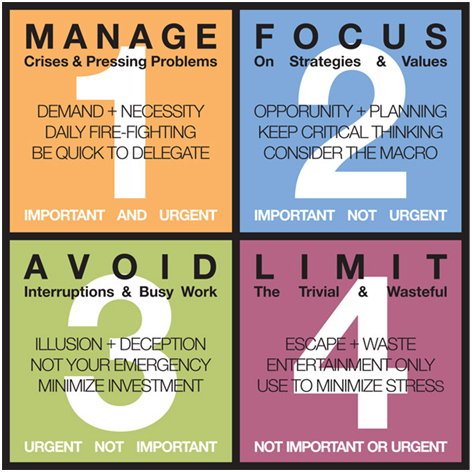
"The Eisenhower Decision Matrix: Important v. Urgent." From: https://www.business2community.com/leadership/eisenhower-decision-matrix-important-vs-urgent-01372854
1. Important & Urgent quadrant items must be taken care of immediately. Examples include:
- Crises like accidents
- A flat tire
- A screaming baby
- A broken water heater
- Last minute deadlines
- Pressing problems
2. Important, Not Urgent quadrant items need to be accomplished but have an end date or due date that isn’t urgent or pressing. Examples include:
- Homework
- Studying for an upcoming exam
- Exercise
- Planning an upcoming trip
- Time with friends, family, and relationships
3. Unimportant & Urgent quadrant are items that can often feel urgent but they really aren’t. Although they may feel like they need to be attended to immediately, they are not very important and can actually wait. Examples include:
- Text messages
- Social media alerts
- Some phone calls
- Junk mail
4. Unimportant, Not Urgent quadrant are are your time wasters, things that are not important and not urgent. Examples include things like:
- Television
- Video games
- Hanging out with friends (not planned social events)
- Social media
As you can see, the Urgent/Important category (#1) needs to be attended to first and should top your list of priorities, followed by the Not Urgent/Important category (#2). You can imagine that the Category #1 is a stressful place, with emergencies and crises, and one you would like to avoid. Life will bring you plenty of Category #1 items so try your best to keep things out of that category. Work productively in Category #2 so items don’t unnecessarily end up being urgent. For example, a paper or a test shouldn’t be urgent, as they aren’t last minute crisis. The more you focus on Category #2, the more you accomplish with less stress
Now that you’ve evaluated how you have done things in the past, you’ll want to think about how you might create a schedule for managing your time well going forward. The best schedules have some flexibility built into them, as unexpected situations and circumstances will likely arise during your time as a student.
For every hour in the classroom, college students should spend, on average, about two to three hours on that class reading, studying, writing papers, and so on. Look at the following scenarios to get an idea of how many hours you should be spending on your classes outside of class time.
12 credit hours over a 15-week session = 12 hours a week in class + 24-36 hours outside of class
6 credit hours over a 15-week session = 6 hours a week in class + 12-18 hours outside of class
3 credit hours over a 6-week session = 8 hours a week in class + 16-24 hours outside of class
If you’re a full-time student with twelve hours a week in class plus your study time, that 36-42 hours is about the same as a typical full-time job, which is why you are considered to be a full-time student. If you work part-time or have a family, time management skills are even more essential. To succeed in college, everyone has to develop effective strategies for dealing with time.
Many students begin college not knowing this much time is needed, so don’t be surprised if you underestimated this number of hours. Remember this is just an average amount of study time—you may need more or less for your own courses. To be safe, and to help ensure your success, add another five to ten hours a week for studying.
USING A PLANNER
A planner, agenda, or calendar can be useful to keep track of your priorities: deadlines and due dates, class times, work schedule, and important dates. It is also a visual tool that can help you understand how you are using your time. The specific type of planner you use will depend on your needs and personal preferences, it can be electronic (like an app on your phone) or paper (like a weekly or daily agenda). It may take you some time to figure what works best for you, but the end result should be something that is tailored to your unique needs.
WHAT GOES IN YOUR PLANNER?
Once you have a planner system in mind, it's time to start filling it in. Let's start in this order: top priorities, discretionary time, and reminders.
Priorities
- Class time
- Work Time
- Designated study time (2-3 hours per hour in class)
- Assignment due dates (check your syllabus)
- Exam dates and quizzes (check your syllabus)
- Appointments
- Birthdays of family and friends
Discretionary Time
- Social events
- Parties
- Exercise
- Club activities
- Church activities
Reminders
- Birthdays
- Anniversaries
- Holidays
Your schedule will vary depending on the courses you’re taking. So pull out your syllabus for each class and try to determine the rhythm of the class by looking at the following factors:
- Will you have tests or exams in this course? When are those scheduled?
- Are there assignments and papers? When are those due?
- Is there any group or collaborative assignments? You’ll want to pay particular attention to the timing of any assignment that requires you to work with others.
Remember your goals. Does your schedule reflect your goals? Set your short and long-term goals accordingly. Ask yourself the following:
- What needs to get done today?
- What needs to get done this week?
- What needs to get done by the end the first month of the semester?
- What needs to get done by the end the second month of the semester?
- What needs to get done by the end of the semester?
Don’t try to micromanage your schedule. Don’t try to estimate exactly how many minutes you’ll need two weeks from today to read a given chapter in a given textbook. Instead, just choose the blocks of time you will use for your studies. Don’t yet write in the exact study activity, just reserve the block. Next, look at the major deadlines for projects and exams that you wrote in earlier. Estimate how much time you may need for each and work backward on the schedule from the due date.
PLAN BACKWARDS
As a college student, you will likely have big assignments, papers, or projects that you are expected to work on throughout the semester. These are often tricky for students to schedule since it isn’t a regularly occurring event, like a weekly quiz or a homework assignment. These big projects often feel overwhelming so students have a tendency to shy away from them and procrastinate on them. This often results in a lot of last-minute stress and panic when the deadline is looming. A way to plan for these big projects is to plan backward. Start at the final project and then figure out all the steps that come before it and assign due dates for yourself. For example, you have a research paper due May 1. Start there!
| Assignment | Due Date |
| Research Paper Due | May 1 |
| Final Draft | April 28 |
| Rought Draft | April 21 |
| Final Outline | April 7 |
| Find Sources | March 24 |
| Thesis Statement | March 17 |
| Select Topic | March 10 |
You have now created a series of assignments for yourself that will keep you on track for your project. Put these dates in your planner the same way you would any other assignment.
ESTABLISH A TO-DO LIST
People use to-do lists in different ways, and you should find what works best for you. As with your planner, consistent use of your to-do list will make it an effective habit.
Some people prefer not to carry their planner everywhere but instead, copy the key information for the day onto a to-do list. Using this approach, your daily to-do list starts out with your key scheduled activities and then adds other things you hope to do today. This is a good fit for those that prefer to keep a wall calendar at home rather than carry their planner with them.
Some people use their to-do list only for things not included in their planners, such as short errands, phone calls or e-mail, and the like. This still includes important things, but they’re not scheduled out for specific times like your planner is.
Although we call it a daily list, the to-do list can also include things you may not get to today but don’t want to forget about. Keeping these things on the list, even if they’re a low priority, helps ensure that eventually, you’ll get to it.
Just as there are several options for planners, there are different types of to-do lists. Check your planner to see if it has one incorporated. If not, get a small notebook or pad of paper that you will designate as your to-do list. Of course, there’s always an app for that! Your smartphone likely came with a Reminder App or another type of To-Do List app. There are also many free apps to choose from and there are apps to help you manage your homework and assignments. Take a few minutes to look through your options to pick the best one for you.
Your To-Do list should be a reflection of your goals and priorities and should support your planner Your To-Do List should answer the question, “What do I have to do today, this week, this month?”
Here are useful ways you can organize the day’s activities:
Step 1: Brainstorm tasks. List all of the tasks you want to get done tomorrow. Each task will become an item on a to-do list. Don’t worry about putting the entries in order or scheduling them yet. List everything you want to accomplish on a sheet of paper or in a notebook. You can also use 3 × 5 cards, writing one task on each card. Cards work well because you can slip them into your pocket or rearrange them, and you never have to copy to-do items from one list to another.
Step 2: Estimate time. For each task you wrote down in Step 1, estimate how long it will take you to complete it. This can be tricky. If you allow too little time, you end up feeling rushed. If you allow too much time, you become less productive. For now, give it your best guess. If you are unsure, overestimate rather than underestimate how long it will take for each task.
Now, pull out your calendar or Time Monitor/Time Plan. A Time Monitor or Time Plan is a structured document where you can plan your day, week, or month—but you can write your activities on your calendar as well. You’ve probably scheduled some hours for events such as classes or work. This leaves the unscheduled hours for tackling your to-do list.
Add up the time needed to complete all of your to-do items. Also add up the number of unscheduled hours in your day. Then compare the two totals. The power of this step is that you can spot time overload in advance. If you have eight hours’ worth of to-do items but only four unscheduled hours, that’s a potential problem. To solve it, proceed to Step 3.
Step 3: Rate each task by priority. To prevent over-scheduling, decide which to-do items are the most important, given your available time. One suggestion for making this decision comes from the book How to Get Control of Your Time and Your Life, by Alan Lakein (1973): Simply label each item as A, B, or C.
- The A items on your list are tasks that are the most critical. They include assignments that are coming due or jobs that need to be done immediately. Also included are activities that lead directly to your short-term goals.
- The B items on your list are important, but less so than the A items. The B items can be postponed, if necessary, for another day.
- The C items are often small, easy tasks with no set timeline. They, too, can be postponed.
Once you’ve labeled the items on your to-do list, schedule time for all of the A tasks. The B and C items can be done randomly during the day—when you are in between tasks and are not yet ready to start the next A task. Even if you get only one or two of your A items done, you’ll still be moving toward your goals.
Here are some more tips for effectively using your daily to-do list:
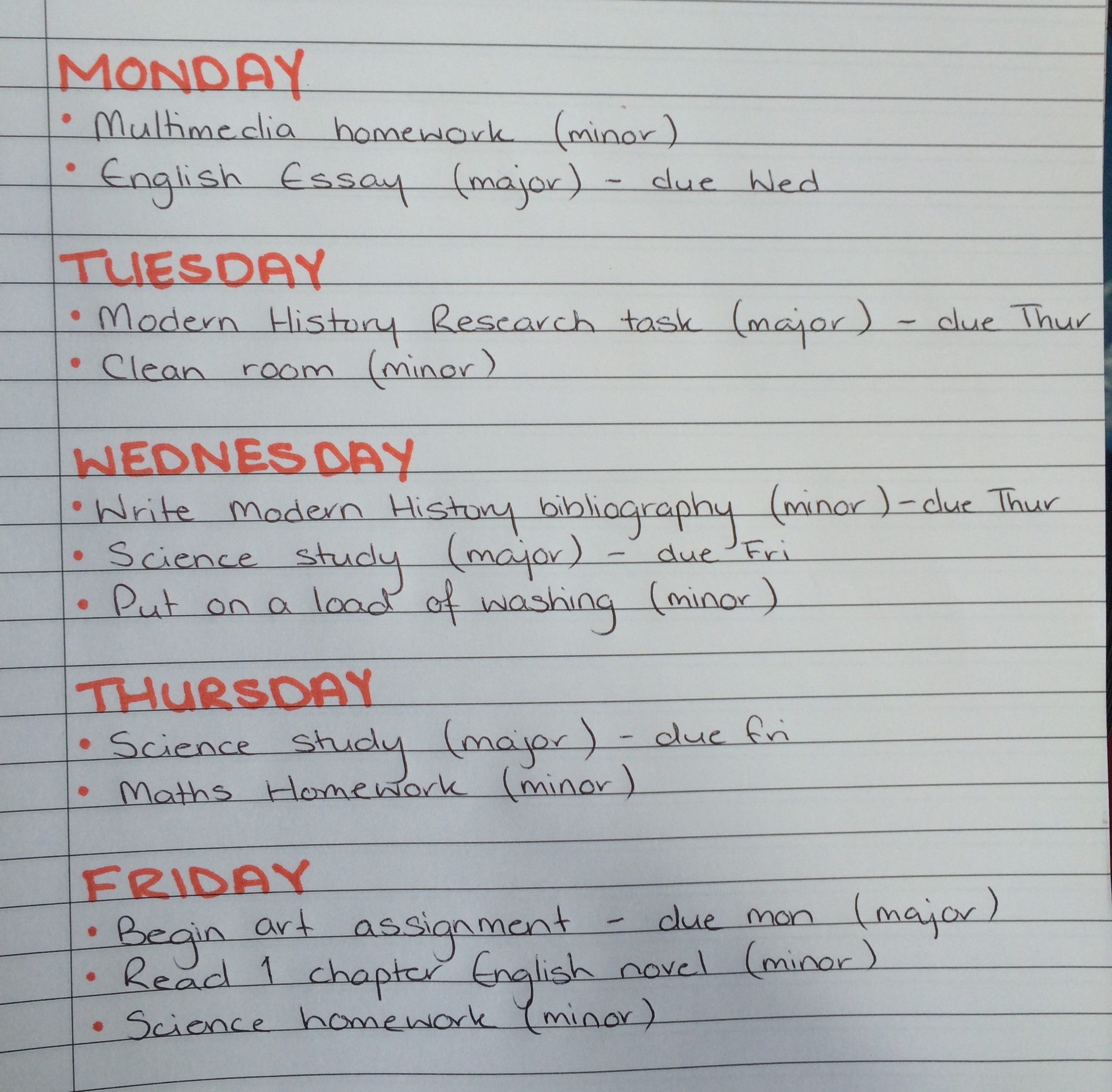
- Be specific: “Read history chapter 2 (30 pages)”—not “History homework.” •
- Put important things high on your list where you’ll see them every time you check the list.
- Make your list at the same time every day so that it becomes a habit.
- Don’t make your list overwhelming. If you added everything you eventually need to do, you could end up with so many things on the list that you’d never read through them all. If you worry you might forget something, write it in the margin of your planner’s page a week or two away.
- Use your list. Lists often include little things that may take only a few minutes to do, so check your list anytime during the day you have a moment free.
- Cross out or check off things after you’ve done them—doing this becomes rewarding.
- Don’t use your to-do list to procrastinate. Don’t pull it out to find something else you just “have” to do instead of studying!
Here are some examples to help you get started:
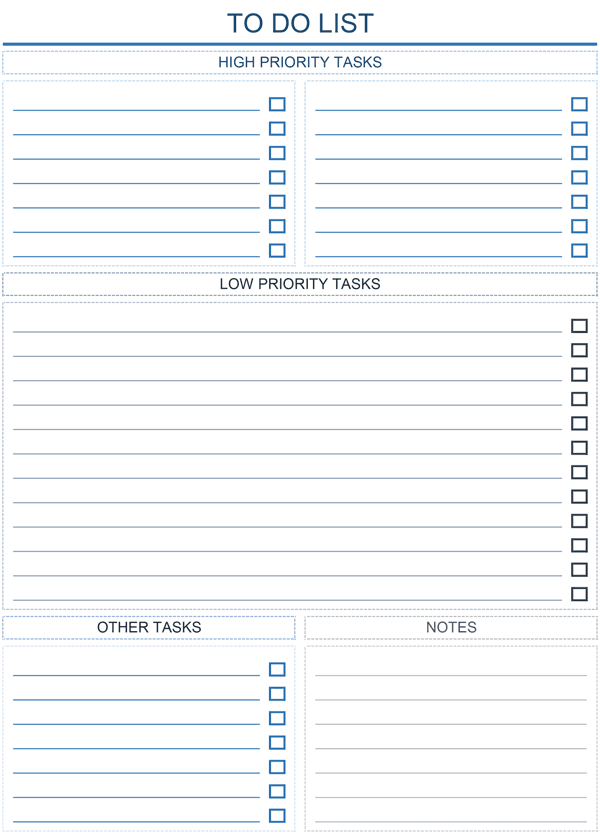
"Prioritized To Do List Template" from Spreadsheet 123, available at : https://www.spreadsheet123.com/ExcelTemplates/prioritized-to-do-list.html
To Do List sample, from "Make Effective To Do Lists" available at: https://www.artofsmart.com.au/write-effective-lists/
TIME MANAGEMENT STRATEGIES
Following are some strategies you can begin using immediately to make the most of your time:
- Prepare to be successful. When planning ahead for studying, think yourself into the right mood. Focus on the positive. “When I get these chapters read tonight, I’ll be ahead in studying for the next test, and I’ll also have plenty of time tomorrow to do X.” Visualize yourself studying well!
- Use your best—and most appropriate—time of day. Different tasks require different mental skills. Some kinds of studying you may be able to start first thing in the morning as you wake, while others need your most alert moments at another time.
- Break up large projects into small pieces. Whether it’s writing a paper for class, studying for a final exam, or reading a long assignment or full book, students often feel daunted at the beginning of a large project. It’s easier to get going if you break it up into stages that you schedule at separate times—and then begin with the first section that requires only an hour or two.
- Do the most important studying first. When two or more things require your attention, do the more crucial one first. If something happens and you can’t complete everything, you’ll suffer less if the most crucial work is done.
- If you have trouble getting started, do an easier task first. Like large tasks, complex or difficult ones can be daunting. If you can’t get going, switch to an easier task you can accomplish quickly. That will give you momentum, and often you feel more confident in tackling the difficult task after being successful in the first one.
- If you’re feeling overwhelmed and stressed because you have too much to do, revisit your time planner. Sometimes it’s hard to get started if you keep thinking about other things you need to get done. Review your schedule for the next few days and make sure everything important is scheduled, then relax and concentrate on the task at hand. • If you’re really floundering, talk to someone. Maybe you just don’t understand what you should be doing. Talk to your instructor or another student in the class to get back on track.
- Take a break. We all need breaks to help us concentrate without becoming fatigued and burned out. As a general rule, a short break every hour or so is effective in helping recharge your study energy. Get up and move around to get your blood flowing, clear your thoughts, and work off stress.
- Use unscheduled times to work ahead. You’ve scheduled that hundred pages of reading for later today, but you have the textbook with you as you’re waiting for the bus. Start reading now, or flip through the chapter to get a sense of what you’ll be reading later. Either way, you’ll save time later. You may be amazed at how much studying you can get done during downtimes throughout the day.
- Keep your momentum. Prevent distractions, such as multitasking, that will only slow you down. Check for messages, for example, only at scheduled break times.
- Reward yourself. It’s not easy to sit still for hours of studying. When you successfully complete the task, you should feel good and deserve a small reward. A healthy snack, a quick video game session, or social activity can help you feel even better about your successful use of time.
- Just say no. Always tell others nearby when you’re studying, to reduce the chances of being interrupted. Still, interruptions happen, and if you are in a situation where you are frequently interrupted by a family member, significant other, roommate, or friend, it helps to have your “no” prepared in advance: “No, I really have to be ready for this test” or “That’s a great idea, but let’s do it tomorrow—I just can’t today.” Even though it can be hard, you shouldn’t feel bad about saying no—especially if you told that person in advance that you needed to study.
- Have a life. Never schedule your day or week so full of work and study that you have no time at all for yourself, your family and friends, and your larger life.
- Use a calendar planner and a daily to-do list.
If you’re both working and taking classes, you seldom have large blocks of free time. Avoid temptations to stay up very late studying, for losing sleep can lead to a downward spiral in performance at both work and school. Instead, try to follow these guidelines:
- If possible, adjust your work or sleep hours so that you don’t spend your most productive times at work. If your job offers flex time, arrange your schedule to be free to study at times when you perform best.
- Try to arrange your class and work schedules to minimize commuting time. If you are a parttime student taking two classes, taking classes back-to-back two or three days a week uses less time than spreading them out over four or five days. Working four ten-hour days rather than five eight-hour days reduces time lost to travel, getting ready for work, and so on.
- If you can’t arrange an effective schedule for classes and work, consider online courses that allow you to do most of the work on your own time.
- Use your daily and weekly planner conscientiously. Anytime you have thirty minutes or more free, schedule a study activity.
- Consider your “body clock” when you schedule activities. Plan easier tasks for those times when you’re often fatigued and reserve alert times for more demanding tasks.
- Look for any “hidden” time potentials. Maybe you prefer the thirty-minute drive to work over a forty-five-minute bus ride. But if you can read on the bus, that’s a gain of ninety minutes every day at the cost of thirty minutes longer travel time. An hour a day can make a huge difference in your studies.
- Can you do quick study tasks during slow times at work? Take your class notes with you and use your downtime at work wisely.
- Remember your long-term goals. You need to work, but you also want to finish your college program. If you have the opportunity to volunteer for some overtime, consider whether it’s really worth it. Sure, the extra money would help, but could the extra time put you at risk for not doing well in your classes? Your circumstances may shift semester to semester, and emergencies happen, but always remember the end goal is a college degree.
- Be as organized on the job as you are academically. Use your planner and to-do list for work matters, too. The better organized you are at work, the less stress you’ll feel—and the more successful you’ll be as a student also.
- If you have a family as well as a job, your time is even more limited. In addition to the previous tips, try some of the strategies that follow.
TIME MANAGEMENT TIPS FOR STUDENTS WITH FAMILY
Living with family members often introduces additional time stresses. You may have family obligations that require careful time management. Use all the strategies described earlier, including family time in your daily plans the same as you would hours spent at work. Don’t assume that you’ll be “free” every hour you’re home, because family events or a family member’s need for your assistance may occur at unexpected times. Schedule your important academic work well ahead and in blocks of time you control. See also the earlier suggestions for controlling your space: you may need to use the library or another space to ensure you are not interrupted or distracted during important study times.
Students with their own families are likely to feel time pressures. After all, you can’t just tell your partner or kids that you’ll see them in a couple years when you’re not so busy with job and college! In addition to all the planning and study strategies discussed so far, you also need to manage your family relationships and time spent with family. While there’s no magical solution for making more hours in the day, even with this added time pressure there are ways to balance your life well:
- Talk everything over with your family, your family members may not have realized changes will occur once you start school. Don’t let them be shocked by sudden household changes. Keep communication lines open so that the people close to you feel they’re together with you in this new adventure. Eventually, you will need their support.
- Work to enjoy your time together, whatever you’re doing. You may not have as much time together as previously, but cherish the time you do have—even if it’s washing dishes together or cleaning the house. If you’ve been studying for two hours and need a break, spend the next ten minutes with family instead of checking e-mail or watching television. Ultimately, the important thing is being together, not going out to movies or dinners or the special things you used to do when you had more time. Look forward to being with family and appreciate every moment you are together, and they will share your attitude.
Procrastination Checklist
Do any of the following descriptions apply to you?
- My paper is due in two days and I haven’t really started writing it yet.
- I’ve had to pull an all-nighter to get an assignment done on time.
- I’ve turned in an assignment late or asked for an extension when I really didn’t have a good excuse not to get it done on time. • I’ve worked right up to the minute an assignment was due.
- I’ve underestimated how long a reading assignment would take and didn’t finish it in time for class.
- I’ve relied on the Internet for information (like a summary of a concept or a book) because I didn’t finish the reading on time.
If these sound like issues you’ve struggled with in the past, you might want to consider whether you have the tendency to procrastinate and how you want to deal with it in your future classes. You’re already spending a lot of time, energy, and money on the classes you’re taking—don’t let all of that go to waste!
Procrastination is a way of thinking that lets one put off doing something that should be done now. This can happen to anyone at any time. It’s like a voice inside your head keeps coming up with these brilliant ideas for things to do right now other than studying: “I really ought to get this room cleaned up before I study” or “I can study anytime, but tonight’s the only chance I have to do X.” That voice is also very good at rationalizing: “I really don’t need to read that chapter now; I’ll have plenty of time tomorrow at lunch.…”
Procrastination is very powerful. Some people battle it daily, others only occasionally. Most college students procrastinate often, and about half say they need help to avoid procrastination. Procrastination can threaten one’s ability to do well on an assignment or test.
People procrastinate for different reasons. Some people are too relaxed in their priorities, seldom worry, and easily put off responsibilities. Others worry constantly, and that stress keeps them from focusing on the task at hand. Some procrastinate because they fear failure; others procrastinate because they fear success or are such perfectionists that they don’t want to let themselves down. Some are dreamers. Many different factors are involved, and there are different styles of procrastinating.
Strategies to Combat Procrastination
Just as there are different causes, there are different possible solutions to procrastination. Different strategies work for different people. The time management strategies described earlier can help you avoid procrastination. Because this is a psychological issue, some additional psychological strategies can also help:
- Since procrastination is usually a habit, accept that and work on breaking it as you would any other bad habit: one day at a time. Know that every time you overcome feelings of procrastination, the habit becomes weaker and eventually, you’ll have a new habit of being able to start studying right away.
- Schedule times for studying using a daily or weekly planner. Commit to your study schedule in the same way you commit to other obligations like class time or school. Carry it with you and look at it often. Just being aware of the time and what you need to do today can help you get organized and stay on track.
- If you keep thinking of something else you might forget to do later (making you feel like you “must” do it now), write yourself a note about it for later and get it out of your mind.
- Counter a negative with a positive. If you’re procrastinating because you’re not looking forward to a certain task, try to think of the positive future results of doing the work, like getting a good grade or raising your GPA.
- Counter a negative with a worse negative. If thinking about the positive results of completing the task doesn’t motivate you to get started, think about what could happen if you keep procrastinating. You’ll have to study tomorrow instead of doing something fun you had planned. Or you could fail the test. Some people can jolt themselves right out of procrastination.
- On the other hand, fear causes procrastination in some people—so don’t dwell on the thought of failing. If you’re studying for a test, and you’re so afraid of failing it that you can’t focus on studying and you start procrastinating, try to put things in perspective. Even if it’s your most difficult class and you don’t understand everything about the topic, that doesn’t mean you’ll fail, even if you may not receive an A or a B.
- Study with a motivated friend. Form a study group with other students who are motivated and won’t procrastinate along with you. You’ll learn good habits from them while getting the work done now.
- Keep your studying “bite-sized”: When confronted with 150 pages of reading or 50 problems to solve, it’s natural to feel overwhelmed. Try breaking it down: What if you decide that you will read for 45 minutes or that you will solve 10 problems? That sounds much more manageable.
- Turn off your phone, close your chat windows, and block distracting Web sites. Treat your studying as if you’re in a movie theater—just turn it off.
- Set up a reward system: If you read for 40 minutes, you can check your phone for 5 minutes. But keep in mind that reward-based systems only work if you stick to an honor system.
- Study in a place reserved for studying ONLY. Your bedroom may have too many distractions (or temptations, such as taking a nap), so it may be best to avoid it when you’re working on school assignments.
- Use checklists: Make your incremental accomplishments visible. Some people take great satisfaction and motivation from checking items off a to-do list. Be very specific when creating this list, and clearly describe each task one step at a time.
- Get help. If you really can’t stay on track with your study schedule, or if you’re always putting things off until the last minute, see a college counselor. They have lots of experience with this common student problem and can help you find ways to overcome this habit.
The 7-Day Anti-Procrastination Plan
Listed here are seven strategies you can use to reduce or eliminate many sources of procrastination. The suggestions are tied to the days of the week to help you remember them. Use this list to remind yourself that each day of your life presents an opportunity to stop the cycle of procrastination.
Monday
- Make it meaningful. What is important about the task you’ve been putting off? List all the benefits of completing that task. To remember this strategy, keep in mind that it starts with the letter M, as does Monday.
Tuesday
- Take it apart. Break big jobs into a series of small ones you can do in 15 minutes or less. Even the biggest projects can be broken down into a series of small tasks. This strategy starts with the letter T, so mentally tie it to Tuesday.
Wednesday
- Write an intention statement. If you can’t get started on a term paper, you might write, “I intend to write a list of at least 10 possible topics by 9 p.m. I will reward myself with an hour of guilt-free recreational reading.” File in your memory the first word of this strategy—write—under Wednesday.
Thursday
- Tell everyone. Publicly announce your intention to get a task done. Make the world your support group. Associate tell with Thursday.
Friday
- Find a reward. Construct rewards for yourself carefully. Be willing to withhold them if you do not complete the task. Remember that Friday is a fine day to find a reward.
Saturday
- Settle it now. Do it now. The minute you notice yourself procrastinating, plunge into the task. Link settle with Saturday.
Sunday
- Say no. When you keep pushing a task into a low-priority category, reexamine your purpose for doing that task at all. If you realize that you really don’t intend to do something, quit telling yourself that you will. Sunday—the last day of this seven-day anti-procrastination plan—is a great day to finally let go and say no.
SOURCES
- College Success. Authored by: Lumen Learning. Provided by: Lumen. Available at: https://courses.lumenlearning.com/sanjacinto-learningframework/chapter/classattendance/. License: CC BY-SA: Attribution-ShareAlike, available at: https://creativecommons.org/licenses/by-sa/4.0/
- College Success. Provided by: The University of Minnesota Libraries. Available at: https://open.lib.umn.edu/collegesuccess/ . License Attribution-NonCommercial-ShareAlike, available at: https://creativecommons.org/licenses/by-nc-sa/4.0/