Individual Learning Experience in Connectivist Environment: A Qualitative Sequence Analysis
Individual Learning Experience in Connectivist Environment: A Qualitative Sequence Analysis
International Journal of Research in Education and Science (IJRES), 5(2), 488-509
Alaa A AlDahdouh
Abstract: Although extensive research has been carried out on massive open online courses (MOOCs) as representative of connectivist environment, none of them has succeeded to enlighten our understanding about the individual learning experience in connectivist environment at higher educational context. This paper taped into this crucial issue and traced the individual learning experiences of nine students at regular universities. The participants engaged into a connectivist learning environment by solving 10 tasks each and were tracked using retrospective think-aloud protocols. The patterns of similarities and differences among participants and among tasks were analyzed using qualitative data analysis supported by visual inspection of the participants’ steps. The experimental work presented in this study provides fresh insight into the way at which students at higher education institutes perceive and experience connectivist environment.
Keywords: Connectivism, Learning experience, Sequence analysis, Online learning, Higher education

Alaa AlDahdouh is a PhD holder from University of Minho, in Educational Technology. He has a computer engineering degree with more than 10 years of experience in software development. His major area of interest resides in investigating AI in education, online learning, digital literacy, online experience, learning theories, connectivism, MOOC, and higher education.
email: AlaaAldahdouh@gmail.com
twitter: @aDahdouh
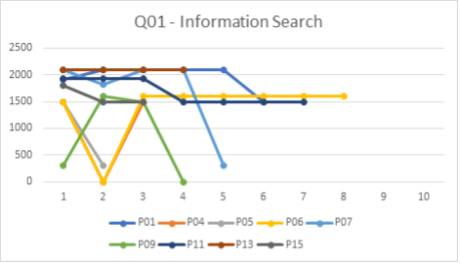
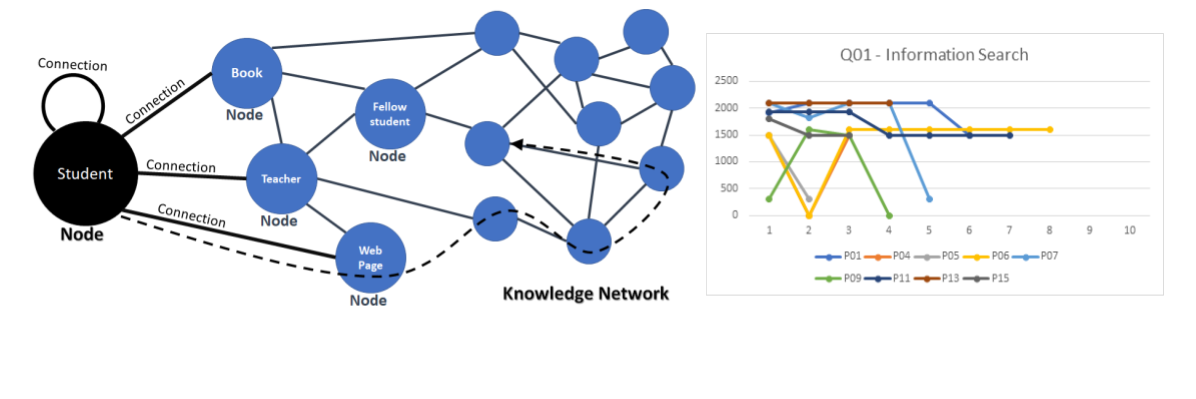
The article is part of a big project to investigate connectivism, an emergent learning theory for digital age. In this article, we tracked the pattern of learning activities of nine participants, each received 10 tasks. The pattern of similarities and differences across participants and across tasks were analyzed using a newly proposed analysis method: Visual inspection of sequential data.
Aldahdouh, A. A. (2018). Jumping from one resource to another: how do students navigate learning networks? International Journal of Educational Technology in Higher Education. https://doi.org/10.1186/s41239-018-0126-x
Aldahdouh, A. A. (2018). Visual Inspection of Sequential Data: A Research Instrument for Qualitative Data Analysis. The Qualitative Report, 23(1631–1649). Retrieved from https://nsuworks.nova.edu/tqr/vol23/iss7/10
Aldahdouh, A. A. (2017). Does Artificial Neural Network support Connectivism’s assumptions? International Journal of Instructional Technology and Distance Learning, 14(3), 3–26. Retrieved from https://papers.ssrn.com/sol3/papers.cfm?abstract_id=3063496
Aldahdouh, A. A., & Osório, A. J. (2016). Planning to Design MOOC? Think First! The Online Journal of Distance Education and E-Learning, 4(2), 47–57. Retrieved from https://www.tojdel.net/journals/tojdel/articles/v04i02/v04i02-06.pdf
Aldahdouh, A. A., Osório, A. J., & Caires, S. (2015). Understanding knowledge network, learning and connectivism. International Journal of Instructional Technology and Distance Learning, 12(10), 3–21. Retrieved from https://papers.ssrn.com/sol3/papers.cfm?abstract_id=3063495