
Chapter 11: Values & Skills
Chapter 11: Values & Skills
Another purpose of this book is to help you start thinking about your academic and career goals now. The next two chapters will cover the process of preparing to choose your major and career, so in preparation this section engages you in the process of reflection and self-assessment to begin aligning your values and skills to your future major and career.
The journey of achieving success in college begins with a single step: identifying your personal values. Your personal values are your core beliefs and guiding principles. They shape the roles you play in daily life. They color your interests and passions and frame your thoughts and words. In essence, your values are a compass that helps you make decisions and choices.
Identifying your own values helps you plan for:
- Your academic goals
- Your career goals
- Your financial goals
- How you spend and manage your time
- How you spend and manage your money
Values are the things that you believe are fundamentally important in the way you live and work. They shape how you interact with others. They determine your priorities (whether you’re conscious about it or not), and they shape the choices you make. They are the measures by which you judge yourself and they’re also the measures by which you judge others.
Identifying your values and reevaluating them periodically is critical to maintaining self-awareness. This process can be also be extremely useful when thinking about your college major and career.
Simply put, values “determine the way that you think and behave. They show you what is alive in you and give you a sense of direction. They relate to something we hold dear, find relevant, or consider important” (Formica, 2018, p. 78). Examples of values are honesty, transparency, and responsibility.
It is important for you to know your values, because they can have a profound impact on both your personal life and career.
To identify your values, reflect on some of the following questions:
- When was a time that you felt happiest?
- When have you felt proud about yourself?
- When do you feel fulfilled?
- What do people say your best qualities are?
- When do people ask you for help?
When your actions are consistent with your values, you feel peaceful with the choices you make even if the outcome of those choices is not positive. When some action or decision is not aligned with your values, you feel conflicted and remorseful.
You can assess your core values by checking to see if it meets these three criteria:
- It has been freely chosen from amongst alternatives after consideration and thought.
- It is prized, cherished and considered precious and is publicly affirmed when appropriate.
- It is acted upon consistently, modeled for others, and pursued even when there are consequences for doing so.
As you ask yourself these questions, make a list of recurring themes and/or topics. The words that describe these themes are most likely your key values
These might seem like rhetorical or obvious questions, but in fact, it is quite important to understand the power and importance of core values. They are your foundation as a person, guiding your actions and your decisions. The stronger the foundation the better and greater the person you will be able to become.
What are your values, then? Which are most important to you, and which are least important? How do your values fit into your educational goals? How do your educational goals relate to your future career? Are you spending your time in a way that prioritizes your goals? Does your budget reflect your goals?
Few words are as widely misunderstood as skill. Defining this word carefully can have an immediate and positive impact on your career planning.
One dictionary defines skill as “the ability to do something well, usually gained by training or experience.” Some skills—such as the ability to repair fiber-optic cables or do brain surgery—are acquired through formal schooling, on-the-job training, or both. These abilities are called work content skills. People with such skills have mastered a specialized body of knowledge needed to do a specific kind of work.
However, there is another category of skills that we develop through experiences both inside and outside the classroom. These are transferable skills. Transferable skills are abilities that help people thrive in any job—no matter what work-content skills they have. You start developing these skills even before you take your first job.
When you think of college, picking a “major” probably comes to mind. Traditionally, choosing your academic major (e.g., psychology, biology, etc.) was the biggest choice you needed to make during your first year. Now, however, it is important to focus on developing a wide variety of skills along with your major. The skills are usually divided into two categories hard skills and soft skills.
- Hard skills are skills that you need to perform a specific task and are typically technical in nature. Your proficiency in these skills is more easily measured. These skills include data analysis, computer programming, using specific computer programs, or speaking a foreign language.
- Soft skills are often referred to as “people skills” and are more emotional and relational in nature. These skills are often difficult to measure.
- Examples of soft skills are: communication, leadership, teamwork, and empathy. These skills are transferable skills, as they are important across all disciplines and in any career that you may have.
Transferable skills are often invisible to us. The problem begins when we assume that a given skill can be used in only one context, such as being in school or working at a particular job. Thinking in this way places an artificial limit on our possibilities.
Think about the things you routinely do to succeed in school. Analyze your activities to isolate specific skills. Then, brainstorm a list of jobs where you could use the same skills.
Consider the task of writing a research paper. This calls for the following skills:
- Planning, including setting goals for completing your outline, first draft, second draft, and final draft
- Managing time to meet your writing goals
- Interviewing people who know a lot about the topic of your paper
- Researching using the Internet and campus library to discover key facts and ideas to
- include in your paper
- Writing to present those facts and ideas in an original way
- Editing your drafts for clarity and correctness
Now, consider the kinds of jobs that draw on these skills. For example, you could transfer your skill at writing papers to a possible career in journalism, technical writing, or advertising copywriting. You could use your editing skills to work in the field of publishing as a magazine or book editor.
When meeting with an academic advisor, you may be tempted to say, “I’ve just been taking general education and liberal arts courses. I don’t have any marketable skills.” Think again. Interviewing and researching skills could help you enter the field of market research. The abilities to plan, manage time, and meet deadlines will help you succeed in all of the jobs mentioned so far.
Use the same kind of analysis to think about transferring skills from one job to another. Say that you work part-time as an administrative assistant at a computer dealer that sells a variety of hardware and software. You take phone calls from potential customers, help current customers solve problems using their computers, and attend meetings where your coworkers plan ways to market new products. You are developing skills at selling, serving customers, and working on teams. These skills could help you land a job as a sales representative for a computer manufacturer or software developer.
The basic idea is to take a cue from the word transferable. Almost any skill you use to succeed in one situation can transfer to success in another situation.
The concept of transferable skills creates a powerful link between higher education and the work world. Skills are the core elements of any job. While taking any course, list the specific skills you are developing and how you can transfer them to the work world. Almost everything you do in school can be applied to your career—if you consistently pursue this line of thought.
You might want to do some additional research on the types of skills important as you develop your career path, and ask yourself:
- What skills are important in my specific career path?
- Which skills do I already possess?
- Which skills do I need to continue to develop?
There are hundreds of transferable skills, but several organizations have distilled some of the most important ones that employers most desire in their new hires. The National Association of Colleges and Employers (NACE, 2017), through research, has identified seven key competencies for career readiness.
- Critical Thinking/Problem Solving: Exercise sound reasoning to analyze issues, make decisions, and overcome problems. The individual is able to obtain, interpret, and use knowledge, facts, and data in this process, and may demonstrate originality and inventiveness.
- Oral/Written Communications: Articulate thoughts and ideas clearly and effectively in written and oral forms to persons inside and outside of the organization. The individual has public speaking skills; is able to express ideas to others; and can write/edit memos, letters, and complex technical reports clearly and effectively.
- Teamwork/Collaboration: Build collaborative relationships with colleagues and customers representing diverse cultures, races, ages, genders, religions, lifestyles, and viewpoints. The individual is able to work within a team structure and can negotiate and manage conflict.
- Digital Technology: Leverage existing digital technologies ethically and efficiently to solve problems, complete tasks, and accomplish goals. The individual demonstrates effective adaptability to new and emerging technologies.
- Leadership: Leverage the strengths of others to achieve common goals and use interpersonal skills to coach and develop others. The individual is able to assess and manage his/her emotions and those of others; use empathetic skills to guide and motivate; and organize, prioritize, and delegate work.
- Professionalism/Work Ethic: Demonstrate personal accountability and effective work habits, for example: punctuality, working productively with others, time workload management, and understand the impact of nonverbal communication on professional work image. The individual demonstrates integrity and ethical behavior, acts responsibly with the interests of the larger community in mind, and is able to learn from his/her mistakes.
- Career Management: Identify and articulate one’s skills, strengths, knowledge, and experiences relevant to the position desired and career goals and identify areas necessary for professional growth. The individual is able to navigate and explore job options, understands and can take the steps necessary to pursue opportunities, and understands how to self-advocate for opportunities in the workplace.
- Global/Intercultural Fluency: Value, respect, and learn from diverse cultures, races, ages, genders, sexual orientations, and religions. The individual demonstrates openness, inclusiveness, sensitivity, and the ability to interact respectfully with all people and understand individuals’ differences.
Career readiness for the new college graduate: A definition and competencies. National Association of Colleges and Employers. (2017). Retrieved from: https://tinyurl.com/jau2ces
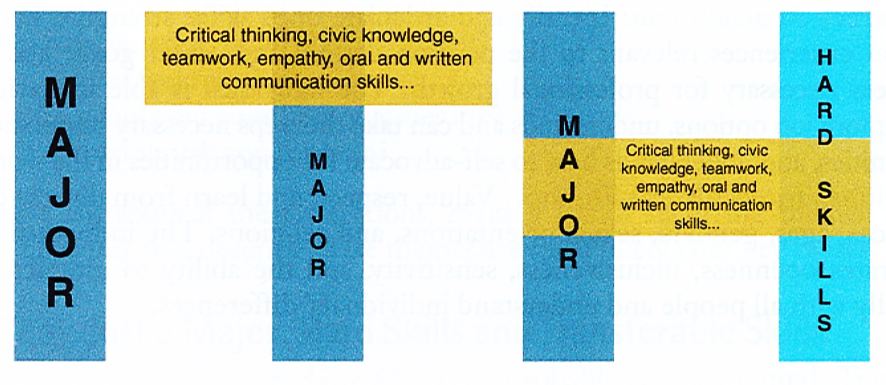
When thinking about preparedness for a career, there are three “shapes” of individuals: the “I” shape, the “T” shape, and the “H” shape. The “I”-shaped graduate will have a lot of deep knowledge about their major, but is not “well-rounded” with other important skills. The “T”-shaped graduate has a lot of deep knowledge about their major, but also has developed competence in a broad set of “soft skills,” like the above career-ready competencies. The “H”-shaped graduate has all of the characteristics of the “T”-shaped graduate, in addition to competence in one or more “hard skills” (e.g., coding, data analysis, etc.).
As a future college student, you should aim to become a “H”-shaped graduate. You can achieve broad competence in many transferable skills through completing internships, participating in leadership or other campus events, and volunteering. You can achieve “hard skills” through certifications or additional coursework.
To assure your success in college, it is important to choose the major that is best for you. If you choose a major and career that match your personality, interests, aptitudes, and values, you will enjoy your studies and excel in your work. It was Picasso who said that you know you enjoy your work when you do not notice the time passing by. If you can become interested in your work and studies, you are on your way to developing passion and joy in your life. If you can get up each morning and enjoy the work that you do (at least on most days), you will surely have one of the keys to happiness
UNDERSTANDING PERSONALITY TYPES
Just as no two fingerprints or snowflakes are exactly alike, each person is a different and unique individual. Even with this uniqueness, however, we can make some general statements about personality. When we make generalizations, we are talking about averages. These averages can provide useful information about ourselves and other people, but it is important to remember that no individual is exactly described by the average. As you read through the following descriptions of personality types, keep in mind that we are talking about generalizations or beginning points for discussion and thoughtful analysis. As you learn about your personality type personality tests you may have taken and the information in this text, focus on your personal strengths and talents.
Building on these personal strengths has several important benefits. It increases self-esteem and self-confidence, which contribute to your success and enjoyment of life. Building on your strengths provides the energy and motivation required to put in the effort needed to accomplish any worthwhile task. Personality assessments also identify some of your possible weaknesses or “blind spots.” Just be aware of these blind spots so that they do not interfere with your success. Being aware of your blind spots can even be used to your advantage. For example, some personality types thrive by working with people. A career that involves much public contact is a good match for this personality type, whereas choosing a career where public contact is limited can lead to job dissatisfaction. Knowing about your personality type can help you make the right decisions to maximize your potential.
Personality type has four dimensions:
- Extraversion or Introversion
- Sensing or Intuition
- Thinking or Feeling
- Judging or Perceiving
These dimensions of personality will be defined and examined in more depth in the sections that follow.
Extraversion or Introversion
The dimension of extraversion or introversion defines how we interact with the world and how our energy flows. In the general school population, 75 percent of students are usually extraverts and 25 percent are introverts.
Extraverts (E) focus their energy on the world outside themselves. They enjoy interaction with others and get to know a lot of different people. They enjoy and are usually good at communication. They are energized by social interaction and prefer being active. These types are often described as talkative and social.
Introverts (I) focus their energy on the world inside of themselves. They enjoy spending time alone to think about the world in order to understand it. Introverts prefer more limited social contacts, choosing smaller groups or one-on-one relationships. These types are often described as quiet or reserved.
We all use the introvert and extravert modes while functioning in our daily lives. Whether a person is an extravert or an introvert is a matter of preference, like being left- or right-handed. We can use our nondominant hand, but it is not as comfortable as using our dominant hand. We are usually more skillful in using the dominant hand. For example, introverts can learn to function well in social situations, but later may need some peace and quiet to recharge. On the other hand, social contact energizes the extravert.
One personality type is not better than the other: it is just different. Being an extravert is not better than being an introvert. Each type has unique gifts and talents that can be used in different occupations. An extravert might enjoy working in an occupation with lots of public contact, such as being a receptionist or handling public relations. An introvert might enjoy being an accountant or writer. However, as with all of the personality dimensions, a person may have traits of both types.
Sensing or Intuitive
The dimension of sensing or intuition describes how we take in information. In the general school population, 70 percent of students are usually sensing types and 30 percent are intuitive types.
Sensing (S) persons prefer to use the senses to take in information (what they see, hear, taste, touch, smell). They focus on “what is” and trust information that is concrete and observable. They learn through experience.
Intuitive (N) persons rely on instincts and focus on “what could be.” While we all use our five senses to perceive the world, intuitive people are interested in relationships, possibilities, meanings, and implications. They value inspiration and trust their “sixth sense” or hunches. (Intuitive is designated as N so it is not confused with I for Introvert.)
We all use both of these modes in our daily lives, but we usually have a preference for one mode or the other. Again, there is no best preference. Each type has special skills that can be applied to the job market. For example, you would probably want your tax preparer to be a sensing type who focuses on concrete information and fills out your tax form correctly. An inventor or artist would probably be an intuitive type.
Feeling or Thinking
The dimension of thinking or feeling defines how we prefer to make decisions.
Thinking (T) individuals make decisions based on logic. They are objective and analytical. They look at all the evidence and reach an impersonal conclusion. They are concerned with what they think is right. T individuals highly value truth and facts.
Feeling (F) individuals makes decisions based on what is important to them and matches their personal values. They are concerned about what they feel is right. F individuals are people-oriented (whether they are E or I types) because they consider the thoughts and feelings of other people in their own-decision making.
We all use logic and we all have feelings and emotions that play a part in our decision making. However, in a general sense, the thinking person prefers to make decisions based on logic, and the feeling person prefers to make decisions according to values.
This distinction is perhaps most clearly visible in an argument. The T type will be concerned with facts, sequences of events, evidence, past events, and finding the truth. The F type will be more concerned with emotions (their own and others’), reaching a compromise, harmony, and understanding others’ motivations.
Both perspectives are equally useful in a debate. The T types can effectively figure out a solution to a problem and F types can figure out how to get others to buy into the solution.
Judging or Perceptive
The dimension of judging or perceiving refers to how we deal with the external world. In other words, do we prefer the world to be structured or unstructured? In the general school population, the percentage of each of these types is approximately equal.
Judging (J) types like to live in a structured, orderly, and planned way. They are happy when their lives are structured and matters are settled. They like to have control over their lives. Judging does not mean to judge others. Think of this type as being orderly and organized.
Perceptive (P) types like to live in a spontaneous and flexible way. They are happy when their lives are open to possibilities. They try to understand life rather than control it. Think of this type as spontaneous and flexible.
Since these types have very opposite ways of looking at the world, there is a great deal of potential for conflict between them unless there is an appreciation for the gifts and talents of both. In any situation, we can benefit from people who represent these very different points of view. For example, in a business situation, the judging type would be good at managing the money, while the perceptive type would be good at helping the business to adapt to a changing marketplace. It is good to be open to all possibilities and to be flexible, as well as to have some structure and organization.
PERSONALITY & PREFERRED WORK ENVIRONMENT
Knowing your personality type will help you to understand your preferred work environment and provide some insights into selecting the major and career that you would enjoy. Selecting the work environment that matches your personal preferences helps you to be energized on the job and to minimize stress. Understanding other types will help you to work effectively with co-workers. As you read this section, think about your ideal work environment and how others are different.
Extraverts are career generalists who use their skills in a variety of ways. They like variety and action in a work environment that provides the opportunity for social interaction. Extraverts communicate well and meet people easily. They like to talk while working and are interested in other people and what they are doing. They enjoy variety on the job and like to perform their work in different settings. They learn new tasks by talking with others and trying out new ideas. Extraverts are energized by working as part of a team, leading others in achieving goals, and having opportunities to communicate with others.
Introverts are career specialists who develop in-depth skills. The introvert likes quiet for concentration and likes to focus on a work task until it is completed. They need time to think before taking action. This type often chooses to work alone or with one other person and prefers written communication such as emails to oral communication or presentations. They learn new tasks by reading and reflecting and using mental practice. Introverts are energized when they can work in a quiet environment with few interruptions. They are stressed when they have to work in a noisy environment and do not have time alone to concentrate on a project.
The sensing type is realistic and practical and likes to develop standard ways of doing the job and following a routine. They are observant and interested in facts and finding the truth. They keep accurate track of details, make lists, and are good at doing precise work. This type learns from personal experience and the experience of others. They use their experience to move up the job ladder. Sensing types are energized when they are doing practical work with tangible outcomes where they are required to organize facts and details, use common sense, and focus on one project at a time. They are stressed when they have to deal with frequent or unexpected change.
The intuitive type likes to work on challenging and complex problems where they can follow their inspirations to find creative solutions. They like change and finding new ways of doing work. This type focuses on the whole picture rather than the details. The intuitive type is an initiator, promoter, and inventor of ideas. They enjoy learning a new skill more than using it. They often change careers to follow their creative inspirations. Intuitive types are energized by working in an environment where they can use creative insight, imagination, originality, and individual initiative. They are stressed when they have to deal with too many details or have little opportunity for creativity.
The thinking type likes to use logical analysis in making decisions. They are objective and rational and treat others fairly. They want logical reasons before accepting any new ideas. They follow policy and are often firm-minded and critical, especially when dealing with illogic in others. They easily learn facts, theories, and principles. They are interested in careers with money, prestige, or influence. Thinking types are energized when they are respected for their expertise and recognized for a job well done. They enjoy working with others who are competent and efficient. They become stressed when they work with people they consider to be illogical, unfair, incompetent, or overly emotional.
The feeling type likes harmony and the support of co-workers. They are personal, enjoy warm relationships, and relate well to most people. Feeling types know their personal values and apply them consistently. They enjoy doing work that provides a service to people and often do work that requires them to understand and analyze their own emotions and those of others. They prefer a friendly work environment and like to learn with others. They enjoy careers in which they can make a contribution to humanity. Feeling types are energized by working in a friendly, congenial, and supportive work environment. They are stressed when there is conflict in the work environment, especially when working with controlling or demanding people.
The judging type likes a work environment that is structured, settled, and organized. They prefer work assignments that are clear and definite. The judging type makes lists and plans to get the job done on time. They make quick decisions and like to have the work finished. They are good at doing purposeful and exacting work. They prefer to learn only the essentials that are necessary to do the job. This type carefully plans their career path. Judging types are energized by working in a predictable and orderly environment with clear responsibilities and deadlines. They become stressed when the work environment becomes disorganized or unpredictable.
The perceptive type likes to be spontaneous and go with the flow. They are comfortable in handling the unplanned or unexpected in the work environment. They prefer to be flexible in their work and feel restricted by structures and schedules. They are good at handling work which requires change and adaptation. They are tolerant and have a “live and let live” attitude toward others. Decisions are often postponed because this type wants to know all there is to know and explore all the options before making a decision. This type is often a career changer who takes advantage of new job openings and opportunities for change. Perceptive types are energized when the work environment is flexible and they can relax and control their own time. They are stressed when they have to meet deadlines or work under excessive rules and regulations.
SOURCES
- “Discover Your Values & Goals” from Effective Learning Strategies at Austin Community College. Authored by Laura Lucas & Heather Syrett. Provided by: Austin Community College. Available at: https://www.oercommons.org/courseware/8434. License: Creative Commons Attribution-NonCommercial-ShareAlike 4.0 License, available at: https://creativecommons.org/licenses/by-nc-sa/4.0/
- Florida International University (2018). “Identifying Your Values and Skills.” In Strategies for Success (pp. 181-188). Dubuque, IA: Kendall Hunt. Rearranged and added original content.
- Fralick, M. (2016). Exploring Your Personality and Major. In College and Career Success (7th ed., pp. 38-51). Dubuque, IA: Kendall Hunt. Rearranged and added original content.
- OpenNow College Success. Authored by Cengage Learning. Provided by: CEngage. Available at: https://oercommons.s3.amazonaws.com/media/editor/179572/CengageOpenNow_CollegeSuccessNarrative.pdf License: Creative Commons Attribution 4.0 International License, available at: http://creativecommons.org/licenses/by/4.0/.