
US History to 1877
US History to 1877
History in the Making: U.S. History to 1877
Common Course ID: HIST 130
Georgia State College Instructor Open Textbook Adoption Portrait
Abstract: This open textbook is being utilized in a U.S. History course for undergraduate students by Sarah Mergel, Ph.D. at Dalton State College in Georgia. The open textbook produced by University Press of North Georgia provides a strong emphasis on critical thinking about U.S. History utilizing learning objectives, reflection opportunities, and critical thinking exercises in each chapter. The information and organization of the text worked well with this history survey course and students have access to a free version of the textbook if desired. The motivation for using the textbook was that instructor is a co-author and wants to make a free boo available for her students. Most students are using the free digital version.
Reviews: The book has been reviewed by a CCC, CSU, and UC faculty member from within the California higher education system. There is also an Accessibility Evaluation.
About the Textbook
History in the 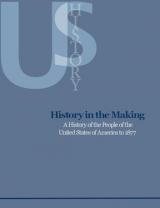 Making: A History of the People of the United States to 1877
Description:
This open textbook, produced by the University Press of North Georgia (UPNG) and now distributed by Nighthawks Open Institutional Repository, examines U.S. History from before European contact through reconstruction, while focusing on the people and their history. This book provides a strong emphasis on critical thinking about US History by providing several key features in each chapter. Learning Objectives at the beginning of each chapter help students to understand what they will learn in each chapter. "Before You Move On" sections at the end of each main section are designed to encourage students to reflect on important concepts and test their knowledge as they read. In addition, each chapter includes Critical Thinking Exercises that ask the student to deeply explore chapter content, Key Terms, and a Chronology of events.
Authors:
- Catherine Locks, M.A., M.Ed., Fort Valley State University
- Sarah K. Mergel, Ph.D., Dalton State College, Georgia
- Pamela Thomas Roseman, Ph.D., Georgia Perimeter College
- Tamara Spike, Ph.D., University of North Georgia
Formats:
Book can be read as PDF or Word document. Can also purchase print copy for $35.
Peer Reviews:
The book has been reviewed by a CCC, CSU, and UC faculty member from within the California higher education system. There is also an Accessibility Evaluation.
Cost Savings:
Students can experience significant savings depending on previous textbook selections. So far, the book is saving my DSC students at least $22 if they were to buy a new printed version in the campus bookstore. In the past three semesters, however, I have not seen many students with the print version of the book. Most students are using the free digital version, so they are saving $57 which was the cost of the previous book.
Accessibility and Diversity:
The full-text PDF version has been evaluated and edited for 508 compliance.The authors of the text attempted to write an inclusive narrative of American history that incorporates the historical experiences of people from diverse backgrounds.
License:
Except where otherwise noted, History in the Making: A History of the People of the United States to 1877 is licensed under a Creative Commons Attribution- ShareAlike 3.0 Unported License. This license lets others remix, tweak, and build upon the work even for commercial use, as long as they credit the author and license their new creations under the identical terms.
About the Textbook
History 2111: U.S. History  to 1877 (Survey 1)
Description:
Surveys the history of colonial America and the United States from the first European encounters with the new world through the Civil War and reconstruction.
Prerequisite: Basic skills reading READ 098 unless exempt.
GE Credit: 3 units, degree applicable
Learning Outcomes:
- Students will articulate an understanding of major forces and events, influences, or ideas that have shaped history and society.
- Students will demonstrate the ability to articulate and analyze perspectives and values of diverse cultural groups and their historical experiences in the United States.
- Students will demonstrate an understanding of the political, social, cultural, economic, diplomatic, or military dimensions of American history emerging before 1877 that shaped and are shaping the nation today.
Curricular Changes:
I use the text in traditional, blended, and online classes at Dalton State College (DSC). Each unit has one or two discussions for which I have developed a grading rubric. Some of these discussions become in-class activities for the traditional class. In all versions, students have access to online self-assessment questions and quizzes.
Teaching and Learning Impact:
Collaborate more with other faculty: Yes, online faculty
Use wider range of teaching material: Yes
Student learning improved: Yes with course redesign
Student retention improved: Not measured
Any unexpected results: Plagiarism issues
Any collaboration I have with other faculty doesn’t really happen at Dalton State as much as it does when I talk about the survey course with other eCore faculty in the state of Georgia.
I did discover an unforeseen complication in my online and hybrid courses. Students began to cut and paste from the digital book into short answer questions on quizzes and into papers. In these instances, students failed to properly quote or cite their sources. I quickly realized that I needed to be more diligent in explaining plagiarism and citation to students early in the semester in multiple ways for my students.
Sample Assignment and Syllabus:
Letter to the Editor Writing Assignment
Explore the differences between the nation’s first political parties, the Federalists and the Republicans, by writing a letter to the editor to support one of these parties’ positions.
Grading Rubric
Criteria for grading students' participation in online and hybrid course discussions.
Textbook Adoption
OER Adoption Process
As a co-author on this text, I had a hand in outlining the chapters and organizing the content. Therefore, I knew the information in the book worked well with what I tend to focus on in the survey course. Moreover, my students have access to a full textbook either for free, if they use the digital version, or for less money than they would pay for a concise textbook.
The college bookstore uses the designation, Coursepack, Not Available Here, for OERs. When students go to buy books, the staff tells them to contact the professor. To avoid confusion, about two weeks before the semester, I email all registered students with detailed information about how they will access History in the Making for the course.
Student Access:
Students have three options to access the text.
- Each chapter is loaded into the course management system under the appropriate lesson.
- Students can download individual chapters (in PDF) or the full text (in PDF or ePub) from the University Press Northern Georgia (UPNG) site. Since the book has no index, I recommend students use this option because then they can search the downloaded versions for specific terms.
- Students can purchase a print-on-demand copy of the book through the UPNG site for $35.
Student Feedback or Participation:
In a survey of students in my summer courses, most respondents had not used a digital textbook before. However, the consensus was they liked having access to a free book and they found the format convenient. Some of the comments included:
- I like the textbook and the fact that it is free is awesome!
- Provides loads of useful information.
- Having a low-cost alternative is huge for someone like me who does not have $100 or more for a textbook.
- It is a great textbook, and I was happy to know it was free!
UPDATE: Student feedback, for the most part, continues to be positive for the textbook as far as what I observe in student course/instructor evaluations. I don’t see a lot of students purchasing the print copy. although a few do. Some students disagree with the content (or the interpretation), which in their mind makes me biased. But I see that in one maybe two evaluations per semester. I have started explaining to my students at Dalton State and in my eCore class that what they read in this book would be similar to any other US history they might purchase. I also created a "how to" video for my students in terms of working with a digital textbook, showing them how to download the book from the LMS to their computer and using Adobe Acrobat or Reader to annotate, comment on, and find terms
 Sarah Mergel, Ph.D.
I am an Associate Professor of History at Dalton College in Georgia. I have taught United States History to 1877, United States History since 1877, Historical Methods, American Foreign Policy, Gilded Age/Progressive Era, America From WWI to WWII, Cold War America, and Research Seminar in American History.
History should be about more than just facts; it should be about evaluating and understanding the decisions and events that have shaped our world. I help students to gain a greater curiosity about the past as well as develop the ability to think critically outside of the classroom. Furthermore, I want to challenge preconceived notions about history by showing students how knowledge about the past is not static. Understanding the shifting perceptions of what has gone before is an important component to understanding the relevance of history to modern life.