
Home
Introductory Statistics
Common Course ID: MATH 110
University of Minnesota Instructor Open Textbook Adoption Portrait
Abstract: This open textbook is being utilized in undergraduate statistics courses for non-math based majors by Irene Duranczyk, Ed.D. at the University of Minnesota. The open textbook focuses on the application of statistical knowledge rather than the theory behind it. The motivation for adoption was to save students money, to be sure that every student had access to a text for the whole semester that supported their learning and that the mathematical topics were in the order preferred for maximizing teaching/learning. The majority of students (80%) used one of the free online formats including access from our institution's Moodle site.
Reviews: The book has been reviewed by a CCC faculty member,a CSU faculty member and a UC faculty from within the California higher education system. There is also an Accessibility Evaluation.
About the Textbook
Description: 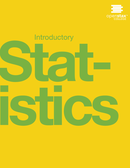
This introductory one-semester textbook is geared towards students who are not majoring in math and science and focuses on the applications of statistical knowledge rather than the theory behind it. The foundation of this textbook is Collaborative Statistics, by Barbara Illowsky and Susan Dean, which has been widely adopted. This new version has enhancements in artwork, terminology, and practical applications to enhance the relevance and accessibility for students. The text also includes Collaborative Exercises, integration with TI-83, 83 , 84 calculators, technology integration problems, and statistics labs.
Irene Duranczyk, Suzanne Loch, and Janet Stottlemyer of the University of Minnesota have created a derivative of the Introductory Statistics text by Barbara Illowsky and Susan Dean to incorporate the use of spreadsheets to explore and display statistical processes. The three authors reorganized the introductory chapters to explore univariate descriptive statistics in a chapter and bivariate descriptive statistics in a separate chapter. There were also additional modifications in presenting step by step models for inferential statistics concepts and tests. This new derivative collection is called: Collaborative Statistics Using Spreadsheets.
Authors:
- Susan Dean, De Anza College, California
- Barbara Illowsky, Ph.D., De Anza College, California
Derivative Collection Editors and Authors:·
- Irene Duranczyk, Associate Professor, University of Minnesota
- Suzanne Loch, Senior Teaching Specialists, University of Minnesota
- Janet Stottlemyer, Senior Teaching Specialist, University of Minnesota
Formats:
The book is available online, as a PDF, or Bookshare. One can also purchase a print copy for $33.50.
Supplemental Resources:
Online homework tools and interactive study guides for students and faculty are provided. Faculty-only resources such as solutions and slides are also available.
Peer Reviews:
The book has been reviewed by a CCC faculty member,a CSU faculty member and a UC faculty from within the California higher education system. There is also an Accessibility Evaluation.
Cost Savings:
Students can experience significant savings depending on previous textbook selections. 20% of my students purchased the hardcopy of the open textbook at $36.00 per copy. The other 80% used a free online version. With 300 students per year using the Collaborative Statistics Using Spreadsheets open textbook over the $180 traditional publisher textbook, the potential annual savings for students savings is $51,840.
Accessibility and Diversity Statement from Publisher:
Not all formats of the textbook have been evaluated for accessibility, but the most recent version of this open textbook is available in a Bookshare format which support Daisy and Braille-Ready-Format (BRF).
License:
Except where otherwise noted, Introductory Statistics by OpenStax College is licensed under a Creative Commons Attribution 3.0 Unported License. This license lets others distribute, remix, tweak, and build upon the work, even commercially, as long as they credit the author for the original creation. This is the most accommodating of licenses offered. Recommended for maximum dissemination and use of licensed materials.
About the Course
PSTL 1004  Statistics: Understanding and Applying Data
Description: This project-based course is an introduction to statistics that emphasizes problem solving and decision making through the collection, analysis, and interpretation of data. Course topics include the organization and presentation of data, summary statistics, sampling methodology, sampling distributions, probability, estimation, correlation, hypothesis testing, contingency tables, and chi-square analysis. The instructional approach includes the use of small active learning groups, computer statistics software, in-depth projects, writing assignments, demonstrations, and discussion and problem solving based on practical examples.
Students learn how to analyze and interpret quantitative information, use statistical thinking, and communicate using the language of statistics. Students will develop a level of statistical literacy that enables them to critically assess information encountered in the media and other sources. This course will be of particular interest to undergraduate students who want to fulfill the CLE requirement in Mathematical Thinking and know that statistical thinking will complement their field of study.
Prerequisite: Intermediate Algebra
GE credit: 4 units; Degree applicable.
Student Learning Outcomes:
- To recognize statistics as a fundamental liberal education skill giving attention to big ideas and general strategies for dealing with data, variation and chance, emphasizing data and concepts rather than recipes and derivations (American Statistical Association and Mathematical Association of America Joint Curriculum Committee for first courses in Statistics).
- To be good “statistical citizens”–understand statistics well enough to be able to recognize, comprehend, explain, critically evaluate, and make decisions from a variety of data information sources (i.e. media, U.S. Government, private and public researcher or research groups, etc.).
- To recognize, use, and apply the principles and mathematical representations of statistics to contemporary topics and in the study of other academic disciplines
- To recognize the academic and cultural roots of statistics in indigenous societies and in the academy.
- To strengthen intuition through verification with the principles of statistics.
- To integrate verbal, symbolic, functional and spatial concepts used in statistics.
- To connect classroom learning experiences with cultural, social, and real-world applications.
- To be prepared to successfully study and work in groups and independently.
- To be able to demonstrate knowledge of statistics through the construction of meaningful applications and explorations.
Teaching and Learning Impact:
- Collaborate more with other faculty: Yes, we worked as a team to create the textbook that meet our needs as faculty and presented material to enhance student learning of concepts and technology.
- Wider range of teaching materials: Developed support materials for using spreadsheets to display and explore statistics and step by step decision-making models for performing inferential test
- Student learning improved: To date there has been no statistical difference in the learning outcomes for students using the open educational resource (OER) and students who used the traditional text (Data from Fall 2012).
- Student retention improved: To date, there has been no statistical difference in student retention before or after the adoption of the OER text (Data from Fall 2012).
Sample Assignment and Syllabus:
Sample Assignment
This is a semester-long project that I use for the class.
Syllabus
This is the syllabus I use for my class.
Textbook Adoption
OER Adoption Process
As a team, we took on the challenge of adapting the Collaborative Statistics text to meet our preferred order of topics, rearranged some groupings of topics, and added the technology support that we felt students needed for an exceptional experience. We had no difficulty with the bookstore or any other unit in the university. We did, however, feel that the ease or lack of ease in changing figures, tables, mathematical equations and expressions was exasperating at times. An easier way to edit mathematics without recalling all our programming skills would be appreciated, as the editing was cumbersome. Some modification to the legacy cnx site is necessary for greater ease in creating and supporting derivatives.
Student Access:
We teach in a computer lab. We had quick links to the epub, pdf, and the course management site, Moodle. Students were encouraged to choose the format that best suited their learning preference including the printed copy.
Student Feedback or Participation:
Answers to "If there is one thing that I liked best about using Collaborative Statistics, learning materials instead of a traditional textbook" include:
- I could access it anywhere, from anything. Also, it was free.
- If I needed the textbook on the dime, I could access it via the internet. It was convenient.
- The mobility and compact size it had.
- I could easily find whatever tab I was looking for. The practice examples were very helpful too, and I could search the text easily. It was also free.
- Well explained examples.
- I didn't have to carry a textbook around every time I needed it. I could find it online and print out select pages.
- I was able to search and flip through pages easily.
- The summary page after each chapter to give a brief review on what the chapter was about.
- I liked how there were instructions within the text book for using excel and the examples provided a nice framework to work through problems.
- Copy and paste was very easy.
Irene Duranczyk, Ed.D
I teach undergraduate, liberal education math literacy courses (statistics, logic, developmental mathematics courses), masters in education: multicultural college teaching and learning courses (Increasing access and success in undergraduate classrooms, multicultural teaching and learning in diverse postsecondary contexts).
I want students to see how mathematics is a framework that is used to promote particular visions of societal policies and practices. I envision my work advancing the work of Moses, D’Ambrosio, Banks, and Vygotsky at the college level by linking a developmental approach to learning mathematics within its social and cultural context and meaning.
Professor Duranczyk is the recipient of the 2013 Multicultural Recognition Faculty Award, College of Education & Human Development at University of Minnesota.