
Fundamentals of Speech Communication
Fundamentals of Speech Communication
Stand Up, Speak Out: The Practice and Ethics of Public Speaking
Common Course ID: COMM 110
CSU Instructor Open Textbook Adoption Portrait
Abstract: This open textbook is being utilized in a communication course for undergraduate students by Armeda C. Reitzel, Ph.D., at Humboldt State University. The open textbook provides a general foundation in the principles and practices of public speaking and includes multiple examples and samples to support student learning. The main motivations to adopt an open textbook were ease of accessibility and cost. Since my course is 100% online, it made sense to use a textbook that could be accessed online. Most students access this open textbook online.
Reviews: The book has been reviewed by a faculty member from CCC, one from CSU and one from UC of the California higher education systems. There are also two Accessibility Evaluations (ACC1 and ACC2).
About the Textbook
Stand Up,Speak Out: 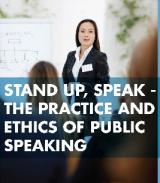 The Practice and Ethics of Public Speaking
Description:
This open textbook delivers a general foundation for the basic principles and practices of public speaking that are typically covered in most general education public speaking courses. The first two lines of the book's preface provide the context for the need to teach public speaking today:
"Public speaking in the twenty-first century is an art and a science that has developed over millennia. In a world that is bombarded by information, the skill set of public speaking is more important today than ever."
From the very first chapter "Why Public Speaking Matters Today" to a well-written chapter on "Ethics Matter: Understanding the Ethics of Public Speaking" to traditional chapters addressing communication apprehension, listening, audience analysis, topic selection, researching, constructing and supporting arguments, organizing and outlining the speech, delivering the speech and using presentational aids when speaking to inform, to persuade and to entertain, this textbook provides a step-by-step approach to the speech-making process. Examples of speeches, chapter exercises, and quiz questions give students and instructors tangible ways to connect with the textbook material.
The authors end the preface with the statement:
"We believe this book will be both intellectually stimulating and realistically applicable."
I agree. I think that this book does both and does both well.
Authors:
- Jason Wrench - State University of New York at New Paltz
- Anne Goding - State University of New York at New Paltz
- Danette Johnson - Ithaca College
- Bernardo Attias - California State University Northridge
Formats:
The free, open textbook version is available free online and in PDF and Word format.
Peer reviews:
The book has been reviewed by a faculty member from CCC, one from CSU and one from UC of the California higher education systems. There are also two Accessibility Evaluations (ACC1 and ACC2)
Cost savings:
Since many of my students are dependent on financial aid and/or part-time jobs, the cost savings is substantial and beneficial to them. I used to use The Speaker: The Tradition and Practice of Public Speaking by Joseph M. Valenzano III and Stephen W. Braden, which retails for $124 on Amazon. Given that I teach this class to 50 students each year, this is potential annual savings for students of $6,200.
Accessibility and diversity statement:
My instructional designer, Kim Vincent-Layton, assisted me by sharing a fully accessible version of the PDF version of the textbook that she created using Adobe Pro. It is also offered in (DAISY) and Braille-Ready-Format(BRF) formats.
License:
The textbook Stand Up, Speak Out: The Practice and Ethics of Public Speaking is licensed under a Creative Commons Attribution-NonCommercial-ShareAlike 3.0 Unported License without attribution as requested by the work's original creator or licensor. This means that you are free to copy and redistribute the material in any medium or format and remix, transform, and build upon the materials. If you remix, transform, or build upon the material, you must distribute your contributions under the same license as the original. You may not use the material for commercial purposes.
About the Course
COMM 100:  Fundamentals of Speech Communication
Description:
Introductory course. Develop oral communication for functioning effectively in various settings. Fundamental communication theory.
Prerequisites: None
GE credit: 3 units, General Education, Area A
Learning outcomes:
By the end of this course, students should be able to:
- Demonstrate the discovery, critical evaluation, and reporting of information by designing appropriately organized and credibly supported speech, using techniques to inform and/or persuade an audience
- Deliver a speech using effective verbal and nonverbal skills.
- Deliver a speech using effective verbal and nonverbal skills.critically listen to and analyze oral communication.
- Explain the role that oral communication plays in human societies.
- Explain the human communication process and how it operates in everyday life.
- Identify the different forms of communication.
- Describe how public speaking is similar to and different from other forms of communication.
- Explain the listening process and how to listen effectively and critically to others.
- Describe the importance and impact of language on public communication
- Describe the type, importance and impact of nonverbal communication on public communication.
- Construct appropriately organized and credibly supported speeches, using classical and contemporary rhetorical techniques to inform and/or persuade an audience.
- Conduct relevant research, evaluating digital and print resources and other sources of authority, credibility, relevance, and bias.
- Exercise ethical considerations in the development, support, and presentation of ideas.
- Select verbal and audio/visual/tactile/etc. supporting material according to the needs of the speech subject, their analysis of the audience, and the situation.
- Deliver informative and persuasive speeches using the principles and practices taught in this course.
Curricular changes:
As a result of this open textbook adoption, I have made numerous curricular changes.
I have added in the viewing and reviewing of eight TED Talks chosen for their specific purposes, delivery styles, and the variety of content. I did not have time for this in my face-to-face class. Teaching the course online and using the open textbook as the principal source of content, I can use the TED Talks as samples of authentic speeches that students and I can analyze and discuss in terms of the principles and practices of good public speaking. My TED Talk assignments have been particularly successful.
I now require students to turn in full sentence outlines, annotated bibliographies, and speaking outlines -- based on the "formula" presented in the textbook -- a full six hours before the start of the synchronous session when students deliver their speeches. These documents have been outstanding for the most part. They are so much more thorough and thoughtful than I have ever received before using this textbook as my main source of content. I have generally been unhappy with the chapters on outlining in most textbooks that I used in the past. This open textbook definitely has the most useful and useable chapter on speech outlining that I have seen in my thirty-six years of teaching public speaking. I have recommended Stand Up, Speak Out to my colleagues in my department because of this feature. I know that some of the instructors in the department are now using this textbook as well.
Because the textbook discusses and applies the National Communication Association's Credo for Ethical Communication in chapter 2, section 2, I was inspired to revise my own grading rubric for the informative and persuasive speeches in my course. I redesigned my evaluation forms for speeches (both for the students doing peer reviews and for me doing the instructor's reviews) using the eight competencies for public speaking suggested by the National Communication Association.
I used one VoiceThread assignment in my earlier Communication 100 classes. Now I have an opening VoiceThread (self-introduction) assignment and a closing (final self-evaluation) VoiceThread because I have time for two VoiceThread assignments. I like the idea of "bookending" the course with VoiceThreads.
Teaching and learning impacts:
Collaborate more with other faculty:Yes
Use wider range of teaching materials:Yes
Student learning improved: Yes
Student retention improved:Unsure
Any unexpected results:Yes
The reason why I say "yes" to "collaborate with other faculty" is that because of using this open textbook, I have gotten the best outlines I have ever received in all of my decades of teaching public speaking. I shared this with my lecturers who teach the vast majority of the Comm 100 sections in my department. This led to wonderful discussions about textbooks among us faculty this past spring. I can't remember the last time we had such meaningful discussions among peers about textbooks. (It's been that long!) It is my understanding that some of them may be switching over to this open textbook in their courses. I plan to facilitate an assignment design charrette on the use of this open textbook with a group of my lecturers during the upcoming academic year.
The degree of "student learning improved" was my "unexpected result." In my thirty-six years of teaching public speaking, I have never had so many public speaking students develop and submit such professional-looking full sentence outlines and speaking outlines. The textbook provided step-by-step directions with examples along with complete sample outlines. I, in turn, created my own step-by-step materials to supplement the book's directions. I received written permission from some of my online Communication 100 students to showcase their outlines and annotated bibliographies in my course. These student samples clearly show how students used the textbook and my materials to guide them in constructing solid speech outlines and bibliographies. The quantity of such high-quality work even with the first speech and throughout the course is the "unexpected result" of "student learning improvement."
Sample assignment and syllabus:
Assignment: Requirements for Speech 1 (Informative Speech)
These are the requirements for the informative speech in my online course. I encourage the students to go back to chapter 12 in our open educational resource for guidelines in putting together their outlines.
Eight Public Speaking Competencies and Criteria for Assessment (NCA)
This rubric that I use for evaluating speeches is from the National Communication Association's Eight Public Speaking Competencies and Criteria for Assessment.
Reitzel Summer 2016 Comm 100 Syllabus
This is the syllabus I developed for my summer session 2016 online course that meets for eight weeks. I revised this syllabus based on my experiences and feedback from my fall 2015 and spring 2016 courses that met for sixteen weeks.
Textbook Adoption
OER Adoption Process
There were several reasons I adopted an open textbook.
- I wanted a textbook that was easily accessible to students in an online public speaking course.
- I wanted a textbook that students would actually read and use in the course. Too many of my students are avoiding buying textbooks because they are so expensive. I even had one student from another class that uses a traditional textbook tell me at the end of last semester that he used to go to the bookstore and sit down to read the chapters right before tests!
- I wanted a textbook that I could customize and supplement easily. I could do that with Stand Up, Speak Out.
Supplemental materials:
I included a wide variety of supplemental materials to complement the open textbook.
I used TED Talks throughout the entire semester. I first showed an inspirational TED Talk about the importance of not staying silent during week 1 and shared my own TED Talk evaluation essay of that TED Talk as a sample for my students. Starting with week 2, the students watched a TED Talk during the even-numbered weeks and wrote their own evaluation essays using my directions and sample during the odd-numbered weeks. I chose TED Talks that went along with the readings from the open textbook so that students could apply what they were learning from the readings to their essays.
I created my own resources to expand on points in the textbook and included them on Moodle. For example, I developed my own handout titled "Developing a specific purpose for your informative speech" which complemented material in chapters 6 and 12 in the textbook.
I was fortunate to have students who developed top-notch essays, outlines, bibliographies and VoiceThreads throughout the two offerings of this course that I have taught so far. I asked some of the students if they would give me written permission to share specific pieces of their work with future classes. I have included several examples of students' work from previous semesters in my course. The textbook clearly guided the students and provided the scaffolding needed for their successes.
Student access:
Students can access the textbook online and in PDF and Word format.
Student feedback or participation:
I have received feedback on the open textbook via Check-ins (a feedback module that I include in Moodle) every three weeks. The students take reading quizzes on the textbook each week. The students have found the textbook valuable in learning the steps in constructing and delivering a speech.
For example, students wrote:
- I have found that the quizzes each week have helped me grasp and keep up with the readings. This allows me to test my understanding of the material each week.
- One thing that I have learned during the first three weeks is from communicating through forums and being able to share our ideas with each other. Another thing that I have learned is from reading the textbook and learning about how to put together a general purpose for a speech.
- Before I had read the book I had not even thought about the audience to speaker interaction.
- I am discovering a lot about public speaking. Before this course, I hadn't learned anything about public speaking. The readings have helped a lot, and I enjoyed the week one TED Talk.
- The readings that we have done in week 6, taking you step-by-step through the developing stages of your speech I have found to be incredibly helpful--I feel that I better understand how to organize my speech properly. The tips and tricks to effective speech skills in the reading are also very helpful and make me feel more confident in giving my speech after practicing with them and reviewing my progress to see how and where I go wrong.
- I think the readings this week have developed my knowledge on preparing and giving speeches. I haven't given a speech like this before, and it has helped me with my research and developing speech. I am becoming more prepared to deliver my speech with the tips in the textbook. The readings have also helped me discover the use and importance of an outline in developing and delivering a speech.
- The tips that I learned throughout chapter 15 in the textbook will help me with my speech and future speeches that I will have. I hope to implement quite a few of them when I present my persuasive speech soon.
- From the week 10 quiz and reading chapter 17 I learned quite a bit about the art of persuasion.
During our synchronous Google Hangout sessions, the students and I always discussed the textbook material in reference to the speaking assignment that they were working on. The feedback was always positive about the textbook as a guide, especially chapters 12 (outlining), 16 (informative speaking), and 17 (persuasive speaking).

I am Chair and Full Professor of Communication at Humboldt State University in Arcata, California. I earned my Ph.D. in Communication from Southern Illinois University in Carbondale, Illinois. After earning my Ph.D. I taught public speaking and phonetics at Ball State University in Munice, Indiana for two years before joining the California State University system as a professor at Humboldt State University in 1981. This is my third time chairing the Communication Department. I have also served as chair of Teacher Preparation Multiple Subjects (1993-1995) and chair of Music (2008-2009).
I typically teach courses in public speaking, interpersonal communication, nonverbal communication, American public discourse, intercultural communication and the senior capstone course.
My teaching philosophy:
I want students to discover and develop their knowledge and skills in communication in a fun, supportive, and safe environment in which they can play, take risks, and learn from new and different experiences that help them grow. It is my job, as a professor of Communication, to create a community of learners. I work diligently and tirelessly in building community among my students and feel that I am successful in achieving this goal in each and every one of my classes.
I go by the nickname of "Doc" (as in "What's up, ___?" or "Hickory, Dickory, ____"). All of my students and even most of my colleagues call me Doc. The first thing that I share with my students the first day of class is my teaching philosophy which can be summed up in two sentences: "Doc doesn't want perfect. She wants good." What do I mean by that? I want students to develop their competence and confidence in communication without the stress of going for perfection. I have included a link to my video "Doc's Philosophy" below. This video is part of my "welcome letter" to my online public speaking students. Students often comment on the supportive climate that I set up in my classes. For example, one student wrote the following in her script for the final self-reflection VoiceThread assignment: "The online video calls are not as excruciating as they sound and you will be relieved to know that Doc is very patient and good natured about any stress or anxiety you may have. Doc sets a comfortable atmosphere, so don't worry everything will be fine."
My research interests:
One of my favorite philosophers is Martin Buber. My favorite quotation from Buber is: “All journeys have secret destinations of which the traveler is unaware.” I feel as if this describes my current research interests in my discipline and my teaching. I have a rather eclectic set of interests that I have developed through my three-and-a-half decades of teaching. First, I am very much involved in curriculum review and revision. I was one of thirty Communication scholars chosen by the National Communication Associaton to participate in a multi-year project to develop Learning Outcomes in Communication through a Lumina Foundation Grant. I am now interested in conducting and researching assignment design charrettes. I am involved in developing and reviewing materials for teaching public speaking online. I study visual rhetoric and popular culture. I have authored papers on the rhetoric of fashion, from tie-dye to Crocs and Birkenstocks to neckwear. I am currently the subject area chair for Midwestern Culture in the Midwest Popular Culture Association. My next major project is a study of Access Television Stations and the freedom of speech in the United States.
Comm Website-Armeda Reitzel
A quick glimpse of who Dr. Armeda C. Reitzel is from the Communication Department website.
Doc Reitzel's Teaching Philosophy
This video describes my teaching philosophy. It is part of the welcome letter to my students in my online public speaking course.