
GSP 101/101L Geospatial Concepts
GSP 101/101L Geospatial Concepts
Geospatial Concepts
CSU Instructor Open Textbook Adoption Portrait
Abstract: This textbook was used in an undergraduate geospatial concepts course by Nicolas R. Malloy, M.S., at Humboldt State University This online resource consists of seven lessons that include the history and fundamental concepts common among all the geospatial sciences. The motivation to use this resource was to ensure that all students, including those with disabilities, have equally effective access to quality learning experiences. Students access the course through the link on the syllabus.
About the Textbook
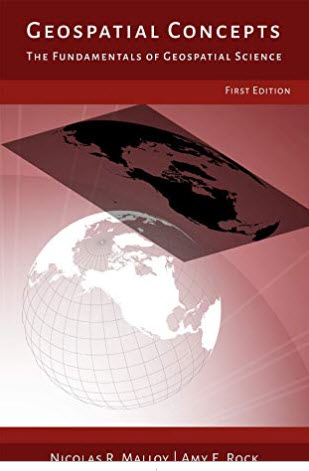
Description:
Geospatial Concepts is a dynamic and evolving textbook provided free for the course of the same name. The first draft is available to anyone with internet access. Because it is offered in such a versatile format, the text communicates through a full range of multimedia content including images, text, and video. The digital format of this textbook also makes it easy to add content and keep the book current and relevant to the geospatial industry.
Author:
- Nicolas Malloy - Humboldt State University
- Amy Rock - Humboldt State University
Formats:
Students access the textbook through a link to the website Geospatial.Institute.
Supplemental resources:
A dedicated YouTube channel accompanies the textbook. There are approximately 30 videos, consisting of different activities.
Peer reviews:
This resource has not yet been reviewed by faculty from within the California higher education system.
Cost savings:
Because this is a new course, there is no comparative textbook. However, a Geographic Information Systems textbook retails for around $130. I teach anywhere from 24 to 96 students each year, which means a potential total annual savings for students of $9,600 to $12,480.
Accessibility and diversity:
There is no information provided on accessibility and diversity.
License:
This book carries a copyright from the Geospatial Institute.
About the Course
GSP 101/GSP 101L:  Geospatial Concepts
Description - GSP 101: Overview: scale, coordinates, geodesy, direction, projections, surveying, global positioning systems (GPS), remote sensing, geographic information systems (GIS), cartography; historical context illustrating how maps depict spatial relationships, chart power, convey authority.
Description - GSP101L: Traditional and computer lab activities to develop understanding of scale, coordinate systems, geodesy, direction, projections, surveying, global positioning systems (GPS), remote sensing, geographic information systems (GIS), cartography.
Geospatial Concepts serves as a gateway course for the remainder of the Geospatial Curriculum, particularly Cartography, Geographic Information Systems, Mobile Mapping, and Remote Sensing. The course topics include the history and fundamental concepts common among all the geospatial sciences. In addition, the course also covers the introductory material and practices specific to each geospatial discipline that follows. The result is an information-dense course that establishes a strong footing moving forward. Relieved of the necessity to cover introductory material, subsequent courses have been free to shift upward in content, method, and application.
Prerequisites: None
GE credit: 3 units, Area D
Learning outcomes:
Students who successfully complete GSP 101/GSP 101L should be able to:
- Describe fundamental concepts that are the basis for all geospatial sciences
- Distinguish between sources of geospatial data needed for a particular task
- Critique maps used by the media, politicians, and scientists.
- Develop a professional geospatial project from start to finish, including data acquisition, written reports, and cartographic design.
Curricular changes: In the spring of 2010, Humboldt State University formed the Geospatial Task Force to improve the geospatial curriculum. Assigned to develop an effective series of Geospatial courses that would serve students across multiple programs, two primary areas of assessment were considered. First, the existing curriculum was evaluated for redundancy and overlap. Second, professional requirements were identified in order to eliminate obsolete content and replace it with relevant job skills.
As a member of the Geospatial Task Force, I conducted interviews with both alumni and students to gain first-hand insight into our assessment goals. The consensus from those who had experience with geospatial courses at HSU was that there were multiple areas of redundancy across the geospatial curriculum, including Cartography, Geographic Information Systems, and Remote Sensing.
Each of these courses shares a similar set of fundamental concepts related to the geospatial sciences. There existed a major overlap of course content, predominantly at the start of the semester. The first several weeks in each course were spent covering similar or identical material related to the central underlying concepts of geospatial sciences. This was followed by several more weeks covering additional introductory material related to the corresponding specializations within the geospatial science. As a result, more advanced topics, methods, and practical applications were sacrificed or placed in subsequent courses. The Geospatial Concepts course would serve to address these issues.
Teaching and learning impacts:
Collaborate more with other faculty: Yes
Use wider range of materials: Yes
Student learning improved: Unsure
Student retention improved: Unsure
Any unexpected results: No
The current geospatial faculty at Humboldt State University have regular meetings where student learning outcomes and course content are evaluated and revised based on two main objectives:
- To provide a consistent learning progression between lower and upper division courses
- To provide students with the job-related skills outlined in the U.S. Department of Labor Geospatial Technology Competency Model.
In addition to the open textbooks, students also have access to GPS receivers from the Humboldt State University Library. The GPS units were purchased through grant funding and placed on reserve. Students can check out a unit for 4 hours at a time in order to complete assignments and class projects. A GPS unit is required for this course and the recommended unit has a cost of about $221.00.
Sample Assignment
This is an assignment on collecting data.
Syllabus
This is the online syllabus I use for the class.
Textbook Adoption
OER Adoption Process
Accessibility is one of the primary advantages of a digital textbook. Course lessons, graphics, audio, and video for the course are designed to meet California State University goals for accessible technology. In addition, best practices are used for web page structure, semantics, and organization to optimize the use of assistive technologies. The goal is to ensure that all students, including those with disabilities, have equally effective access to quality learning experiences.
In order to make the most of the OER adoption process, I participated in several professional development activities. These workshops were supported by the Humboldt State University College of eLearning and Extended Education and included a Course Redesign Intensive, an HSU Sustainable Learning workshop, and a course titled How to Apply the QOLT Instrument.
The Course Redesign Intensive was a cohort of twelve faculty working together to revitalize their courses (face-to-face, hybrid, online, or technology-enhanced) during a week-long summer intensive with cross-campus collaborative support from various units. This workshop offered expertise and support on a variety of critical topics related to course design, such as active learning, building community, diversity, and inclusion, assessment, technology and open educational resources.
The HSU Sustainable Learning Workshop was coordinated between Cyril Oberlander, Library Dean, and the HSU College of eLearning and Extended Education. This workshop provided opportunities to learn about methods to incorporate sustainable learning and library resources into our academic courses.
Student access:
Students access the text book online.
Student feedback:
Students in my course were asked to complete a survey evaluating the quality and use of the open educational resources (OER) I provided in my online course. The results of the survey indicated:
- students felt the quality was either the same or superior to standard textbooks.
- students interacted with the course material more often than in other courses.

The Roman philosopher Seneca once said “Docendo discimus," “by teaching, we learn.” My position as lecturer in the Geospatial Curriculum at Humboldt State University provides the opportunity to learn a great deal. Teaching concepts, techniques, and designing course content has reinforced my knowledge related to the geospatial sciences. I have been continuously employed by Humboldt State University since 2007 with work related to GIS, cartography, and teaching. The courses I teach are part of the Geospatial Curriculum, a program that spans three departments and two colleges. These courses include:
- Geospatial Concepts
- Geographic Information Systems
- Intermediate Geographic Information Systems
I have an M.S. in Natural Resources Planning and Interpretation and a Certificate of Study in Geographic Information Systems and Remote Sensing. My research interests focus on cartographic design for the web, programming for geospatial applications, and data collection methods using small-unmanned aerial systems for environmental science applications.
I live in Eureka, California and in my spare time, I enjoy the cool weather and beautiful scenery of the North Coast.