
ECOL 10 Environment Concepts and Issues
ECOL 10 Environment Concepts and Issues
Concepts of Biology
CCC Instructor Open Textbook Adoption Portrait
Abstract: This open textbook is being utilized in an ecology course for undergraduate students by Virginia Moran, M.S., at Yuba College. The open textbook is designed for the introductory biology course for nonmajors taught at most two- and four-year colleges. The main motivation to adopt an open textbook was to help low-income students afford the textbook. Most students access the open textbook directly from the OpenStax site.
Reviews: The book has been reviewed by a CCC faculty member and a UC faculty member from within the California higher education systems. There is also an Accessibility Evaluation.
About the Textbook
 Biology
Description:
Concepts of Biology is designed for the introductory biology course for nonmajors taught at most two- and four-year colleges. The scope, sequence, and level of the program are designed to match typical course syllabi in the market. Concepts of Biology includes interesting applications, features a rich art program, and conveys the major themes of biology.
I only used one chapter of the textbook, Chapter 12 "Diversity of Life" to supplement our discussions of genetics.
Authors:
- Samantha Fowler, Clayton State University
- Rebecca Roush, Sandhills Community College
- James Wise, Hampton University
Formats:
The book is available online, as PDF or ePub and as Bookshare. One can also purchase a print copy.
Supplemental resources:
Online homework tools and interactive study guides for students and faculty are provided. Faculty-only resources such as solutions and slides are also available.
Peer reviews:
The book has been reviewed by a CCC faculty member and a UC faculty member from within the California higher education systems. There is also an Accessibility Evaluation.
Cost savings:
Since I am only using one chapter from an OER textbook, students do not experience a cost savings, since they still have to purchase the regular textbook.
Accessibility and diversity statement:
Not all formats of the textbook have been evaluated, but the most recent version of this open textbook is available in Bookshare format which supports Daisy and Braille-Ready-Format (BRF).
License:
Except where otherwise noted, Concepts in Biology by OpenStax College is licensed under a Creative Commons Attribution 3.0 Unported License. This license lets others distribute, remix, tweak, and build upon the work, even commercially, as long as they credit the author for the original creation. This is the most accommodating of licenses offered. Recommended for maximum dissemination and use of licensed materials.

About the Course
ECOL10: Environment Concepts and Issues
Description:
Ecology studies the interaction and interdependence among living organisms in their environment. The course presents fundamental scientific principles in examining how natural ecosystems function and how human actions affect natural ecosystems. Emphasis is placed on the role of science in determining causes and in contributing solutions to local and global environmental problems.
Prerequisites: Basic biology course is recommended/helpful but not required.
GE credit: 3 units
Learning outcomes:
Regarding this particular component of the course, the learning outcome is to enhance/improve their understanding of basic Mendelian genetics in order to improve their understanding of evolution and ecology.
Curricular changes:
Ideally, students that come into any college-level science classroom have some background in biology or have had at least a high school biology class however; many do not. It is not possible to teach the basics of evolution without a basic understanding of at least Mendelian genetics so I try to provide some introduction to Mendelian genetics prior to introducing them to evolution. It makes a huge difference in their comprehension of evolutionary concepts. I was casting around for some kind of supplemental book, chapter to make up for this deficiency. I had just reviewed this Biology text for OER. I decided to use the genetics chapter of this (revised) text (Chapter 12) to supplement my overview lecture on Mendelian genetics. It met two objectives: cover basic genetics, give an online text a trial run.
Teaching and learning impacts:
Collaborate more with other faculty: No
Use wider range of teaching materials: Yes
Student learning improved: Unsure
Student retention improved: Unsure
Any unexpected results: Unsure
Syllabus:
Syllabus
This is the portion of the syllabus that describes the use of the one chapter.
Textbook Adoption
OER Adoption Process
The motivation for assigning one chapter of the Concepts of Biology text is to help the students that have never had any biology to understand the evolution chapter better. Evolution operates through genetic "machinery" so students need to know at least the basics about genetics. I cannot only help my students and get their feedback, but also support this effort. Many of my students are low income and being able to access free quality online textbooks is going to help them immensely.
Student access:
The awesome folks at the college IT department created a dedicated link to the text that the student's could just click on. I posted the link to the text on the class portal and it was up the entire semester. I also told them to consider consulting other subject areas in the text if they were deficient.
Regarding student response, while they seemed excited at the prospect of free online texts, I was soon swamped with comments about 'hardware'. "I don't have a computer at home". "I can't read it over my phone". "Can you post just the chapter we need?" There is no doubt that accessing these texts is easy but students seemed to think they needed specific hardware to do so (or just didn't want to do it. This did lead me to the idea--what if college bookstores provided all of a student's texts on a recycled tablet/pad they could sign-out, rent, buy? Could we keep computer waste out of the waste-stream in this way too? Then they all have the same hardware/access as well so comments about this are eliminated).
Overall, it worked out well and I would do it again. I think high-quality, online texts are especially valuable for adjunct faculty who do not have the time to review multiple texts, are worried about costs to students, and need ready access to the information.
Virginia Moran, M.S.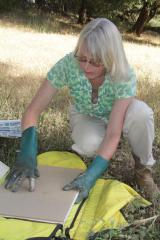
I have been a professional ecologist/writer/teacher for over 20 years with experience ranging from Alaska to Italy. I have been working as adjunct faculty off and on for over 15 years at multiple colleges. I hold a M.S. and B.S.
I have to admit that in the past few years, Ecology is not as 'fun' to teach in light of all the major planetary changes going on, many of which my students are concerned about for their future. My approach is to teach them the nuts and bolts, the fundamentals of not only ecology but of science. Once we have established this baseline knowledge, we branch out into talking about ecological problems and their ideas for solving them. All the students have to select an 'ecological problem', present a scientific paper about it, then think up solutions. I also bring in speakers and we go on campus/local field trips when time allows. They are encouraged to earn extra credit by participating in community events like creek clean-ups, attending relevant local talks, and ecological events (such as the Swan Festival in the Central Valley). I guess you could say my approach to teaching ecology is well, ecological.