
English 1a: Composition and Reading
English 1a: Composition and Reading
Rhetoric and Composition
Common Course ID: English 105
CCC Instructor Open Textbook Adoption Portrait
Abstract: This open textbook is being utilized in an English course for undergraduate students by Sabrina L. Nelson, M.A., at Berkeley City College. The open textbook provides an introduction to composition and rhetoric, as well as extensive writing strategies and techniques, and grammar instruction. The main motivation to adopt an open textbook was to help save students money, and provide a standard rhetoric text that can be adapted as needed for teaching English composition. Most students access the open textbook as a searchable PDF.
Reviews: The book has been reviewed by faculty from within the three segments (CCC, CSU, and UC) of the California higher education systems. There is also an Accessibility Evaluation.
About the Textbook
Description:
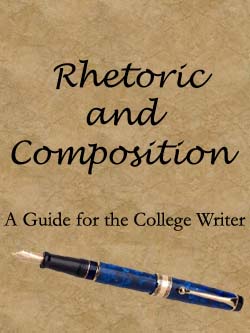
Rhetoric and Composition is a Wiki Book that can be used as is, or saved as a searchable PDF. The book provides quite a bit of information on the basics of good academic writing and research, including topics such as planning and prewriting, drafting, editing, revising, etc. The book discusses typical genres found in composition courses such as memoirs, reviews, reflections and commentaries, as well as academic research papers. In addition, the book has an extensive chapter on grammar, and provides some insight into writing within other disciplines, such as science and business.
Authors:
Formats:
Supplemental resources:
None
Peer reviews:
The book has been reviewed by faculty from within the three segments (CCC, CSU, and UC) of the California higher education systems. There is also an Accessibility Evaluation.
Cost savings:
A typical rhetoric can cost between $50-75. This text is free and provides much of the same information. Since I teach approximately 300 students per year, this is a potential annual savings for students of $22,500.
Accessibility and diversity statement:
The book is provided as a web site or PDF, and can easily be read by modern text reading software or converted to Braille.
License:
Rhetoric and Composition is licensed under Creative Commons Attribution-ShareAlike 3.0 license. This means you can copy and redistribute the material in any medium or format and remix, transform, and build upon the material for any purpose, even commercially.

About the Course
English 1a:  Composition and Reading
Description:
Reading and writing expository prose: Critical thinking, identifying logical fallacies, and reasoning inductively and deductively.
Prerequisites: ENGL 201B or appropriate placement through multiple-measures assessment process.
GE credit: 4 units: AA/AS area 4a; CSU area A2; IGETC area 1A (C-ID ENGL 100)
Learning outcomes:
By the time a student is finished with the course, they should be able to:
- write well organized, well developed, effective, well edited, logically sound, and clear essays
- write effective, well edited, well-organized research papers of 3,000-5,000 words which apply appropriate and clear organizational strategies
- apply active reading strategies in order to identify main ideas and critically analyze and explain ideas in texts.
The majority of students who take this class are planning on transferring to CSUs or UCs for humanities, arts, and science. Recently, CTE (career technical education) majors have taken the course to complete newly developed certificates and 4-year transfer degrees in Video Production, Animation, Digital Imaging, BioTech, etc.
Curricular changes:
Lessons on genre, grammar, prewriting and revision, as well as research have been adapted to incorporate this text. I have shared this text with other instructors, seeking a low-cost, good quality alternative for their courses.
Teaching and learning impacts:
Collaborate more with other faculty: Yes
Use wider range of teaching materials: Yes
Student learning improved: Yes
Student retention improved: Yes
Any unexpected results: Yes
I saw some improvement in grammar, between the first and second (final) research papers. I particularly noticed more attention to grammar in papers written by second language learners (there were about ten in the class).
I noticed some retention, with respect to the grammar lessons.
Surprisingly, for the second research paper, I noticed students paid more attention to the quality of their source material.
Sample assignment and syllabus:
First Research Paper
To prepare for academic research, students read chapter 10 of Rhetoric and Composition. They were given an informal oral quiz and were also given a workshop on evaluating sources, hosted by our library.
Second Research Paper
The research project was a large-scale project done throughout the semester, scaffolded to help students understand the complexities of research, a little bit at a time. The first project was a topic search on a problem associated with food (the course theme). The second project was an annotated bibliography (done as a group project). The first (midterm) and second (final) research paper assignments provided causes and solutions to a specific problem.
English 1a Syllabus
My Fall 2015 syllabus for English 1a.
Textbook Adoption
OER Adoption Process
The major reason for adopting this textbook was to save students money, and to have the ability to customize a rhetoric text to meet the needs of my students.
In addition to the text, we use a theme based reader and another book:
- Food. Fountain Head Press V Series, Brooke Rollins & Lee Bauknight, eds. Fountainhead Press, 2010. ISBN: 978-1-59871-431-9.
- Fast Food Nation: The Dark Side of the All-American Meal by Eric Schlosser, ISBN-10: 9780547750330.
Student access:
Rhetoric and Composition is provided as a searchable PDF and is stored on the course Moodle website.
Student feedback or participation:
I gave students a survey to see what they thought of the OER text. At the bottom of this column is a link to a spreadsheet with comments from students. Some highlights:
- "It was very informative and helped me to make educated decisions when a teacher wasn't available."
- "I thought the sections were very useful, as well as the part about structuring a strong thesis and argumentative essay."
- "It really helped me bring my writing to the next level, the tips for planning and pre-writing broke a few of my bad habits."
- "I found this text really helpful mainly for the fact it was available on the computer. It saved money as well as was easily accessible during class when we needed to look something up."
- When asked if the book was useful: "Yes, definitely, I think it can be an important part of any English students arsenal."
OER Book In-Class Survey
On the last day of class, I gave students a brief survey about the OER textbook we used. Attached are their answers. The students found the book useful and helpful, and a few of them provided some critique, to make the book better.

I am an English professor at Berkeley City College. I teach English 1a, English 5, Graphic Design, Film Editing, Arts Festival Production Management.
Reading and writing encompass more than just interpretation of traditional texts in books, journals and magazines. Today’s digital and visual world bombards our students with complex imagery and new forms of communication, without much of a road map to follow. In my class, we explore visual as well as traditional texts, web-based texts, and informal writing (such as social media), mining them for clues to identity, culture and subtext. Taking this approach to visual and non-traditional texts helps situate students in the digital landscape they already travel through and provides them with a socio-cultural context that can inform their own critical thinking.