
Introductory Elementary Statistics
Introductory Elementary Statistics
Introductory Statistics
Common Course ID: Math 110
CCC Instructor Open Textbook Adoption Portrait
Abstract: This open textbook is being utilized in a statistics course for undergraduate students by Hasan Z. Rahim, Ph.D., at San Jose Community College. The open textbook provides content superior to high-cost non-open textbooks that impose a huge financial burden on students. The main motivation for adopting an open textbook is to give students access to high-quality content at nominal or no charge. Most student access the open textbook as a PDF in the form of a course reader.
Reviews: The book has been reviewed by a CCC faculty member, a CSU faculty member and a UC faculty member from within the California higher education system. There is also an Accessibility Evaluation.
About the Textbook
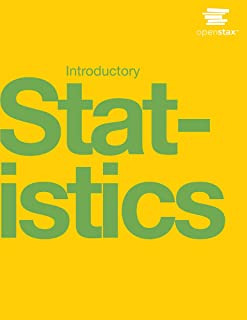 Description: Introductory Statistics follows the scope and sequence of a one-semester, introduction to statistics course and is geared toward students majoring in fields other than math or engineering. This text assumes students have been exposed to intermediate algebra, and it focuses on the applications of statistical knowledge rather than the theory behind it. The foundation of this textbook is Collaborative Statistics, by the same authors, which has been widely adopted.
Introductory Statistics includes innovations in art, terminology, and practical applications, all with a goal of increasing relevance and accessibility for students. The authors tried to make the discipline meaningful and memorable, so that students can draw a working knowledge from it that will enrich their future studies and help them make sense of the world around them. The text also includes Collaborative Exercises, integration with TI-83, 84 Calculators, technology integration problems, and statistics labs.
Authors:
- Barbara Illowsky - De Anza College, California
- Susan Dean - De Anza College, California
Formats:
This book is available online, as a PDF or Kindle. A print copy can also be purchased for $33.50.
Supplemental resources:
Extensive supplemental resources are available for faculty and students.
Peer reviews:
The book has been reviewed by a CCC faculty member, a CSU faculty member and a UC faculty member from within the California higher education system. There is also an Accessibility Evaluation.
Cost savings:
Instead of spending $150 or more for a traditional statistics textbook, this OpenStax text is free for students to read online. It will only cost students a nominal printing charge if they want to purchase a printed copy. This can significantly reduce the financial burden on students, many of whom are forced to drop out from institutions of higher learning because of price gouging by predatory textbook publishers. I teach this class to about 200 students per year, for a total annual savings of $30,000.
License:
Except where otherwise noted, Introductory Statistics by OpenStax College is licensed under a Creative Commons Attribution 3.0 Unported License. This license lets others distribute, remix, tweak, and build upon the work, even commercially, as long as they credit the author for the original creation. This is the most accommodating of licenses offered. Recommended for maximum dissemination and use of licensed materials.
About the Course
Math 063 -  Elementary Statistics
Description: Students are introduced to the study of statistics. Students will learn methods of displaying data, descriptive statistics, basic concepts of probability theory, random variables, common statistical distributions, estimates and sample size, hypothesis testing, goodness-of-fit test, contingency table analysis, tests of two independent population parameters, Chi-square, ANOVA, and regression and correlation. Students will apply basic statistical concepts to data from education, business, social sciences, and natural sciences. To aid in the analysis of data, the use of computational technology will be required.
Prerequisites: Math 013, with C or better
GE credit: 3.0 Units, Degree Applicable
Learning outcomes:
- Analyze raw data from sociology, law medicine, politics, business, and other sciences using sample statistics and graphs.
- Calculate probabilities including basic, binomial, and normal distributions.
- Use confidence intervals for population means and proportions for one and two populations, and calculate sample sizes for various confidence levels.
- Conduct hypothesis tests of a population means and proportions for one and two populations.
- Plot scatter diagrams of real life data, perform linear regression and correlation on paired data to analyze such data, predict values of a dependent variable from the regression equation, and determine whether the correlation is sufficient to make the regression equation a useful predictor.
- Test independence and homogeneity in 2-way tables.
Curricular changes:
At this time, I do not see any need to change the content, since each topic is developed fully and with practical examples from relevant disciplines. If anything, there is more detail than I can cover in a semester-length course, so there is an abundance of riches, so to speak. However, I plan to introduce some more examples from medicine, economics and sports to clarify applications of contingency tables, false positives and negatives, and the power of hypothesis tests.
Teaching and learning impacts:
Collaborate more with other faculty: No, since I am the only one using it at SJCC now
Use wider range of teaching materials: Yes
Student learning improved: Yes
Student retention improved: Yes
Any unexpected results: No
Student Learning Improved:
Students learned to see statistics as relevant to their everyday life, a clear priority in the OER statistics textbook I recommended to my students. Hence, there was more interest in mastering the subject.
For instance, in Hypothesis Tests, I emphasize the mistakes we make in rejecting a Null Hypothesis that is True (Type I) and Failing to Reject a Null Hypothesis that is False (Type II). The way to interest students is to show that they are always, knowingly or unknowingly, choosing between these two opposing errors. For instance, imagine a girl waiting for Mr. Right to come along in her life. If she accepts Mr. Right or rejects Mr. Wrong, she will have made the right decision. The problem arises when she ends up accepting Mr. Wrong (Type I) or rejecting Mr. Right (Type II). Which one is more serious?
After a few minutes of reflection, students decide that rejecting Mr. Right is sad but tolerable, because there are other Mr. Rights in the world too, and one of them just may come along later. However, accepting Mr. Wrong means several years of pain and even more years of therapy! (The same is true for guys waiting for Ms. Right!)
Giving relevant examples (improbable events happen, ginkgo biloba does NOT sharpen memory, and so on) increase student curiosity and help them take ownership of their own studies. I have had several nursing students, for instance, who found statistics critical to advancing in their profession.
Student retention improved:
A problem that plagues community colleges is the unacceptably high student dropout rate. I have studied this problem in depth and found that the most important reason for this sad state of affairs is not lack of cognitive skills but lack of relevance. By combining humor with relevance, only 7 students dropped my statistics classes in the last two years, 3 of them due to family emergencies. So, yes, student retention improved considerably when I began to focus on relevance, spiced up with humor.
Sample assignment and syllabus:
Assignment
This is a sample assignment for finding a confidence interval.
Syllabus
This is the syllabus I used for the Fall 2015 class.
Textbook Adoption
OER Adoption Process
My main motivation is to save my students money without compromising on the quality of the text. Happily, this dual purpose is served extremely well by using this OER. The material is easy to access via PDF documents and/or by copying and pasting sections of the text into emails and in Learning Management Systems. All in all, students come out winners, as teachers can focus on helping students graduate on time and succeeding in their academic and professional lives.
Student access:
Students can access the textbook in a number of formats, including PDF, HTML or in print. I encourage students to purchase the print version, as they are more comfortable in this traditional format and the price is just the cost of printing, no more than about $20. Students can also access the material using tablets or smartphones. All the resources I have created from the OER text are also available on SJCC's Learning Management System.
Student feedback or participation:
Students are heartened by the possibility of doing away with the burden of exorbitant textbook costs. When I presented the PDF text of Introductory Statistics in my statistics class, students were overjoyed when they heard they can download it for free. Once they reviewed the content and compared it with the content of the statistics textbook we normally use, the overwhelming majority agreed that the content was as good, if not better, than the "regular" textbook. (Those who had mild reservations were concerned about not being able to sell the textbook they had bought!) When students realized that the OER textbook was free, there was just no contest. Their only complaint was: "How come we didn't adopt this sooner?"
To familiarize students with the OER text, I used its chapter on "Confidence Intervals" (Chapter 8) in place of the "Confidence Intervals" chapter from the regular text. Students were more impressed by the relevance of the problems and exercises to their daily lives than what they had encountered in the "regular" text. The only jarring note in the OER text was labeling "Margin of Error" by the rather intimidating label of "Error Bound for a Population Mean (EBM)" or "Error Bound for a Population Proportion (EBP)." This was a minor objection.
What students particularly appreciated was the fact that the use of TI-83/84 calculators in solving various statistical problems was clearly demonstrated in the body of the text itself. The "regular" textbook is table-centric in that it asks students to use the z, t and chi-square distribution tables (a real pain) for answers, and includes the use of calculators at the end of each chapter as an afterthought.
Conclusion: The OER textbook is superior in terms of content as well, clearer and more relevant.
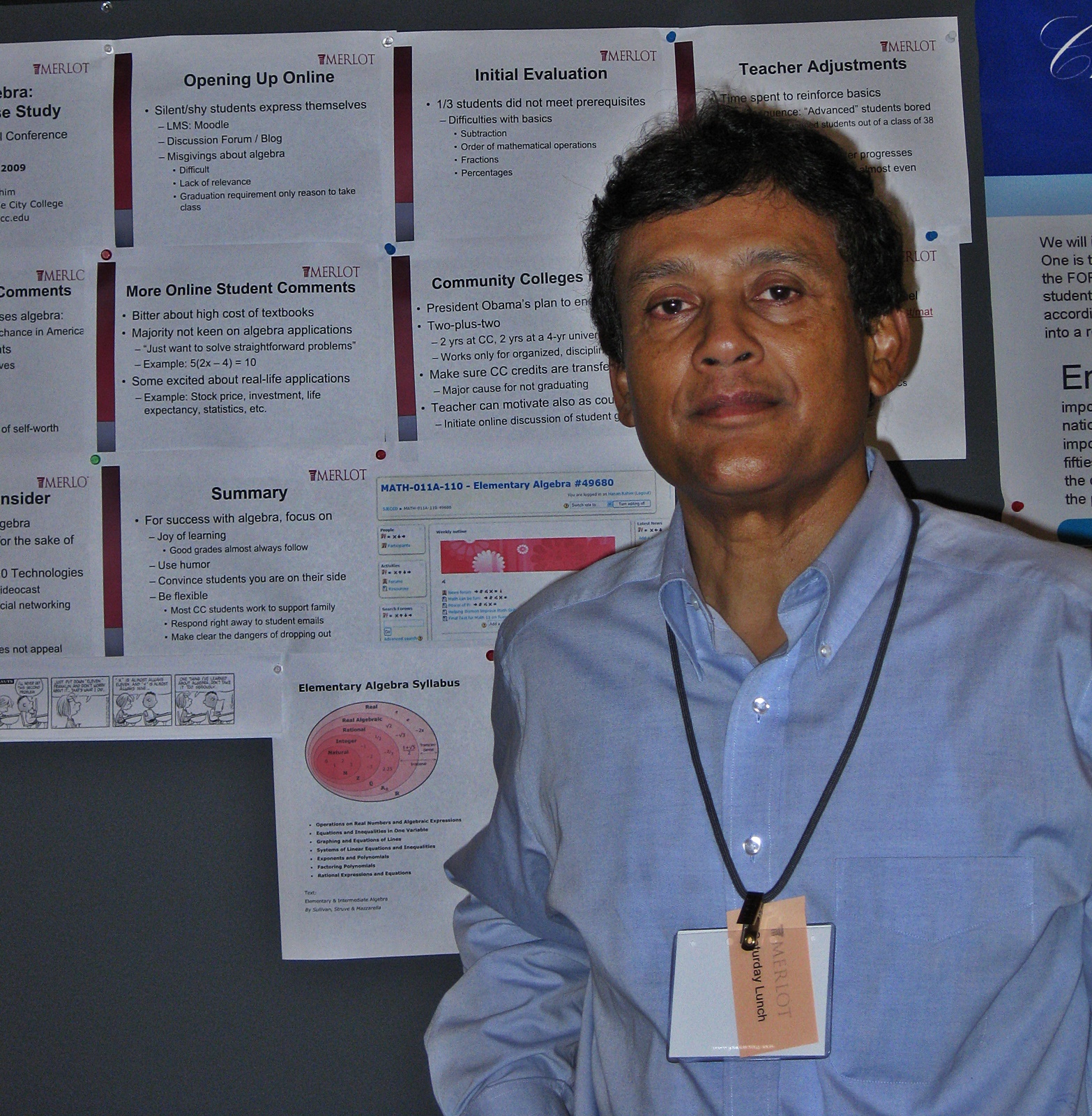
I am a mathematics professor at San Jose City College. I teach Introductory and Intermediate Algebra, Statistics, and Trigonometry and Pre-Calculus Courses.
My teaching philosophy is straightforward: Make subjects student-centric, relevant to life, act as guide by the side, quantify and demonstrate uncertainty, relax students by using humor, convince students I am committed to their success on the very first day of class, respond to student emails in 6 minutes or less, check for understanding every 10 minutes or so, and at least twice a semester act crazy in a benign way so students know I am not a genius but that they are.