
United States History
United States History
U.S. History
Common Course ID: HIST 140
CSU Instructor Open Textbook Adoption Portrait
Abstract: This open textbook is being utilized in a U.S. History course for undergraduate students by Stephen Campbell, Ph.D., at Cal Poly Pomona. The open textbook provides an excellent overview of the major themes and topics of an introductory level U.S. History course, along with quizzes and PowerPoints. The main motivation to adopt an open textbook was as a cost reduction for students. Most student access the open textbook as a PDF file on their laptop computers.
Reviews: The book has been reviewed by a CCC faculty member, a CSU faculty member, and a UC faculty member from within the California higher education systems. There is also an Accessibility Evaluation.
About the Textbook
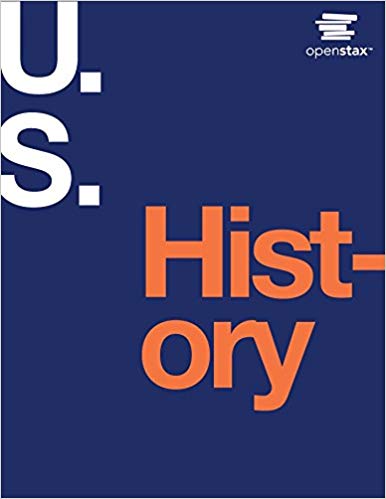 Description: U.S. History covers the breadth of the chronological history of the United States and also provides the necessary depth to ensure the course is manageable for instructors and students alike. U.S. History is designed to meet the scope and sequence requirements of most courses. The authors introduce key forces and major developments that together form the American experience, with particular attention paid to considering issues of race, class, and gender. The text provides a balanced approach to U.S. history, considering the people, events, and ideas that have shaped the United States from both the top down (politics, economics, diplomacy) and bottom up (eyewitness accounts, lived experience).
Authors:
- P. Scott Corbett, PhD - Ventura College
- Volker Janssen, PhD - California State University-Fullerton
- John M. Lund, PhD - Keene State College
- Todd Pfannestiel, PhD - Clarion University
- Paul Vickery, PhD - Oral Roberts University
- Sylvie Waskiewicz, PhD - Lead Editor
Formats:
The textbook is available free online and as a printable PDF. It is also available as an iPad app and a print copy for $42.
Supplemental resources:
The textbook site includes a variety of supplementary resources, including interactive study guides for students and faculty-only resources such as test banks, videos, homework problem sets, and PowerPoint slides.
Peer reviews:
The book has been reviewed by a CCC faculty member, a CSU faculty member, and a UC faculty member from within the California higher education systems. There is also an Accessibility Evaluation.
Cost savings:
Typically a student taking a lower-division survey course in history would pay approximately $100 for texts. This sum would include a textbook and supplementary materials. I recently used Give Me Liberty!, 4th edition. The current price on Amazon is $52.00. There are normally 64 students who take this class every quarter. This results in an annual savings to students of at least $13,312.
Accessibility and diversity statement:
This book has not yet been assessed for accessibility and the publisher does not have a statement regarding diversity.
License:
Except where otherwise noted, U.S. History by OpenStax is licensed under a Creative Commons Attribution 3.0 Unported License. This license lets others distribute, remix, tweak, and build upon the work, even commercially, as long as they credit the author for the original creation. This is the most accommodating of licenses offered. Recommended for maximum dissemination and use of licensed materials.
About the Course
HST 202:  United States History, from 1877
Description: History of the United States from the end of Reconstruction (1877) to the present. Ethnic and gender diversity and the democratization of the United States. Emphasis on the political, social, cultural and economic trends and events that have shaped and characterized the United States as a modern nation and world power.
Prerequisites: None. It is desirable, though not imperative that the student take History 201 (first part of U.S. History) prior to taking History 202.
GE credit: 4 units, lecture/discussions. Meets the U.S. History and Institutions requirement for graduation. Course fulfills GE sub-area D1 in combination with PLS 201.
Learning outcomes:
The expected student learning outcomes include the following:
- Knowledge: Demonstrate factual knowledge of important areas of American economic, cultural, and political history. Demonstrate knowledge of concepts needed to analyze and evaluate the American experience.
- Analysis: Students will be expected to understand and analyze important historical interpretations. Students will analyze selected primary source historical documents through close reading and contextualization.
- Representation: Students will represent knowledge through written work that requires them to demonstrate a basic understanding of major themes in American History. Students will be expected to represent knowledge in class through small group projects/assignments and in-class presentations.
- Preparation for upper-division History and Humanities: Students will be introduced to major events, people, and themes in U.S. History. Students will be introduced to primary sources and a variety of historical interpretations in U.S. History.
HST 202 is a required course and thus, most of the students who take this class are non-majors, ranging from Business to Hospitality to various engineering majors. Many, perhaps most, of them are first-generation college students. Students’ skills in language, reading comprehension, public speaking, analysis, research, and background knowledge vary widely.
Curricular changes:
So far, I have not made any curricular changes to the course.
Teaching and learning impacts:
Collaborate more with other faculty: Yes
Use wider range of materials: No
Student learning improved: Unsure
Student retention improved: Unsure
Any unexpected results: No
I plan to share my experiences of using OER with other faculty through word-of-mouth and perhaps an inter-departmental email.
Sample assignment and syllabus:
Assignment
This is the essay assignment that illustrates how the open textbook is used in the course. It includes a rubric and grading criteria for evaluating student work.
Syllabus
This is the syllabus I used for Fall 2015.
Textbook Adoption
OER Adoption Process
Adopting U.S. History by OpenStax seemed like a good idea for several reasons. One of my colleagues at another institution recommended it. I also wanted to save money for my students, which is important since, as a whole, they are highly indebted upon finishing their degrees. After examining the text and hearing about an OER program through the Chancellor’s Office at Cal Poly Pomona, I made arrangements to offer it in my class. I supplement the OER text with a primary source reader, videos, music files, and links to related news stories and podcasts.
One minor challenge was that the PDF file, in high resolution, was 350MB, and thus, a fairly large file. Students using older computers had difficulty viewing the file. In addition, since the Blackboard Learning Management System limits the amount of memory that professors can use to 200 MB (unless they request an additional 100 MB), this meant that I could not post the textbook on Blackboard. Upon examining the OpenStax website further, I found that one could download a lower-resolution PDF of the textbook. The low-resolution PDF, which takes up approximately 27MB of memory, can be posted on Blackboard for students to view.
Survey results suggest that students, as a whole, are strongly desirous of using OER texts in the future. However, faculty should consider a variety of factors before choosing to select an OER text for their class. Obviously, it will take time for an instructor to become acquainted with a new text, including the manner in which the text arranges content. In terms of constructing a larger analytical framework and then following through on this framework throughout the entire text, traditional textbooks written by well-acclaimed scholars may still be superior.
At times, I felt that the writing style and argumentation of this OER text could have been improved. Then there is the potential for widespread adoption of online textbooks to imperil the salaries of those who work either directly or indirectly in jobs related to publishing traditional textbooks, which include campus bookstore employees, publishers, scholars, salespeople, etc. Faculty must balance these concerns with the key benefits of using a free online text, which include convenience, the absence of delays, back orders, or miscommunications between a professor and bookstore, and above all, the cost reductions from an increasingly expensive higher education system.
Student access:
Students have three options of accessing the textbook — they can view it online; download a copy of the textbook as a PDF file, or order a hard copy in print for a little over $50. To view the textbook online, click on this link, where you can download a PDF file. A low-resolution PDF file of the textbook is available on Blackboard, the campus’s Learning Management System. Finally, the Cal Poly Pomona Campus Bookstore offers a hard copy version. The hardbound book is $52. The spiral bound is 2 volumes and costs $58.75. You can have a hard copy ready within two days of ordering.
Student feedback or participation:
Student feedback was mostly positive. In a survey of 175 students:
- 75% either strongly agreed or slightly agreed with the statement that the free textbook “met my expectations for this class.”
- Over 80% either strongly agreed or slightly agreed with the statement, “I had no trouble accessing the OER textbook for this class.”
- Most students read the textbook as a PDF file on their laptop computers.
- While a few students had trouble accessing the textbook or downloading it onto their computers, an overwhelming percentage — 86% — either strongly agreed or slightly agreed with having more classes use OER textbooks.
The formal survey results can be viewed here. A pdf of the survey results can be viewed here.
 I am a lecturer in the department of history at California State Polytechnic University, Pomona. In nearly nine years of teaching at all three levels of public institutions in California - the CCC, CSU and UC systems - I typically teach US survey courses (both online and face-to-face) but have also taught courses in California history, colonial history, the early republic, and academic writing.
One of my central goals as a history instructor is to challenge students intellectually while teaching skills that are applicable to other disciplines and employment opportunities. Analyzing primary sources and developing sound argumentative skills in writing are paramount. To help students become more effective writers, I operate from the premise that writing is a process that requires several drafts and revisions. Students find it helpful when I hand out examples of successful and problematic introductory paragraphs, discussing effective writing techniques aloud as a group. I give detailed rubrics and handouts notifying students of my expectations, and show examples of “A” quality papers so that students may emulate sound writing. These techniques help students become more effective communicators in writing, which can have positive spillover effects in public speaking and life more generally.
You can read the rest of my teaching philosophy here.
My research specialization and publication history lie in the intersection of politics, media, and finance in the antebellum era, but I also have broader interests in economic history, European history, environmental history, and many other sub-fields.