
International Management 405
International Management 405
International Business: Opportunities and Challenges in a Flattening World
CSU Instructor Open Textbook Adoption Portrait
Abstract: This open textbook is being utilized in a management course for undergraduate business students by David Olson, Ph.D., at California State University, Bakersfield. The open textbook provides an overview of the issues and topics covered in international business. Because this course had an abbreviated session on campus followed by a short-term study abroad component, there was less time to utilize a formal text and there was also a disincentive to carry a heavy text overseas. Therefore, the two main motivations for adopting an open source textbook were to provide students with an overview of the topic without the expense of a typical text and to allow the student to bring the material along without the physical weight and space associated with a traditional textbook. Students accessed the open textbook in pdf format on the device of choice.
About the Textbook
International Business: Opportunities and 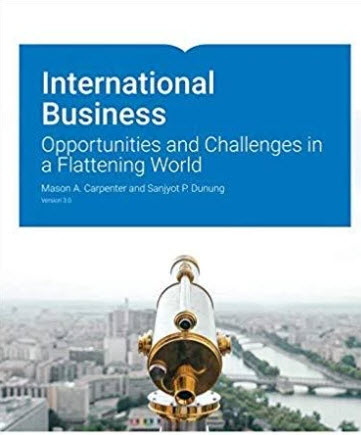 Challenges in a Flattening World
Description:
Carpenter and Dunung’s International Business: The Opportunities and Challenges of a Flat World provides exploration into building, leading and thriving in global organizations in an increasingly flat world. The authors define ”Flat world“ as one where (1) service industries are at least as important as production industries, (2) internet is pervasive, and (3) networks define modern businesses. Borders are seen as bridges, not barriers. The authors develop students’ knowledge of international contexts with the aim that they may launch, run, and work in any organization that is global in scope (or is wrestling with global competition or other global threats).
The textbook is organized in five Sections
- Section 1: Introduction to global business opportunity
- Section 2: Global business environment
- Section 3: Global business strategy
- Section 4: Globalization in a flat world
- Section 5: Organizing for global effectiveness.
Every chapter has five enumerated learning objectives and each of these five sections concludes with a short summary (”Key Takeaways“) and five review questions. In addition, each chapter concludes with a mini case on a unique global business that encompasses the topics shown in the chapter.
Authors:
- Mason Carpenter, University Of Wisconsin-Madison
- Saniyot P. Dunung, Atma Global
Formats: The textbook can be read online and can also be accessed as a PDF.
Supplemental resources: For each chapter, there are "Key Takeaways", review questions, mini-cases, end-of-chapter questions, and AACSB learning standard alignments.
Cost savings:
New hardback International Business texts can cost $250. I teach this course to 50 students each year, so the potential savings for students could be $12,500.
Accessibility and diversity statement:
The book is in PDF format with no accessibility information. However, students with visual problems, could print the book or increase the size of the font for easier reading.
License:
International Business: Opportunities and Challenges in a Flattening World is licensed under a Creative Commons Attribution-NonCommercial-ShareAlike 3.0 Unported license. Under the conditions of this license, you must attribute the work in the manner specified by the author or licensor (but not in any way that suggests that they endorse you or your use of the work). You may not use this work for commercial purposes. If you alter, transform, or build upon this work, you may distribute the resulting work only under the same or similar license to this one.

About the Course
MGMT405:  International Management
Description:
An examination of contemporary issues related to managerial training, political structure, foreign receptivity to United States business, cultural factors, organizing, and controlling the international firm.
Prerequisites: Junior level status or professor approval
GE credit: 3 semester units or 5 quarter units
Learning outcomes:
Upon completion of the course, students will:
- Understand and empathize with cultural and economic difference across borders
- Understand differences and challenges that occur across borders because of cultural, administrative, geographic, and economic distance between countries
- Understand opportunities that occur across borders because of variance in resources and stage of development.
Although not a requirement, most students who take this course are from the schools of business and economics.
Teaching and learning impacts:
Collaborate more with other faculty: No
Use wider range of materials: Perhaps
Student learning improved: Unsure
Student retention improved: Unsure
Any unexpected results: Unsure
Curricular Changes (Study Abroad)
Because this was a study abroad, less than half the time was spent in the classroom. The curriculum was enhanced with visits to actual businesses and conversations with their employees. Students were able to see first hand what they read about in the book.
Each student also selected a book "on an organization we are visiting, the culture of where we are visiting, international business etiquette, etc." The student wrote a book report on the chosen book, prior to the trip abroad.
Students also prepared a report of each chapter in the book on Blackboard, the LMS.
Classroom discussions took place prior to the trip. Students were then able to take the OER book with them on the trip.
Sample Assignment and Syllabus:
Assignment
This discussion assignment was scheduled for students.
Syllabus
This is a copy of the syllabus we used for the study abroad.
Textbook Adoption
OER Adoption Process
This course had an abbreviated session on campus followed by a short-term study abroad component. Therefore, there was little time to utilize a formal text and a disincentive to carry a heavy text during overseas travel. In looking for traditional text alternatives, MERLOT provided a small number of viable alternatives. This text provides good coverage of the material and is easily accessed for all students with a laptop or smartphone. The material is available in pdf and can be downloaded so students have access at all times.
While no external materials are necessary, it is noteworthy that the course was run with a short-term international experience component that inherently augments any text.
Student access:
Students may access the text online and through pdf. Therefore, students could also print the textbook, if desired.
Student feedback or participation:
Students in the course were asked to provide feedback on each of four criteria for the text.
- In rating the Content of the text, the average score on a 10 point scale was 9.2.
- The Format of the text was scored at 7.9 out of 10.
- Convenience of the text was also scored at 7.9 out of 10.
- Overall, the student recommendation for the text was 8.7 out of 10.
Exerpts from student comments include:
- "need more color"
- "very easy to read"
- "more mobile"
- "good fit for the course"
- "so simple and cheap"
- "simple enough for everyone"
- "I prefer physical texts"
- "excellent supplemental information"
- "helped lighten my backpack"
- "access from all my devices"
- "more mobile than a downloaded e-book"
- "amazing solution for students"
- "similar to a regular textbook"
 I am a management professor at California State University, Bakersfield. I teach strategic management, international management, and other courses. I believe that students should be exposed to different teaching styles and philosophies and hope that I will continue to develop new methodologies as well.