
Environmental Crime Prevention
Environmental Crime Prevention
Crime and Everyday Life
CSU Instructor Open Textbook Adoption Portrait
Abstract: This textbook is being utilized in a Criminal Justice course for undergraduate students by Nerea Marteache, Ph.D. at California State University San Bernardino. The textbook explains the theoretical tenets of the discipline using a clear and engaging style. The main motivation to adopt a new textbook was to reduce the textbook cost for students. This is not an open textbook, but one that is purchased at a much lower cost. Students purchase or rent the textbook.
About the Textbook
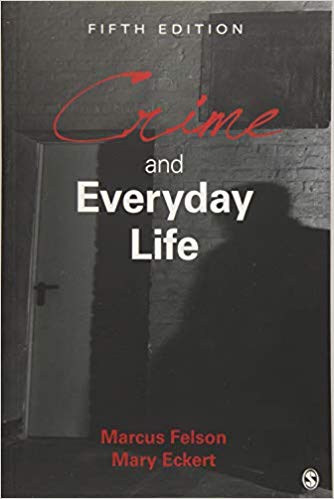
Description: Crime and Everyday Life, Fifth Edition, offers a bold approach to crime theory and crime reduction. The text shows how crime opportunity is a necessary condition for illegal acts to occur. The authors offer realistic, often common-sense, ways to reduce or eliminate crime and criminal behavior in specific settings by removing the opportunity to complete the act. Using a clear and engaging writing style, author Marcus Felson and new co-author Mary Eckert talk directly to the student about criminal behavior, the routine activity approach, and specific crime reduction ideas. The authors emphasize how routine daily activities set the stage for illegal acts -- offering fascinating new ideas and examples not presented in earlier editions. Most importantly, this book teaches the student how to think about crime, and then do something about it.
This book was written by Marcus Felson, the author of the routine activity approach, one of the most important theories in Environmental Criminology. In this book, he explains the theoretical tenets of the discipline using a clear and engaging style. He provides multiple examples and even suggests activities for the classroom. Students tend to love this book due to its short chapters, and to how easy it is to comprehend.
Authors:
- Marcus Felson - Texas State University
- Mary A. Eckert - Texas State University
Formats: Students can purchase or rent this textbook from Amazon.
Supplemental resources: I used the free following resources to supplement the course.
- Crime Analysis for Problem Solvers in 60 Small Steps. U.S. Department of Justice. Office of Community Oriented Policing.
- Opportunity Makes the Thief. Police Research Series. Paper 98.
- Tool Guides
- PST #4: Analyzing Repeat Victimization
- PST #6: Understanding Risky Facilities
- PST #8: Using CPTED in Problem Solving
- PST #12: Understanding Theft of “Hot Products”
- Problem-Specific Guides
- PSG #2: Street Prostitution
- PSG #38: Exploitation of Trafficked Women
Cost savings: I previously used the following textbook for this class: Environmental Criminology and Crime Analysis, 2nd Edition by Wortley and Townsley. This book retails on Amazon for $128.79. The new textbook costs $26.23 to purchase and $13.12 to rent. Since I teach this course to approximately 110 students each year, the potential annual savings for students is between $11,281.50 (purchasers) and $12,723.70 (renters).
License:
Since this was published by Sage, it carries standard copyright terms.

I am a Criminal Justice professor at the California State University San Bernardino. I teach the following courses:
- CJUS 311 – Research Methods in Criminal Justice
- CJUS 312 – Statistics in Criminal Justice
- CJUS 470 – Environmental Crime Prevention
- CJUS 575 – Internships in Criminal Justice
- CJUS 608 – Crimes, Criminals and Victims
- CJUS 595 – Independent Study in Criminal Justice
- CJUS 590 – Wildlife Crime
Imparting knowledge, while at the same time motivating our students is one of the most challenging and rewarding aspects of my job at this University. I am always trying to improve the quality of my teaching, and one of my objectives is to integrate High-Impact Practice into my courses. In my experience, the best teaching involves concrete, hands-on examples, so in my classes, I always use real-life cases and often refer to results from my own research.
For example, with the goal of teaching practical knowledge and skills, the main assignment in the course CJUS 470 (Environmental Crime Prevention) consists of an analysis of a problem of relevance to the city of San Bernardino. The students are then asked to come up with strategies to prevent that crime from happening and to discuss their pros and cons. At the end of the course, they present their findings to representatives of San Bernardino Police Department. This is a different and innovative approach that promotes the exposure of undergraduate students to research and gives them the chance to engage in a project they are already familiar with, and interested in. In a Hispanic-serving institution with 80% first-generation college students, I believe that it is critical to provide them with opportunities to contribute to the creation of knowledge through scientific research.
My research interests are in the following areas:
- Environmental Criminology and Crime Analysis
- Situational Crime Prevention and Problem-oriented Policing
- Crime Prevention through Environmental Design (C.P.T.E.D.)
- White collar/Occupational Crime
- Public Opinion and Criminal Justice Policy
About the Course
CJUS 470 - Environmental Crime Prevention
Description:
Crime Prevention Through Environmental Design (CPTED) and Situational Crime Prevention used by criminal justice agencies, community planners and architects, to increase the security of public and private facilities.
In this course, we look at criminal acts as events, where and when they occur, how they occur, who is present or absent, and how they can be prevented. This course surveys such topics as problem-oriented policing, crime analysis, environmental criminology, crime risks, situational crime prevention, and crime prevention through environmental design.
It is an elective for the B.A. Criminal Justice, but it is required for the concentration of Crime Analysis within this major. Once we go to semesters in Fall 2020, this course will still be an elective for the B.A. Criminal Justice, but it will be a core course for the new B.S. Intelligence and Crime Analysis.
This is a 400-level course, most of the students tend to be Criminal Justice juniors or seniors, but some sophomores take it too. Occasionally some other majors have taken the course.
Prerequisites: None
GE credit: 4 units
Learning outcomes:
- Institutional. In this course:
- Students will learn how to identify, explain, and apply multiple approaches to problem-solving and knowledge production from within and across disciplines and fields to intellectual, ethical, social, and practical issues.
- Students will develop and use new approaches to thinking and problem-solving.
- Departmental. In this course:
- Students will acquire an in-depth understanding and awareness of the criminal justice system and its components.
- Course: At the completion of this course, students will be able to:
- Explain and distinguish between the main theories of environmental criminology: routine activities, rational choice, and crime pattern theory.
- Discuss problem-oriented policing.
- Examine crime problems using the SARA model.
- Apply the crime triangle and the basic elements of crime to different crime types.
- Describe patterns of crime concentration such as repeat victimization or hot products.
- Examine specific crimes using crime scripts.
- Discuss different techniques to prevent crime, such as situational crime prevention and CPTED, and use them to devise practical ways to reduce employee theft, illicit drug dealing, motor vehicle theft, or other crimes.
Curricular changes:
I added a few supplementary readings, as the new book is easier and shorter than the previous one, so I felt students need the extra materials. These are found in the first column under Supplemental Resources.
Teaching and learning impacts:
Collaborate more with other faculty: No
Use wider range of materials: Yes
Student learning improved: Yes
Student retention improved: Unsure
Any unexpected results: Yes
I have added supplementary materials.
I believe this book is easier to comprehend, and students remember better the concepts explained.
Some students prefer a more expensive book if that limits the number of sources they need to go through.
Sample syllabus and assignment:
Syllabus
This is the syllabus I used for Spring 2019.
Assignment
This assignment is for a group project in this course.
Textbook Adoption
OER Adoption Process
I adopted this textbook for two reasons. First, I wanted to reduce the cost of the textbook. Second, I thought that the textbook I was using was too complicated for undergraduates, and I was looking for something a little bit easier for them to understand.
I browsed multiple books that address the theoretical background of Environmental Criminology. I chose one that was cheaper, but also less complicated than the one that I had previously used. For this reason, I felt I needed to complement the textbook with additional resources.
So far it is working well (I am implementing it this quarter), although I find it surprising how students get stressed out by having to navigate multiple sources, to the point that some of them have said that they would prefer a more expensive book if I just assigned that.
Student access:
Students buy or rent the textbook, and the rest of the materials are available online, free of charge (I provide the links to all other materials).
Student feedback or participation:
I created a survey and asked students to answer this question: In past editions of CJUS 470, I used to assign only one textbook, which includes original chapters from many relevant environmental criminologists but is more complicated to read and about twice as expensive as your current textbook.
This term I decided to go with a considerably easier and cheaper textbook, complemented with additional articles that are available for free online. This makes preparing for the quizzes more complicated, as you have to read multiple sources. Which of the two approached do you prefer, and why? A total of 24 students answered the survey.
- 2 of them said that either approach was fine, as they both had pros/cons.
- 13 students preferred the easier and cheaper textbook, complemented with additional articles (current approach). A few quotes:
- I prefer the current approach. As criminologists, we should always take in to account all the different perspectives there are on crime and crime prevention. I appreciate that this option is the least expensive option as well and that the additional sources are easily available online for us.
- I prefer the cheapest route just because we are college students and I know people have bought this book, but I think if it had been the more expensive one you would see a decline in the people having the book and knowing the material. ·
- I prefer the method that we are currently using because it is cheaper and although the content is spread out, finding the information is still relatively convenient and simple to understand.
- I think both of them are fine with me. However, I enjoy reading the easier and cheaper book because it’s easy to understand and it makes sense. Also as a student any form or way to save money is always good with me. That is why I also like the cheaper textbook. The articles are not too bad, but it can get a bit confusing with the quizzes when adding the articles. Other than that I like how things are going.
- 9 students preferred the more expensive, complicated book, without additional readings (previous approach). A few quotes:
- I personally appreciate when professors use only one source regardless of the cost. Due to when preparing for the quizzes it is harder to remember what you read and what you did not.
- Although price is very important, I actually prefer the one text book option. The option is centralized and allows for an easy following; multiple sources are decentralized and feel chaotic.
- I prefer the single textbook. I understand that it is more expensive, but for me it is easier to find, and understand the material. Having everything in one spot is easiest for me. I have forgotten (I know, probably not the best thing to admit to a professor!) about the additional readings sometimes, and when I remember, it makes me feel overwhelmed and feel like I am behind.
- Of the two options, I prefer having the one textbook regardless of the prices and reading level. This makes it much easier to take my readings with me wherever I need to go and not have to worry about having an Internet connection to get the online articles. I do appreciate you posting all of the additional readings at no extra cost. It's nice having other sources to get this type of information but at the same time, it makes it a bit difficult to find the page where you left off on with online articles that don't have bookmarks.