
Elementary Statistics - Introduction
Elementary Statistics - Introduction
Introductory Statistics
Common Core ID: MATH 110
CSU Instructor Open Textbook Adoption Portrait
Abstract: This open textbook is being utilized in an Elementary Statistics course for undergraduate students by Julie Simons, Ph.D., at California State University Maritime Academy. The open textbook provides innovative practical applications that make the text relevant and accessible. The main motivation to adopt an open textbook was as part of a course redesign effort to modernize the curriculum and create a more accessible course for students. Most students access the open textbook directly online.
Reviews: The book has been reviewed by a CCC faculty, one CSU faculty and one UC faculty member from within the California higher education system. There is also an Accessibility Evaluation.
About the Textbook
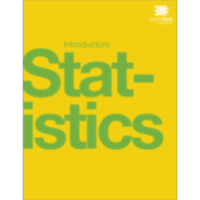
Description: Introductory Statistics follows the scope and sequence of a one-semester, introduction to statistics course and is geared toward students majoring in fields other than math or engineering. This text assumes students have been exposed to intermediate algebra, and it focuses on the applications of statistical knowledge rather than the theory behind it. The foundation of this textbook is Collaborative Statistics, by Barbara Illowsky and Susan Dean, which has been widely adopted.
Introductory Statistics includes innovations in art, terminology, and practical applications, all with a goal of increasing relevance and accessibility for students. We strove to make the discipline meaningful and memorable so that students can draw a working knowledge from it that will enrich their future studies and help them make sense of the world around them. The text also includes Collaborative Exercises, integration with TI-83,83,84 Calculators, technology integration problems, and statistics labs.
Authors:
- Barbara Illowsky - De Anza College, California
- Susan Dean - De Anza College, California
Formats: This book is available online, in PDF, and Bookshare format. A print copy can also be purchased for $21.75.
Supplemental resources: Extensive supplemental resources for the textbook are available here.
I also developed some materials to use in the class. Two examples are:
- Development of a Table of Formulas that displays formulas in words, as well as using mathematical symbols. This has helped math-averse students understand the mathematical terminology better and serves as a go-to resource for students throughout the semester. See Table of Formulas file below.
- Developed homework assignments for topics like confidence intervals that require students to use both Excel and RStudio to do the same calculation. This allows students to check their work and understand the differences between the software and reinforces how both programs work. See the files CI_R and CI_Excel files below.
Peer reviews:
The book has been reviewed by a CCC faculty, one CSU faculty and one UC faculty member from within the California higher education system. There is also an Accessibility Evaluation.
Cost savings:
We previously used Introductory Statistics by Prem S. Mann for this course. It currently retails for $66 on Amazon. Since I teach about 100 students each year, this is potential student savings of $6,600.
Diversity statement:
This textbook uses a variety of approaches to teaching statistics and is heavy on illustrating concepts with concrete examples, exercises, and sample questions throughout the text, to engage the reader as they progress through the text. Solutions to sample problems are provided. The examples come from a variety of topical scenarios, thus providing a broad basis for contextualizing statistics.
Table of formulas
This helps students understand the math better and also serves as a go-to resource when they need help.
Confidence Intervals - RStudo
This is the file I give students to use for RStudio
Confidence Intervals - Excel
This is the file I give students to use for Excel
License:
Except where otherwise noted, Introductory Statistics by OpenStax College is licensed under a Creative Commons Attribution 3.0 Unported License. This license lets others distribute, remix, tweak, and build upon the work, even commercially, as long as they credit the author for the original creation. This is the most accommodating of licenses offered. Recommended for maximum dissemination and use of licensed materials.
About the Course
MTH 107: Elementary Statistics 
Description:
This course is a study of general concepts of statistics, including sampling, probability distributions, statistical inferences, confidence intervals, hypothesis tests, and correlations. Use of technology, including graphing calculators or computers will be used extensively to describe and analyze data.
Prerequisite(s): MTH 100 or ELEC 70
The students who take this course are either majors from Global Studies & Maritime Affairs (GSMA) or International Business & Logistics (IBL), or else minors in business. Their typical incoming knowledge is college algebra and trigonometry, but the student body tends to be math-averse and not well-equipped for the rigors of college-level mathematics. While they may have met mathematical prerequisites, over half of the students in this course tend to struggle with basic algebra and arithmetic.
Learning outcomes: The Student Learning Outcomes are:
- Analyze simple statistical and probability problems.
- Develop a vocabulary for decoding the jargon of statistical analyses.
- Learn how to use statistical software to aid in data analysis.
Curricular changes: I have created a lot of course content–from electronic lecture notes, to survey tools, to sample Excel and RStudio files that students can use to explore data. I have also incorporated some videos, news articles, and podcasts into the course content to motivate students topically. This has been particularly energizing in the course.
Teaching and learning impacts:
Collaborate more with other faculties: Yes
Use wider range of materials: Yes
Student learning improved: Yes
Student retention improved: No
Any unexpected results: Yes
Due to the adoption of this free online textbook, I have moved away from traditional problem sets and exams and towards in-class worksheets and activities (some of which the book provides), projects, podcasts, using statistical software as a more regular teaching tool, and internet-based data websites. Due to the project-based nature of the course, this has enabled me to collaborate with faculty who teach critical thinking as well as our librarians on campus, who help support student research needs for the projects. Student learning outcomes over the past two semesters have significantly improved: only 20-30% of students were proficient in employing statistical techniques and analysis in prior instances of the course whereas approximately 60% of students were proficient in Spring 2018. At the same time, the course has maintained or improved fairly high percentages of students able to articulate basic statistical concepts. Unexpectedly, there are three things that have sprung out of this new way of teaching.
First, students have actually expressed an interest in having more problem sets to practice. While the book has many sample problems, with solutions, students did not always use this resource so I will be finding or creating new resources to address this in the future.
Second, changes in this course have encouraged me to redesign this course as a linked course with our Critical Thinking course, where the two courses can work synergistically with each other as a First-Year Interest Group experience for our students.
Last, and most exciting to me, the projects developed in this course are now being used to help student advocacy in the development of policies on our campus.
Sample syllabus and assignment:
Syllabus
This is the syllabus I used for this class during Spring 2018
Assignment 1
This is the assignment to a course project.
Assigment 1 Rubric
This is the rubric I used for the project
Assignment 2
This is a homework assignment I used in the class
Assignment 2 spreadsheet
This is an Excel file used for hypothesis testing in the homework assignment
Textbook Adoption
OER Adoption Process
The motivation to adopt an OER for this course came as part of a course redesign effort to modernize the curriculum and create a more accessible course for students, in terms of content and cost. The student body traditionally enrolled in this course are from majors that are not quantitatively-focused, so their prospect of using or consulting the previously required textbook beyond this one course was unlikely. With its high cost to students and minimal use, many students chose not to purchase the text. This undermined the likelihood of students studying the course material besides class notes since those who did not purchase the book had no outside resources that matched the course content.
To choose an open textbook for this course, I browsed Merlot and OpenStax and other OER sites. I reviewed the options available, in terms of content and ease of use. Due to the interface and accessibility options for this book, it stood apart from some other resources
Student access:
The text can be accessed through OpenStax, and various options for how to access the content are available there.
Student feedback or participation:
One challenge is to encourage students to actually use the text, instead of solely relying on materials from class meetings. Additionally, since my course does not follow the order of this textbook, some students found it incongruous to try to determine where we were in the textbook at some points during the course. I plan on more cohesively working the textbook into the course material as time goes on, and adding supplemental text for the topics not covered in the text.
So far, some students have mentioned that they have found the textbook useful to read, particularly to read ahead of time, in preparation for class meetings. Survey results of student perceptions have not been compiled yet, but will in the near future. Student comments include:
- I’ve enjoyed the class very much, and I found the new program of RStudio and the new tools in Excel to be extremely useful when interpreting data. In high school, I had a less than positive experience with statistics, but after this class, I really learned to enjoy it. Your teaching is really straightforward and the resources you give us are really beneficial to our learning.
- I liked learning to use RStudio and Excel and would have liked to learn a little more as there are so many real-world applications.
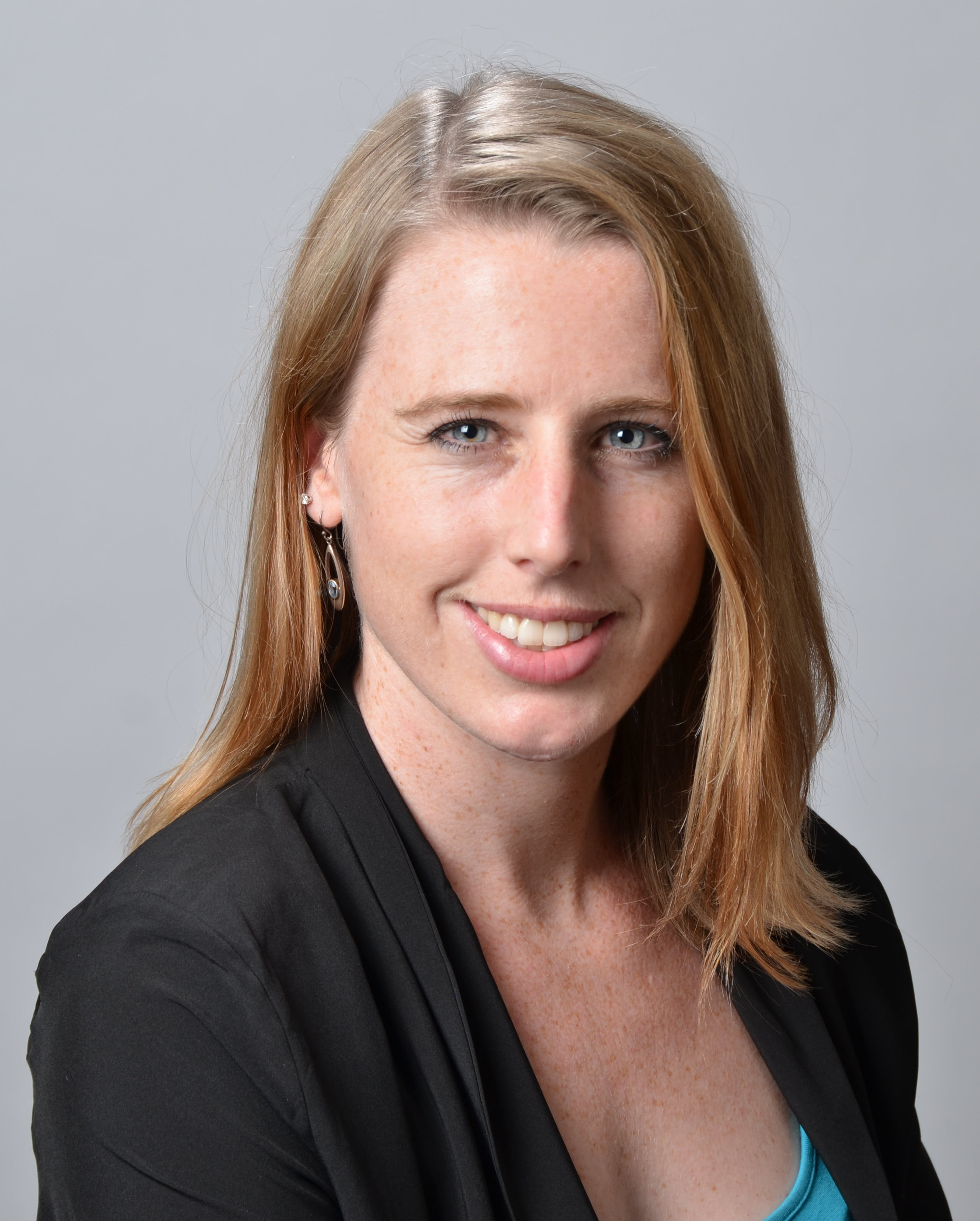
I am an Assistant Professor in the Department of Sciences and Mathematics at the California State University, Maritime Academy. I teach the following courses:
- Precalculus and Trigonometry
- Calculus I-III
- Ordinary Differential Equations
- Linear Algebra
- Introduction to Applied Math
- Analytical Methods of Applied Math (Partial Differential Equations)
- Scientific Computing (Intro Numerical Analysis)
- Statistics (Introductory)
Motivating students in mathematics courses is a creative process, particularly when working with a student body that tends to be math-averse, like those who typically enroll in an elementary statistics course. As an educator, my goal is to provide a positive but challenging atmosphere to motivate mathematical topics and spark curiosity. I use a variety of teaching devices to accomplish this and supplement lesson plans with learning technologies and mathematical or statistical software. In particular, I like to use projects to motivate my students to think beyond mathematical or statistical problem sets and consider the wide-reaching applications that mathematics has.
Another focus of mine is to actively work goal-setting throughout the semester with my students to help them achieve their goals in my courses. This tactic helps students conceptualize their mathematical development as a training process and helps me positively reinforce study habits. I feel strongly that our students should be challenged and if I am not challenging them, then they are missing out on a learning opportunity. With such challenges, creating an encouraging and exciting atmosphere and focusing on growth potential is paramount to helping our students rise to meet these challenges.
The general focus of my research is biologically-motivated spatio-temporal problems in mathematics. The goal of my research is to provide insight into biological phenomena using mathematical modeling and computational tools, as well as to develop new mathematical models inspired by biological observations. Primarily, I use partial and ordinary differential equations and scientific computing to understand problems in sperm motility, blood clotting disorders, and bacterial chemotaxis.