
NAU 102: Navigation 1
NAU 102: Navigation 1
American Practical Navigator
CSU Instructor Open Textbook Adoption Portrait
Abstract: This open textbook is being utilized in a Marine Transportation course for undergraduate students by Tamara Burback, M.S., at California State University Maritime Academy. The open textbook provides information on navigation and piloting to supplement video content and practice problems created by the instructor. The main motivation to adopt an open textbook was to lower the textbook cost to Marine Transportation students. Most students access the open textbook in PDF format.
About the Textbook
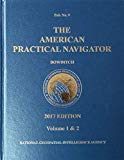
Description: The American Practical Navigator, first published in 1802, was billed as the "epitome of navigation" by its original author, Nathaniel Bowditch. The text has evolved with the advances in navigation practices since that first issue and continues to serve as a valuable reference for marine navigation in the modern day.
The publication describes in detail the principles and factors of navigation, including piloting, electronic navigation, celestial navigation, mathematics, safety, oceanography and meterology. It also contains various tables used in typical navigational calculations and solutions, including the formulas used to derive the tabular data. Many of these solutions can also be found using the on-line calculators located in the Nautical Calculators section of this Web site.
Authors:
- Nathaniel Bowditch - Harvard College
- Updated by: US National Geospatial-Intelligence Agency
The 2017 edition of the American Practical Navigator returns to a two-volume format, which can be downloaded as complete PDF documents by selecting one of the hyperlinks, Volume I and Volume II. Individual chapters, tables and sections can be viewed and downloaded from the Chapters pull-down list.
The book is available for purchase for $60.
Supplemental resources:
Additional resources are available on Moodle, the campus' online classroom platform. Resources include instructor-created videos, PowerPoint lectures, and practice problems.
Cost savings:
This course previously required two books, both American Practical Navigator ($75) and Dutton's Nautical Navigation ($38). The American Practical Navigator is a free PDF, so textbook requirements for this course are now eliminated. With 85 to 110 students enrolled in this course each year, there is a total potential student savings of $9605 to $12,430.
License:
This book is copyrighted by the US National Geospatial-Intelligence Agency. It is available for download for free.
About the Course
NAU 102: Navigation 1
Description:
This course introduces the basic tools and theory of piloting. Elements include basic coastal piloting, using terrestrial features and various plotting systems and techniques. Chart interpretation, plotting, and correction are emphasized, as are passage planning and navigation cross-checking. Emphasis is placed on neatness and precision and, toward the end of the course, speed in arriving at basic piloting solutions. This course is the foundation upon which all subsequent navigation courses will build.
Prerequisite: MTH 100
Corequisite: NAU 102L
GE credit: 4.0
Learning outcomes:
This course is taken by second year students pursuing a B.S. in Marine Transportation. It is the first in a series of Navigation courses.
- SLO1 Determine a ship’s position by using dead reckoning, landmarks, and aids to navigation including light houses, beacons and buoys taking into account winds, tides, currents and estimated speed.
- SLO2 Demonstrate thorough knowledge of and ability to use navigational charts and publications such as Sailing Directions, Coast Pilots, Light Lists, Tide and Tidal Current Tables and Notice to Mariners.
- SLO3 Explain the principles of magnetic and gyro compasses.
- SLO4 Use and interpret information obtained from shipboard meteorological instruments.
- SLO5 Demonstrate an understanding of variation, deviation, and how to correct for them.
Curricular changes:
The availability of supplementary digital content allows for less in-person review of course concepts.
Teaching and learning impacts:
Collaborate more with other faculty: No
Use wider range of teaching materials: Yes
Student learning improved: Unsure
Student retention improved: Unsure
Any unexpected results: No
The wider range of teaching materials is that I make videos and example problems. The videos in particular change the class. I need software and hardware to film, edit, and post the videos. The students view them and can even watch them from their phones during the lab session.
Syllabus
This is the syllabus I used for Fall 2017
Assignment
This is a sample assignment from the class.
Textbook Adoption
OER Adoption Process
The main motivation for adopting the open textbook, a U.S. government publication that is free online, is to save the students money. All that was needed to make this change was a shift in teaching mentality. The course was previously taught with the mindset that students would read more and therefore learn more if a hard copy of the book was in front of them.
External materials used to supplement the textbook are sample problems and solutions and instructional videos created by the instructor.
Sample problems are provided for all course calculations including tide and tidal current calculations, conversions between true, relative, and magnetic degrees, and calculations of magnetic variation and deviation.
Instructional videos include plotting a waypoint, position, and trackline, and setting up a Universal Plotting Sheet.
Student access:
A link to this webpage is provided in the NAU 102 Moodle course page. The book is available as a PDF document.
Student feedback or participation:
I haven’t asked for comments about the book because it has been used to teach this course for decades, and the only change I made was to promote the free online version. The students have provided feedback on the supplemental materials; videos in particular. I have been thanked by a dozen or more students for my time and told that the ability to pause, rewind, and work alongside the video has helped them master confusing concepts. Some of the videos were created in response to student request. I plan to include a feedback question on the course mid-semester evaluation and make improvements based on the findings.
 I am a Marine Vocational Instructor at the California State University Maritime Academy. I teach courses in Navigation and Bridge Simulation.
I believe that every student has the potential to succeed. I take pride in being an approachable instructor who knows students by name. I strive to present and adapt course content to accommodate the needs of each class and I often create additional practice problems or videos at the request of an individual student.
I am pursuing a M.S. in Environmental Policy and Management where I am focusing on the prevention of plastic marine debris from land-based sources. I am contracted to write the fourth edition of the Master's Handbook on Ship's Business for Cornell Maritime Press. I am also involved in course integration between the Marine Transportation and Marine Science departments to encourage peer instruction, authentic learning, and increased ocean literacy.