
HIST 131: U.S. History 1877-Present
HIST 131: U.S. History 1877-Present
The American Yawp
Common Course ID: HIST 140
CSU Instructor Open Textbook Adoption Portrait
Abstract: This open textbook is being utilized in a history course for undergraduate students by Michael Henderson, Ph.D., at California State University, San Marcos. The open textbook was created by two professional historians, using contributions solicited from hundreds of college- and university-level history instructors, and with the aid of almost 30 chapter editors. The main motivation to adopt an open textbook was to lower the textbook cost for students. Most students access the open textbook online
Reviews: The book has been reviewed by faculty (CCC, CSU, UC) within the three segments of the California higher education systems.
About the Textbook
Description:
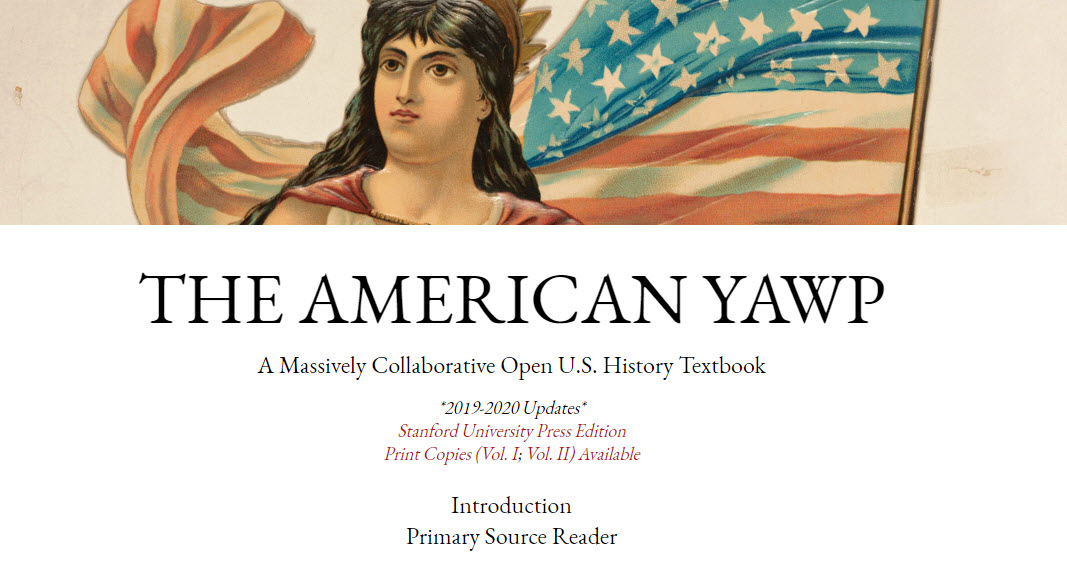
Subtitled "A Free and Online, Collaboratively Built American History Textbook," The American Yawp constructs a coherent and accessible narrative from all the best of recent historical scholarship. Without losing sight of politics and power, it incorporates transnational perspectives, integrates diverse voices, recovers narratives of resistance, and explores the complex process of cultural creation. It looks for America in crowded slave cabins, bustling markets, congested tenements, and marbled halls. It navigates between maternity wards, prisons, streets, bars, and boardrooms. Whitman’s America, like ours, cut across the narrow boundaries that strangle many narratives. Balancing academic rigor with popular readability, The American Yawp offers a multi-layered, democratic alternative to the American past.
Editors:
- Joseph Locke - University of Houston-Victoria
- Ben Wright - University of Texas at Dallas
Formats:
The textbook is only available online.
Supplemental resources:
I provided some primary source documents for my students to read. These can be accessed through the link below.
Peer reviews:
The book was reviewed by three faculty members (CCC, CSU, UC) within the three segments of the California higher education systems.
Cost savings:
I previously used Give Me Liberty: An American History 5th edition, Volume 2, which currently retails for $108 retail on Amazon. Since I teach this class to about 270 students on an annual basis, this results in total cost savings for students of $29,160.
Accessibility and diversity statement:
The OER text is readily available and free for students. It is accessible for those with visual impairments and other reading issues. Similarly, the PDF files that I provide, containing the primary source documents, are accessible and can be read aloud in proper reading order using appropriate screen-reading software. These documents can be printed cheaply at the CSUSM library, for students who do not have printers at home.
One of the themes of the course is diversity in US History, and as such I hope that the approach used is one that supports learners from a variety of backgrounds. I certainly make an effort to create a safe and comfortable learning environment for all my students, and that has not changed with the adoption of a new OER text.
Primary Source Documents
These are some of the primary source documents I used in the class.
License:
This book is licensed with a Creative Commons Attribution-ShareAlike 4.0 International license. This means you are free to copy and redistribute the material in any medium or format and remix, transform, and build upon the material for any purpose, even commercially. You must give appropriate credit, provide a link to the license, and indicate if changes were made. You may do so in any reasonable manner, but not in any way that suggests the licensor endorses you or your use. If you remix, transform, or build upon the material, you must distribute your contributions under the same license as the original.
Sharing Best Practices: The course proceeded very much along the lines that I envisioned when I decided to reduce the costs of course materials. The overall themes and direction of the class did not change very much, and there were not really any particular surprises, either positive or negative, arising out of the adoption of new, low-cost and free materials.
As noted in the section on student feedback, the students themselves responded very positively to the reduced costs of course materials, and they also indicated that the materials themselves were useful and appropriate for the class. While these positive student responses are gratifying, we should be somewhat wary of focusing too much on student evaluations of the content and its usefulness for historical understanding. Because most of the students are Freshmen, and are not professional historians, they lack some of the experience and the analytical tools necessary to make a reliable evaluation of the actual content of the materials. To an experienced, professional historian, I believe it is quite clear that the textbook previously used in the course (Eric Foner’s Give Me Liberty: An American History) is superior to the free online book (Locke and Wright, The American Yawp) that replaced it. Eric Foner is one of the most distinguished and highly respected historians in the United States, and his textbook is a model of clear writing combined with sophisticated analysis of key issues in American history. In particular, his focus on changing ideas about freedom and its limits and boundaries provides an excellent framework for understanding key developments in American history. Foner’s work also benefits from the coherent voice of a single author, rather than being a collaborative work like The American Yawp.
Despite this, however, I believe that the free, online book is completely appropriate for use in a freshman course at CSUSM. It is generally well written, and has a clear narrative. Because it is somewhat less complex than Foner’s work, our students have an easier time following the text; some students in the past have found Foner’s more complex arguments a bit difficult to grasp. This does not mean that the issues raised by Foner are abandoned in my course; it simply means that I take it upon myself to address such issues in our class discussions, and to encourage students to think about how those issues apply to the historical story told in The American Yawp, and to our primary source documents and other readings.
One problem often encountered in freshman courses such as this, especially courses with a large number non-History majors who are taking the course as a requirement for their degree, is apathy. Some students resent being in the class, and do their best to pass while doing as little reading as possible. This remains a problem even in a class with free materials, and there were some weeks where it seemed that the main difference between previous courses and the new course was that, in previous courses, students were NOT reading Eric Foner, while in the new course, students were NOT reading The American Yawp. Still the fact that the free online text is considerably shorter than a regular textbook did encourage some students to read more often, and my overall impression was that most students made an effort to read the textbook on a regular basis.
One way to encourage reading is to have in-class quizzes and writing exercises that rely on a familiarity with the assigned reading. I used such exercises in my class, and I plan to include more of them in future iterations of this course. Sometimes such quizzes seem like busywork, inappropriate to a university-level history class, but some imagination in writing the questions allows the historians to produce quizzes and writing tasks that test not simply memory, but historical understanding, as well as skills of critical thinking and analysis, and writing ability.
As I continue to teach this course, I will continue to use the free textbook, but my aim is also to rely on it less heavily, and to substitute high-quality historical essays from other online sources, such as university and government websites, historical societies, scholarly journals, literary magazines, and other repositories of good-quality historical writing. In doing this, I not only want to emphasize the variety of historical sources available, but to make clear to students that the process of selecting quality materials is more complicated than simply looking at the first search result that comes up on the internet. Some historical sources are better than others, and the better sources are generally produced by people with a commitment to rigorous consideration of historical evidence and a willingness to offer fair and judicious evaluations of that evidence. In a world where many people seem to have difficulty distinguishing good information and analysis from bad, I believe that helping students develop these skills will be of great benefit to them, and to society as a whole.
I am in constant contact with other members of the History Department who teach these introductory courses, and I have been sharing my stories of successes and failures with them. I am also currently involved in a California State University Chancellor’s Office Sustaining Success grant, in which historians from six CSU campuses are, with the help of educational experts and social scientists, designing a survey instrument with the intention of learning more about our students social and intellectual challenges, in the hope that we can improve their learning outcomes and their retention and graduation rates. The survey is currently being designed, and it will be used in classrooms across the CSU in the 2017-2018 academic year.
About the Course
HIST 131: U.S.  History 1877-Present
Description: A survey of the development and the changing historical interpretation of institutions and society in the United States from the end of Reconstruction to the present. Special attention to the interplay between races and cultural diversity and conflict. Themes include immigration, constitutional development, politics, economics, religion, reform, the growth of the United States as a world power, status of women, westward expansion, and urbanization.
Prerequisites: None
GE credit: 3 units
Learning outcomes:
After taking this course, students will be able to:
- identify and discuss key issues and transformations in the history of the United States since the Civil War.
- identify and discuss the significance of the three main course themes - government, freedom, and diversity - and the connections between them.
- read and analyze primary source documents, as well as secondary source materials such as the textbook and documentary videos.
- build arguments and generalizations about historical change using evidence from different types of sources.
- present and defend historical arguments and generalizations using clear written and oral communication, drawing on evidence found in the sources.
- demonstrate awareness of how historical knowledge can improve understandings of current events, and of how current events can both improve and distort historical understanding.
Curricular changes:
For the most part, the curriculum in my course did not change very much as a result of using the new materials. The free, online textbook follows a similar chronological progression to the regular textbook that I was using previously, and so I essentially slotted the new text in to replace the old one, making some modifications to the schedule and to my class lectures where necessary in order to make sure that all important issues were addressed.
The free online text was shorter and, in places, not as complex or as sophisticated in some of its arguments as the regular textbook used previously (Foner’s Give Me Liberty). This necessitated some adjustments in class. In some cases, ensuring that the key issues were fully address in class required adding some more detail to my class lectures and focusing more closely on certain issues in our class discussions. In general, though, the class proceeded in essentially the same manner, and addressing most of the same key themes and historical changes, as the earlier iterations of the course.
A key focus of my history courses is on the importance of reading and analyzing of primary source documents, and discussing them in the classroom. Students are encouraged to read the documents carefully, and class sessions involve extended discussions, both in small groups, and as a whole class. This is the case whether the textbook used is a regular book, or a free online text. As a result, this key component of the course changed very little.
Teaching and learning impacts:
Collaborate more with other faculty: No
Use wider range of teaching materials: Yes
Student learning improved: No
Student retention improved: No
Any unexpected results: No
We use some historical websites such as the Densho Archive, as well as a magazine article from The Atlantic as the last reading of the semester.
Overall, student grades in the course did not change appreciably during the first semester using the free online textbook. The number of students achieving grades in the A, B, and C range was quite close to the historical average in my classes, and the number of repeatable grades (D/W/F) was also not significantly different from previous iterations of the course. Student retention was about the same also. It is worth noting that overall student results in this required freshman course can vary considerably from one semester to another, even when exactly the same course materials and lesson plans are used. My sense, however, both from grade results and from student performance in class discussions and other activities, is that overall student performance and learning are not appreciably different using the OER text.
Students
HIST131 is one of two courses that satisfies the university’s Lower Division General Education U.S. History requirement (Area D). All students must fulfill this requirement, meaning that a typical HIST131 class includes students representing the full range of CSUSM majors.
In the semester currently under review, my three sections of HIST131 enrolled a total of 136 students, and the four most common majors among students in this group were:
- Pre-Health Sciences (20 students)
- Criminology and Justice Studies (17)
- Pre-Kinesiology (14)
- Pre-Business (13)
Other majors enrolled in the class included: Anthropology; Biochemistry; Biological Sciences; Communication; Computer Science; Economics; Literature and Writing; Political Science; Psychology; and Social Sciences.
In Fall 2016, there were four History majors among the 136 students in my class sections. This number of History majors was smaller than usual, but not markedly so; HIST131 is, for the most part, a course that is dominated by students whose major is NOT History.
There are no prerequisites for HIST131, and many students take this course in their first semester at CSUSM. Their preparation for the class generally consists of whatever history studies they completed during their secondary schooling. Students’ preparation for HIST131 is also shaped by their more general competence in areas such as reading, critical thinking, analysis, argumentation, and writing. Because the class draws students from the whole campus population, the age and ethnicity distribution of the students quite closely mirrors the broader statistics for the campus.
Sample assignment and syllabus:
Assignment 1
This is an in-class group assignment on immigration reform in the early twentieth century.
Assignment 2
This is a short paper on the Gilded Age Inequality
Assignment 3
These are examples of in-class writing exercises I have used.
Assignment 4
This is an example of a long essay assignment on Imperialism, Immigration, and American Civilization.
Assignment 5
This is an example of a long essay assignment on Civil Rights, Freedom, and the Role of Government.
Syllabus
This is the syllabus I used for Spring 2017.
Textbook Adoption
OER Adoption Process
The cost of a college education has increased markedly over recent years. Not only have CSU tuition rates increased, but other educational costs, including textbooks and other course material, have risen faster than the general rate of inflation, and faster than wages, causing significant financial hardship for many students and their families.
A recent study commissioned by CSU Chancellor Tim White showed that about 1 in 5 students across the California State University system suffer from food insecurity, and about 1 in 10, at some stage during their college years, experience homelessness or residential instability. Add these problems to the national crisis of escalating student debt, and it is clear that we need to do a better job of making college affordable.
These issues were important in my decision to adopt lower-cost materials in my class, although I am well aware that saving each of my students $60 per semester is a relatively small drop in the bucket, when the full cost of their education is taken into consideration.
The large percentage of HIST131 students who are not History majors was also a factor in my decision to reduce the cost of class materials. I firmly believe in the importance of understanding American history as part of being a thoughtful and informed member of American society, and I support the CSU’s decision to require that students study American institutions as part of their degree program. At the same time, however, I recognize that many students who are not History majors might prefer to devote their limited financial resources to courses within their primary fields of study. I hope that I can help my students develop the critical thinking and analytical and writing skills, and the sense of civic engagement, that are central to the study of history, while also making their college experience just a bit less financially burdensome.
I considered a number of options in my efforts to reduce the cost of course materials, including: free online textbooks, scholarly articles available to students though databases such as JSTOR; and the use of websites provided by government and educational institutions. After considerable investigation, I decided to use Joseph Locke and Ben Wright (ed.), The American Yawp, a free, online textbook created by two professional historians. I spent time over the summer of 2016 reading this book, and evaluating its contents in the context of my historical and pedagogical aims, in order to determine whether it would suit my course, and I came to the conclusion that the material was appropriate for a freshman-level course in US History.
In addition to the free EOR text, I provided students with PDF files of primary source materials. These documents were provided at no cost to the students, but all students were required to print the documents and bring the hard copies to class. The cost of printing the documents for the semester, at the CSUSM library price of 12 cents per page, is less than $15.00.
Student access:
Students access the online textbook directly from the book’s website. It is available only in HTML format online, although students with access to software such as Acrobat Pro can easily convert individual chapters to PDF documents for offline reading. All CSUSM students have access to Acrobat Pro through campus computing stations in labs and the library.
Student feedback or participation:
In a survey asking about the free textbook, and about the materials used for the course, student responses were overwhelmingly positive. Significant results from the survey include:
- Over 90% of students reported that materials for this class were “much more affordable” than materials for their other classes.
- Over 95% of students found the free textbook “easy to access.”
- About 95% of students found the free resources “relevant to the course.”
- Over 90% of students strongly agreed that “the quality of the free resources…was high.”
- Almost 95% of students would recommend that those same free resources be used again, in future classes.
- Only about 6-7% of students would prefer a regular, purchased textbook to the free resources provided in the course, while about 80% strongly disagreed with the idea of returning to a regular textbook.
Students were, in the survey, given an opportunity to comment on the materials used in the class. The vast majority of student comments expressed satisfaction with the materials, and in particular with the no-cost online textbook. There were a number of comments indicating that not having to purchase a textbook made it easier for students to meet other expenses such as parking costs, class materials for other courses, etc.
Quite a few students complimented the online textbook for being clear and easy to read. Some explicitly said that it was easier to understand than a regular textbook, and students were also happy to have the text accessible at any time from computers and other electronic devices, without having to carry around a heavy book.
A small number of students had minor criticisms of the class materials. One student expressed a dislike for reading on computer screens, and would have preferred a regular, printed text. A couple of respondents wanted a glossary to explain difficult words or new historical terms. A few complained about the requirement to print out the primary source documents.
Overall, if we evaluate the use of new course materials based on student responses, it is hard to reach any conclusion except that it was a resounding success.

I am a history professor at the California State University, San Marcos. The classes I teach include:
- HIST130 - U.S. History, 1500-1877
- HIST131 - U.S. History, 1877-present
- HIST343 - American Religious History
- HIST347 - California History
I have a broad interest in the history of the United States from the colonial period to the present, but my main areas of interest are intellectual history, the history of race and civil rights, and the 20th-century history of the United States. In addition to teaching both halves of the US History survey course (1500-1877, and 1877-present), I have taught US Religious History and California History at CSU San Marcos. Courses I have taught at other institutions include American Intellectual History, the History of the City, the Politics and Practice of History, and a graduate seminar on the Teaching of History in Schools. From 2010 through 2012, I spent two years working with the San Diego County Office of Education on a US Government grant-funded project to improve the teaching of US history in San Diego County high schools.