
Introduction to Philosophical Issues: PHIL 190
Introduction to Philosophical Issues: PHIL 190
Reason and Responsibility (15th Edition)
Common Course ID: PHIL 100
CSU Instructor Open Textbook Adoption Portrait
Abstract: This open textbook is being utilized in a Philosophy course for undergraduate students seeking to meet GE requirement by Thomas Gardner, Ph.D., at California State University San Bernardino. The used textbook provides a proven selection of high-quality readings that cover centuries of philosophical debate. The main motivation to adopt an open textbook was to save students money. Most students access the textbook by purchasing a print copy.
About the Textbook
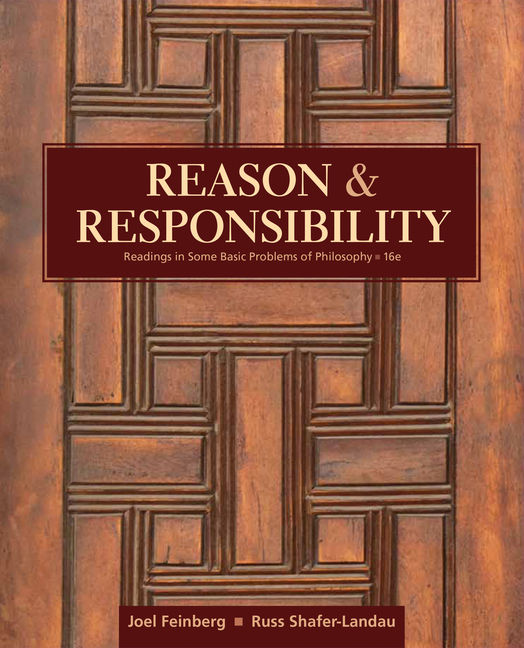
Reason & Responsibility - 15th Edition
Description:
Reason and Responsibility, 15th Edition, has a well-earned reputation for clarity and breadth, with a selection of high-quality readings that cover centuries of philosophical debate. The anthology covers the central issues in metaphysics, epistemology, philosophy of religion, philosophy of mind, and ethics, as well as debates over the value of philosophy and the meaning of life. The book is clearly organized: the readings complement each other, guiding you through contrasting positions on key philosophical issues. Clear, concise introductions provide reading tips and background information to help you engage directly and meaningfully with the primary sources.
Authors:
- Joel Feinberg - Late of University of Arizona
- Russ Shafer-Landau - University of North Carolina at Chapel Hill
Formats:
Students purchase a used copy of the 15th edition physical book.
Supplemental resources:
None
Cost savings:
I previously used the same textbook, but the updated version (Edition 16) which retails for $199.95. By having students purchase a used copy of Edition 15 for $13.54, they save $186.11. Since I teach approximately 192 students each year, the annual potential savings for students is $35,733.12
License:
This book has a regular U.S. copyright.
About the Course
PHIL 190: Introduction to Philosophical Issues
Description: An introduction to philosophical thinking by means of reading, discussing and writing about selected philosophical works. Students are encouraged to develop their own philosophical views in critical exchange with the views of the philosophers studied.
The general aim of this course is to provide students with an introductory understanding of the basic methods and a few of the traditional problems of western philosophy. The content of the course is divided into four main sections: The Ontological Argument for the Existence of God, Evil and Faith, Personal Identity, and Knowledge of the External World.
Students taking the course are those seeking to meet the GE requirement.
Prerequisites: satisfaction of the GE written communication (A1) requirement or equivalent
GE credit: 4 units
Learning outcomes:
- understand what is involved in the study of philosophy
- identify and analyze arguments for and against the main positions discussed in the study of philosophy
- use philosophical reasoning techniques in a rudimentary way
- improve critical thinking, reading, and writing skills
Curricular changes:
There were no changes needed because the book is the same.
Teaching and learning impacts:
Collaborate more with other faculty: No
Use wider range of materials: No
Student learning improved: Unsure
Student retention improved: Unsure
Any unexpected results: No
Sample syllabus and assignment:
Syllabus
This is the syllabus I used for Spring 2019
Assignment
This is a sample of one of the course assignments.
Textbook Adoption
OER Adoption Process
I decided to use the 15th edition of the book to save students money, increase the likelihood that students would acquire the textbook, and increase the likelihood that students would read the text. I looked around to determine whether or not I could find a cheaper alternative for students.
Student access:
Students purchase used copies of the older (15th) edition of the text instead of the newer, 16th edition.
Student feedback or participation:
Below are the survey results for the following two questions:
- “What is your likelihood of completing the course readings given that the textbook is available to you at a reduced cost?” (88.44%)
- “What would your likelihood of completing the course readings have been if the textbook had not been made available to you at a reduced cost?” (41.67%)

I am a Philosophy professor at California State University San Bernardino. I teach critical thinking and two different introductory courses in philosophy. The courses I teach are:
- PHIL 190 Introduction to Philosophical Issues
- PHIL 194 Introduction to Knowledge and Reality
- PHIL 105 Critical Thinking Through Argument Analysis
I am a philosopher because I think that the questions philosophers ask are the most compelling and important questions. When I work with students, I certainly hope that my interest in philosophy will be infectious and that they will come to appreciate the significance of the problems that philosophers address. But engendering this kind of appreciation is not my primary aim in teaching philosophy. I teach philosophy because I value the careful attention to ideas that learning philosophy promotes. My most basic objectives as a teacher are to help students learn to identify, clarify, understand the relations between, critically assess, and clearly express ideas.
One way I teach students to work more effectively with ideas is to help them recognize and appreciate the kinds of things philosophical thinkers do with ideas in their writing. I try to get them to see that understanding a piece of writing involves more than just being able to identify and articulate the basic claims that an author is making. I focus on making them more aware of the different roles that ideas can play within the dialectic of a work, the relative significance of the different claims the author is making, and the overall structure of the author’s reasoning. In every course that I teach which involves reading philosophical texts, I construct brief writing assignments in connection with specific readings that target the development of these skills. A typical reading response assignment might ask the student to identify the evidence that the author offers in support of some claim or to determine the role that a given claim plays in the overall development of the author’s position. I am also very deliberate about connecting the content of class lectures and discussion back to the text. After working with students to help them get clear about the structure of an author’s argument, I often show them exactly where in the text the author expresses the key elements of that argument. I think this is of crucial importance. I want my students to understand the relevant argument, but I also want them to be able to track the author’s presentation of that argument through the reading.
I think that one of the most effective ways to teach idea analysis to students is to have them write thesis-driven papers. But I also think that students need a fair amount of direction if the effectiveness of this kind of writing is to be maximized. When I give students this kind of assignment, I present them with a set of written guidelines and spend a fair amount of time discussing those guidelines. I make clear to them the importance of marshaling evidence in support of one’s thesis, the need for term definition and concept illustration, the importance of recognizing potential objections, and the value of making the structure of one’s reasoning as transparent to the reader as possible. These are also the kinds of things that I emphasize repeatedly when I meet with students to discuss outlines, drafts, revisions, and/or completed papers. I also spend time familiarizing my students with the different kinds of theses that may be defended in a paper of this sort, and I provide a list of possible topics that illustrate this diversity. This is another opportunity for me to highlight the different possible ways in which ideas can be related to one another within different possible argumentative structures.
My general aim in critical thinking courses is to teach students how to distinguish between good and bad patterns of reasoning. Perhaps the central pedagogical challenge in these courses is determining the most effective way to help students learn to recognize and employ (or avoid) certain formal argumentative structures. Research in educational psychology suggests that, when students become aware of a formal structure by abstracting it from specific contexts themselves, they achieve “farther transfer” — i.e., they are able to recognize and apply that formal structure in more diverse contexts. So, instead of presenting students with an already abstracted formal pattern and then giving them specific examples of arguments that exhibit that pattern, I try to set up learning situations in which they are asked to identify the formal pattern by noticing it as the common structure shared by several specific instances of argumentation.
My research interests concern a couple of different aspects of the so-called "problem of consciousness" within the philosophy of mind. I am interested in assessing the viability of what is known as "non-reductive physicalism" — a general view according to which scientific naturalism is true even though consciousness is a non-physical phenomenon. I am also interested in current attempts to explain consciousness solely in terms of the ways in which our experiences represent features of the world to us. Such views are forms of what is called "representationalism."