
Anthroplogy 600: Proseminar in Anthropology
Anthroplogy 600: Proseminar in Anthropology
The Devil behind the Mirror
CSU Instructor Open Textbook Adoption Portrait
Abstract: This open textbook is being utilized in an Anthropology course for graduate students by Teresa Velásquez, Ph.D. at California State University, San Bernardino. The open textbook provides a compelling and intimate account of the impact that transnational processes associated with globalization are having on the lives and livelihoods of people in the Dominican Republic. The main motivation to adopt an open textbook was to save students money. Most students access the open textbook from the Library website.
About the Textbook
(Although this link is 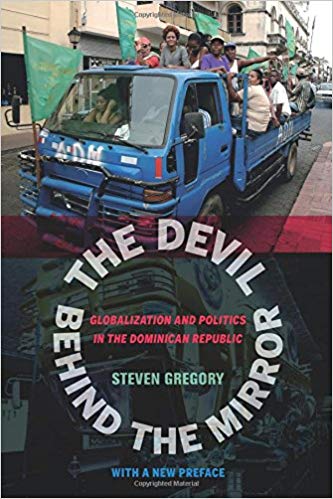 to the Amazon site, the book is accessible from Proquest through the Library website)
Description:
In The Devil behind the Mirror, Steven Gregory provides a compelling and intimate account of the impact that transnational processes associated with globalization are having on the lives and livelihoods of people in the Dominican Republic. Grounded in ethnographic fieldwork conducted in the adjacent towns of Boca Chica and Andrés, Gregory's study deftly demonstrates how transnational flows of capital, culture, and people are mediated by contextually specific power relations, politics, and history. He explores such topics as the informal economy, the making of a telenovela, sex tourism, and racism and discrimination against Haitians, who occupy the lowest rung on the Dominican economic ladder. Innovative, beautifully written, and now updated with a new preface, The Devil behind the Mirror masterfully situates the analysis of global economic change in everyday lives.
Author:
- Steven Gregory - Columbia University
Formats:
Students download the book as a PDF from the Library E-Book Central website.
Supplemental resources:
I provide journal articles to supplement the course. These articles are available for free for students via the library website (jstore, etc), though I compiled them into a Blackboard folder for them.
Cost savings:
I previously used the following textbooks* for this class:
- Devil Behind the Mirror: Globalization and Politics in the Dominican Republic - $66.82
- Broccoli and Desire: Global Connections and Mayan Struggles in Postwar Guatemala, - $80
- Unearthing Conflict: Corporate Mining, Activism, and Expertise in Peru, $75.28
*Prices based on Amazon hardback books. These books total $222.10. Since I teach about 25 students, this is a potential saving for students of $5,552.50.
Accessibility and diversity statement:
The online book is particularly relevant to learners interested in ethnic/racial and gender inequalities. The book addresses these issues from a cross-cultural perspective with a case study from the Dominican Republic.
License:
This book has a standard U.S. copyright.
About the Course
ANTH 600: Proseminar in Anthropology
Description: Survey of the concepts and methods that anthropologists employ to study, describe and analyze globalization.
ANTH 600 is a graduate seminar that serves as an introduction to anthropological research on neoliberal globalization. Anthropologists are largely concerned with the inter-relationship between society, politics, and the economy. We will explore how neoliberalism affects these multiple registers asking: What is neoliberalism and globalization? What does neoliberalism mean for questions of power and governance? What are the socio-cultural formations shaped by neoliberalism? Are there spaces, fissures and cracks within the neoliberal project that allow for challenges and creative reformulations? We will study neoliberal globalization from a range of theoretical perspectives while at the same time learning about it unfolds in historically and culturally specific ways.
Students who take the class are graduate-level students enrolled in the Masters of Social Science and Globalization Program
Learning outcomes:
- Master key theoretical approaches to the study of neoliberal globalization.
- Develop an understanding of how social identities are constructed in relationship to neoliberal globalization.
- Develop an understanding of anthropological research methods.
- Improve critical thinking skills
- Work collaboratively with peers.
Curricular changes: Some course readings were supplemented with documentary films, most of which were available on the library website. I also developed assignments that allowed students to use key concepts found in the reading and apply them to the documentary film.
Teaching and learning impacts:
Collaborate more with other faculty: No
Use wider range of t materials: Yes
Student learning improved: Unsure
Student retention improved: Unsure
Any unexpected results: No
Replacing three textbooks with one textbook allowed me to find resources on similar topics from a broader range of published works including book chapters and articles. This allowed me to teach students about the same concepts but in different socio-political and cultural contexts.
Sample assignment: I prefer not to display my syllabus. If you wish to see it, please contact me at: tvelasqu@csusb.edu
Exam
This is a sample of an essay exam for the class.
Textbook Adoption
OER Adoption Process
The main motivation for adopting the open textbook was to save students money.
After reviewing MERLOT and other sites and not finding exactly what I needed for a graduate level seminar, I conducted a Library search for materials.
In seminar discussions, I have found that most students do not readily have the articles/book on hand or have a hard time finding exact quotes/examples that would enrich discussion because they either did not print it out or their phones are too small or they do not have the right application installed in their phone to search terms.
Supplemental resources:I provide a variety of other resources that are available at the Library website. The list can be found at the link below.
Student access: Students access the resources using mobile devices or laptops from the Library website.
Student Comments: Students were surveyed at the end of the course and they rated the cost of course materials as “moderate” to “very important." As one student put it, the cost of books "can be a crucial difference in the cost associated with a course." The majority of the students did not see any drawbacks to using free, online materials, however, a few students did mention that it would be nice to have a hardcopy to mark up. All students were enthusiastic about having online accessible readings.
Student comments:
- I saved a lot of money,
- cost-efficient and easily accessible at any time
- don’t have to carry it with you
- I was able to access it wherever I went: on the way to a family party, Disneyland, and gym.
Overall, students valued the convenience and cost savings of having freely accessible online materials.
Supplemental Readings
This is a list of the supplemental readings for the course.
I am an Anthropology professor at the California State University San Bernardino. I also teach:
- ANTH 333: Sex and Gender
- ANTH 346: Indigenous Politics in Latin America
- ANTH 356: Cultures of South America
- ANTH 470: Globalization and Culture
- ANTH 472: Colonial and Post-Colonial Anthropology
I primarily teach upper division, seminar-style courses in the areas of my research expertise, including Indigenous Peoples; Environmental Anthropology; Globalization and Culture; Community-Engaged Research Methods, and Sex/Gender in a Cross-Cultural Perspective. In addition, I support student learning through independent study courses, thesis supervision, and other mentorship opportunities.
My courses combine the strengths of both student-centered and instructor-centered approaches to teaching and learning. I want the student to not only be excited and inspired by the material but to be able to apply the concepts learned in the course to understand the inner workings of the social worlds that they inhabit. My courses incorporate high impact learning strategies, including collaborative assignments, discussion groups, and service learning, with the overall goal to enhance students’ understandings of cultural differences, engage in issues of equality and justice, and sharpen their analytical and problem-solving skills.
I want my students to be able to make connections between their lives and the course in productive ways so that it gets them to think and interact with the world in new ways. In a recent course, one student said: “I will never look at nature the same again!” My hope is that students feel inspired to use the anthropological perspective in their everyday thinking about the socio-cultural worlds, become more sensitive and prepared to interact with an increasingly globalized and diverse world, and become active citizens that make positive contributions to society.
I study the socio-cultural dimensions of mineral conflicts in the Ecuadorean Andes. For over a decade, my research has followed small-scale, family dairy farmers as they oppose the extraction of gold in their community watershed. My focus is primarily on the forms of social protest that rally human and non-human entities into political struggles against mineral extraction and towards greater democratization of development practices. I am also interested in the intersections of law, identity, environment, and knowledge practices as they relate to mining conflicts. My work has appeared in NACLA, Latin American and Caribbean Ethnic Studies, Latin American Perspectives, and the edited volume Subaltern Struggles: New Dynamics of Mining, Oil, and Gas in Latin America.