
Corporate Finance Fundamentals
Corporate Finance Fundamentals
Fundamentals of Corporate Finance
CSU Instructors Open Textbook Adoption Portrait
Abstract: This open textbook is being utilized in a Corporate Finance course for undergraduate business students by five Accounting and Finance professors at California State University San Bernardino. Those professors include Dong Man Kim, Ph.D., Ghulam Sarwar, Ph.D., Yu Liu, Ph.D., Gilna Samuel, Ph.D., and Liang Guo, Ph.D. The open textbook provides T an introduction to corporate finance and focuses on the responsibilities of the financial manager, who oversees the accounting and treasury functions and sets the overall financial strategy for the firm. The main motivation to adopt an open textbook was to reduce student costs. Most students access the open textbook via Blackboard.
About the Textbook
Fundamentals of Corporate Finance (with Connect Code)
Description: 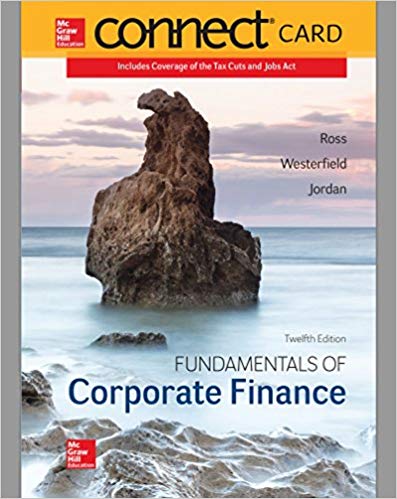
This textbook provides an introduction to corporate finance. It focuses on the responsibilities of the financial manager, who oversees the accounting and treasury functions and sets the overall financial strategy for the firm. It pays special attention to the financial manager’s role as a decision maker. Also, it emphasizes the mastery of fundamental financial concepts and tools which are used to make sound financial decisions that create value for stockholders. Those financial concepts and tools apply not only to business organizations but also to other venues, such as government entities, non-profit organizations, and sometimes even our own personal finances.
There are three basic themes that are the central focus of the book:
1) An emphasis on intuition--the authors separate and explain the principles at work on common sense, intuitive level before launching into any specifics.
2) A unified valuation approach--net present value (NPV) is treated as the basic concept underlying corporate finance.
3) A managerial focus--the authors emphasize the role of the financial manager as a decision maker, and they stress the need for managerial input and judgment.
Authors:
- Stephen Ross - MIT
- Randolph W.Westerfield - University of Southern California
- Bradford D. Jordan - University of Kentucky
Formats:
We adopted the new Inclusive Access Program offered by McGraw-Hill, which allows the Connect access code with the e-book. Students can access the text materials and online support via Blackboard. Students also have an alternative option for purchasing Loose leaf text directly through Connect/Bookstore given that students choose to participate in the inclusive access (IA) program.
Supplemental resources:
None
Cost savings:
We previously used the hard copy textbook, Fundamentals of Corporate Finance, which retails on Amazon for $205.21. The e-book with Connect costs $116.97 on Amazon, which is a savings of $88.24 per student. Since we teach this course to approximately 1900 students each year, the total potential saving annually for students is $167,656.
License:
Fundamentals of Corporate Finance has a normal U.S. copyright license.
About the Course
We use the textbook for both Business Finance (FIN 313) and Corporate Financial Management (FIN 314). Both courses are upper-division required courses for the B.A. in administration. Most of the students are business or public administration majors with basic knowledge in accounting, math, and statistics.
FIN 313 - Business Finance
Description:
Basic principles of financial analysis for management. Techniques of financial decision-making for liquidity management, financial forecasting, dividend policy and selection of sources of capital.
Prerequisites: ACCT 212 or ACCT 312, MATH 110 and ADMN 210
GE credit: 4 units
FIN 314 - Corporate Financial Management
Description:
An advanced study of internal business financial policies and decisions. Includes capital budgeting, sources, and forms of long-term financing, financial structure, cost of capital, equity management, and mergers and acquisitions.
Prerequisites: FIN 313
GE credit: 4 units
Learning outcomes:
Students will be able to
- Communicate, orally and in writing, information, and ideas pertinent to business decision-making.
- Use quantitative analysis and quantitative and non-quantitative reasoning to effectively identify and solve business problems.
- Incorporate a global perspective in business decisions.
- Identify ethical and legal issues in a business context and find alternatives that demonstrate ethical values.
- Prepare a term project that reports financial information and trends for the case study
- Complete homework, quizzes, and exams that probe your understanding of financial quantitative analysis including capital budgeting, risk measures, portfolio diversification, payout decision, and international exchange rates
- Incorporate a global perspective in their corporate analysis term project
- Be presented with issues such as agency problems and insider trading concerns and how such problems have a detrimental effect in achieving financial objectives
Curricular changes:
Explain any curricular changes made to the course as a result of the open textbook adoption.
Teaching and learning impacts:
Collaborate more with other faculty: Unsure
Use a wider range of teaching materials: Yes
Student learning improved: Yes
Student retention improved: Yes
Any unexpected results: Yes
More online support (including online assignment, excel example, reading and video assignment, etc.) provided by the publisher is used for the class.
It makes it more convenient to access to online support and e-book. Students don’t need to carry the printed book back and forth and they can search the content by keywords.
The inclusive access program is more affordable
Sample syllabus and assignment:
Syllabus
This is a syllabus we used for Spring 2019.
Assignments
This is an example of how the assignments are set up in Connect Code.
Assignment Example
This is an example assignment from the McGraw-Hill site for Connect Code.
Textbook Adoption
OER Adoption Process
The main purpose of using an OER textbook was to save money for students.
The book has three basic themes that are the central focus:
1) An emphasis on intuition—the authors separate and explain the principles at work on a common-sense intuitive level before launching into any specifics.
2) A unified valuation approach—net present value (NPV) is treated as the basic concept underlying corporate finance.
3) A managerial focus—the authors emphasize the role of the financial manager as a decision maker and they stress the need for managerial input and judgment.
The Twelfth Edition continues the tradition of excellence that has earned Fundamentals of Corporate Finance its status as the market leader. McGraw-Hill’s adaptive learning component LearnSmart provides assignable modules that help students master chapter core concepts and come to class more prepared. In addition resources within Connect help students solve financial problems and apply what they’ve learned. Ross Fundamentals’ intuitive approach managerial focus and strong end-of-chapter content combine with a complete digital solution to help your students achieve higher outcomes in the course.
The textbook is chosen and voted by the Finance curriculum committee after the intensive research and studies by each finance faculty.
Student access:
Students can access the text materials and online support via Blackboard. Students also have an alternative option to purchasing a Loose leaf text directly through Connect/Bookstore given that students choose to participate in the inclusive access (IA) program.
The Bookstore and book publisher’s representative have reported that some students are demanding refunds for the money charged by the bookstore because instructors did not inform them to drop from IA program by the census date, even though all instructors confirm otherwise. This situation presents a new challenge and learning experience for instructors as they do not want to be involved in or blamed for any IA program payment transaction between students and bookstore.
Student feedback or participation:
Accessing Connect platform through Blackboard was relatively easy.
This new program saved a lot of money. However, many students who bought the access code from the last quarter were not familiar with the opt-out option of this new program and they complained about the refund process. But this will not be an issue in the future.
Accounting and Finance Team
We are Finance professors in the Jack H. Brown College of Business and Public Administration. We teach undergraduate and graduate finance courses, including FIN 313, FIN314, FIN430, FIN433, FIN435, FIN527, FIN380, FIN546, FIN602, etc.
Integration, relevance, and adherence to learning principles are the terms that best characterize our teaching and mentoring philosophy in the classroom. Students are more likely to be interested in and retain the material when it is relevant to their personal life and professional goals and when it integrates theory and practice.
Thus, we have three main objectives for the students we mentor in the classroom:
(1) To fully engage them in real-world financial topics. We make the teaching materials relevant through real-world examples, metaphors, and connections to students’ life in an attempt to awaken students’ curiosity. For example, we begin the class with a discussion of current issues in the financial markets. These discussions enable students to raise questions about what they read reported in the financial press and provide them another avenue to apply what we are discussing in class;
(2) To assist them to develop critical thinking skills. We believe that students’ critical thinking is promoted by engaging and challenging them in a hands-on experience such as research-related projects, investment simulation competitions, real-world case study assignments, etc. The concepts and theories students have studied in their textbooks come alive in these activities. We can see that students start to gain self-confidence through our mentorship which leads to increase problem-solving skills and appetite;
(3) To teach them to communicate effectively. We encourage our students to obtain practice in oral communication by presenting their ideas and results in the class. They are also expected to write a report on their research projects on which we provide feedback.
Our research interests include corporate finance, investment, asset pricing, international finance, real estates, etc.

 h.D.
h.D.
 h.D.
h.D. h.D.
h.D.