
Arab 381: Cultures and Writings of Arab-American Women
Arab 381: Cultures and Writings of Arab-American Women
Several Open Textbooks
CSU Instructor Open Textbook Adoption Portrait
Abstract: Several open textbooks are being utilized in an Arabic course for undergraduate students majoring or minoring in Arabic by Oraib Mango, PH.D. at California State University San Bernardino. The open textbooks provide ease of navigation and allow students to search by key terms and themes.The main motivation to adopt open textbooks was to reduce costs for students. Most students access the open textbooks through the LMS, Blackboard.
About the Textbooks
There are 4 books that I use in this class. Bint Arab records narratives and histories of Arab women in America. Arab American Feminisms provides critical narratives by Arab American women. All the e-Books are easy to navigate and allow students to search by key terms and themes. In addition, instead of buying short stories and poetry collections by Arab American authors, they could use the online book, Dinarzad's Children. These books are detailed below:
Bint Arab Description: Shakir tells the long-neglected story of the bint arab―the Arab woman―in the United States. Drawing on primary sourc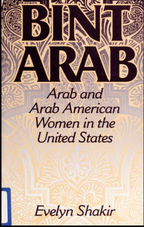 es such as club minutes, census records, and dozens of interviews, she explores the experience of late 19th- and early 20th-century immigrants―mostly Christian peasants from Lebanon and Syria―and their American-born daughters. Later, she moves on to the well-assimilated granddaughters (many of whom have reidentified with the Arab community and begun to fight its political battles). The work concludes with those women―most of them Muslim―who have emigrated over the last quarter century from many Arab countries, particularly Palestinians. While attempting to correct stereotypes that picture Arab women as passive, mindless, and downtrodden, Shakir gives voice to women caught in a tug of war, usually waged within the family, between traditional values and the social and sexual liberties permitted women in the West. Author: Evelyn Shakir
Arab and Arab-American Feminisms: gender, violence, and belonging Description: In this collection, Arab and Arab American feminists en list their intimate experiences to challenge simplistic and long-held assumptions about gender, sexuality, and commitments to feminism and justice-centered struggles. Contributors hail from multiple geographical sites, spiritualities, occupations, sexualities, class backgrounds, and generations. Poets, creative writers, artists, scholars, and activists employ a mix of genres to express feminist issues and highlight how Arab and Arab American feminist perspectives simultaneously inhabit multiple, overlapping, and intersecting spaces: within families and communities; in anticolonial and antiracist struggles; in debates over spirituality and the divine; within radical, feminist, and queer spaces; in academia and on the street; and between each other. Contributors explore themes as diverse as the intersections between gender, sexuality, Orientalism, racism, Islamophobia, and Zionism, and the restoration of Arab Jews to Arab American histories. This book asks how members of diasporic communities navigate their sense of belonging when the country in which they live wages wars in the lands of their ancestors. Arab and Arab American Feminisms opens up new possibilities for placing grounded Arab and Arab American feminist perspectives at the center of gender studies. Authors: Rabab Abdulhadi, Evelyn Asultany, & Nadine Naber
Dinarzad's Children: An Anthology of Contemporary Arab American
Description: Here authors of 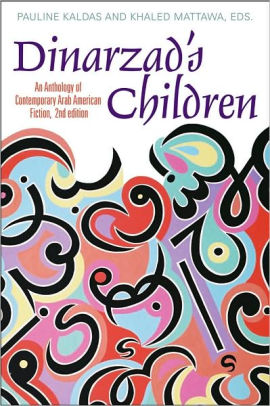 Lebanese, Palestinian, Syrian, Egyptian, and Libyan descent, some with established reputations, others new young writers, tell tales about Muslims and Christians, recent immigrants and fully assimilated Americans, teenagers and grandmothers, guerillas and peaceniks, professors, housewives, grocers, bookies, those who long for their homeland, and those who refuse to speak Arabic. A number of the stories center on conflicts between immigrants and their American-born children. Others wrestle openly with topics such as in-group stereotyping, domestic violence, familial discord, and other difficult issues. But what sets this literature apart from other ethnic literatures is its tendency to keep an eye on the overseas political situation. By turns sassy or lyrical, biting or humorous, always moving, the stories in this collection are good reading and an important contribution to the body of ethnic American literature. Authors: Pauline Kaldas, Editor & Khaled Mattawa, Editor
Acts of Narrative Resistance Description:This exploration of women 's autobiographical writings in the Americas focuses on three specific genres: testimonio, metafiction, and the family saga as the story of a nation. What makes Laura J. Beard’s work distinctive is her pairing of readings of life narratives by women from different countries and traditions. Her section on metafiction focuses on works by Helena Parente Cunha, of Brazil, and Luisa Futoranksy, of Argentina; the family sagas explored are by Ana María Shua and Nélida Piñon, of Argentina and Brazil, respectively; and the section on testimonio highlights narratives by Lee Maracle and Shirley Sterling, from different Indigenous nations in British Columbia. In these texts Beard terms "genres of resistance," women resist the cultural definitions imposed upon them in an effort to speak and name their own experiences. The author situates her work in the context of not only other feminist studies of women's autobiographies but also the continuing study of inter-American literature that is demanding more comparative and cross-cultural approaches. Author: Laura Beard
Supplemental resources: I also used several other websites for supplementary materials:
Cost savings: I previously used the following books for this course (with the costs now on Amazon):
- Food for Our Grandmothers ($39.02)
- Bint Arab ($35.00)
- short stories/poems
The total cost for students was $74.02. Since I teach this class to 45 students each year, the total cost savings is $3,331.
Accessibility and diversity statement: There is no information on Accessibility, but all textbooks provide narratives and critical analyses of different theories and movements from the viewpoints different minoritized groups focusing in particular on the views of Arab American women writers and scholars who share the experiences of other thinkers and scholars of color in the US.
About the Course
ARAB 381: Cultures and Writings of Arab-American Women
Description:
Examination of the history and lives of Arab American women through their own writings and essays.
Prerequisites: None
GE credit: 4 Units
Learning outcomes:
- Get an understanding of the Arab American cultures and view the world through the eyes of Arab American women writers
- Explore points of identification between their lives and the ones represented through the literature they read for the class
- Understand and analyze Arab American literature through postcolonial and feminist perspectives
- Critically think about and question held assumptions, cultural conventions, and media stereotypes
- Recognize the value and validity of literary representations of others’ history
- Appreciate the common humanity that connects people together regardless of their diverse backgrounds.
Curricular changes: I added many online resources for the students in addition to the online books available through the CSU. I also added online resources such as the Poetry Foundation, NPR interviews, TED talks, performances and talks from YouTube.
Teaching and learning impacts:
Collaborate more with other faculty: Yes
Use wider range of materials: Yes
Student learning improved: Yes
Student retention improved: Unsure
Any unexpected results: Yes
Now I am aware of the work of other professors and what they are doing to provide low-cost resources for their students
Moving away from relying on one textbook allowed me to research and find a plethora of valuable resources that range from written texts to audiovisual engaging resources
The course allowed Student learning to improve as it became easy for them to access rich meaningful resources and make choices without having to worry about cost and convenience. Also, providing students with rich audiovisual resources within the curriculum allows them more effective learning as they construct meaning and make connections using media they are well versed at in their own personal lives.
In their online journals, students have expressed that they learned a lot. Some have expressed that their experiences resonated with the experiences of writers they read about and that that the course left a life-changing impact on their lives.
Syllabus This is the syllabus I used for Winter 2019
Assignment This is a sample assignment I use for the class.
OER Adoption
OER Adoption Process
The main motivations to adopt OERs were to save students money, provide them with a variety of teaching resources of different modalities, increase student engagement, and find more relevant materials.
In order to find these books and resources, I researched all the resources in the library using relevant keywords. I also searched online and checked online recommendations from different experts in the field from different platforms including Twitter.
The major challenge was that it is very time-consuming to conduct wide searches and to keep following different leads
Student access: Students access all the materials through the LMS Blackboard, where there are links to the different resources and sites including Pfau library.
Student feedback or participation:
Here are comments from several students:
"I am thankful for choosing this class as one of my electives, thank you so much professor Mango! I loved learning and reading the various stories of many Arab and Arab American women, the way that this online class is organized is perfect for the busy lives of a college student. Including very valuable information that lasts a life time, by every single lesson taught in the course!"
"What is working best for me in terms of success in this course, definitely has to be the helpful links that are provided.”
I am an Arabic professor at the California State University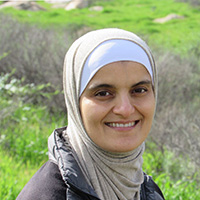 San Bernardino. I teach courses that relate to the Arabic language and culture with a focus on social justice within a critical framework.
In my teaching, I seek to provide a meaningful learning experience where learners are active, creative and critical thinkers engaged in discovery, integration, and application where we all aim to contribute to making the world a better place.
I research in the following areas: Sociolinguistics, language teaching, and learning, educational experiences of learners from minoritized backgrounds.