Home

MiXR in Kinesiology
Tumay Tunur
San Marcos
Course Name & Description: KINE301 Motor Control and Learning
Project Abstract: Movement in eXtended Reality Lab (MiXR) is developed to serve to enable students experience scenerios, otherwise would be limited or impossible in a traditional learning environment. My main goal is to increase student interaction with the material, stimulate active learning, and increase the students' literacy and skill level pertraining the new technological advancements in the eXtended reality field.
Keywords/Tags: Virtual Lab, Undergraduate Research, Active Learning
Instructional Delivery: Lecture and Lab
Pedagogical Approaches: Peer Instruction, Active/Inquiry-based Learning, AR/VR Labs
About the LIT Redesign
Stage 1
Background on the Redesign
Why Redesign your Course?
- Course Characteristics
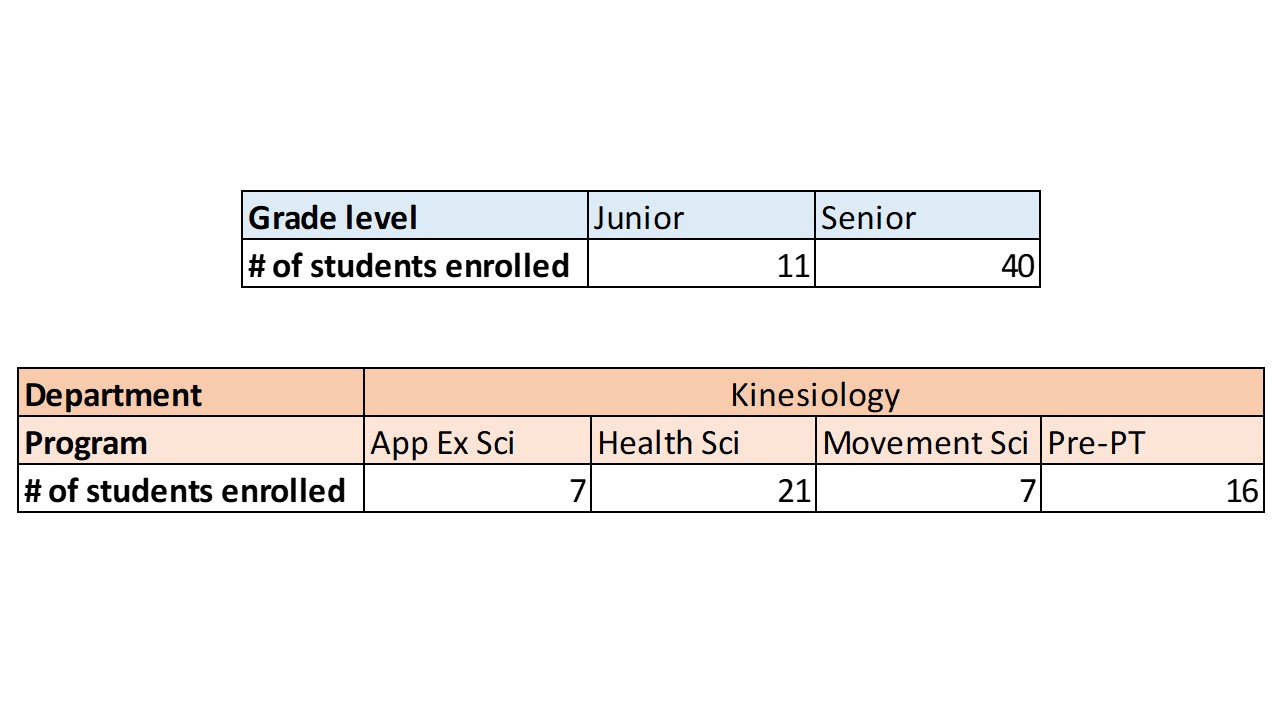
This is a 4-unit upper-level undergraduate course. Each course has one lecture and 2 lab sections. Even though majority of the student body is composed of junior and senior students, most of the students come to the class unprepared in necessary tools such as Excel, statics software, or experiemental design techniques.
- The Learning Problem
Students will learn how to use the latest technological advancements, and simulations in motor control. Virtual reality is one of the most flexible platforms for measuring balance and movement as the options are unlimited in creating visual, haptic, and sound feedback. Students who successfully complete this class will be proficient at using a virtual reality platform, along with biomechanical equipment and statistical software. Students will also be proficient at critical thinking, data analysis, and scientific communication. Experienced with the latest technology, students will enter the workforce better prepared.
High Demand/Low Success/Facilities Bottleneck Issues
- Describe the high demand/low success/facilities bottlenecks issues, if any, which are affecting the course you are redesigning?
While the students in the lab are running experiements, only one or two at a time can engage, while others wait their turns. Also, because of how expensive kinesiology research tools are, and that we have limited space, it is extremely difficult to allow the undergraduate students design and run their own experiements.
Course History / Background
How is course placed in the department?
Enrollment:
- Fall 2017 (72 – 2 sections)
- Spring 2018 (64 – 2 sections)
- Spring 2018 Temecula/ABSK (63 – 3 sections)
- Summer 2018 (15 – 1 section)
- Fall 2018 (64 – 2 sections)
- Fall 2018 ABSK (20 – 1 section)
- Spring 2019 (82 – 2 sections)
- Spring 2019 Temecula/ABSK (41 – 2 sections)
- DFW Rate: <%1 (Only 2 students in AY 2016/17)
- The need for using highly expensive equipment to collect data requires micromanaging, and does not allow the students to gain as much hands on experience, independence, and confidence in their ability to conduct experiements on their own.
Syllabus Fall2017
Syllabus from past years from an another instructor of the course.
About the Students and Instructor(s)
Stage 2
Advice I Give my Students to be Successful
- On the first day of classes, I ask my students why they are "here"? I share the Career Services statistics for our graduates employment rates, and remind them to take advantage of their time in courses to prepare themselves for the future. We talk about how "change" requires "challenge" and that they need to give 100% effort and stay motivated. Finally, I ask them to be perfectly honest and open with me so they can take charge of their own learning experience and shape the course accordingly.
Student Characteristics
Impact of Student Learning Outcomes/Objectives (SLOs) on Course Redesign
- The overall objective of KINE 301 is to share an understanding of how humans make effective movements. Understanding involves thinking about what the requirements for making movements are – what makes movement inherently difficult. Even simple movements that we take for granted are complex at many levels! From the physics of segmented systems themselves, to the many muscles involved in most movements, to the physiological properties of muscle and the nervous system that both enable and constrain movement. KINE 301 is about understanding how the nervous system works with the musculoskeletal system to overcome complexity and achieve high performance. Understanding the dynamic neuro-musculo-skeletal interactions that result in effective movement involves learning a bit about how neurons work, how the spinal cord and brain function, and some ideas about how movements may be planned and executed. However, because we learn to do so many movements, we need also to think about the process of learning – where learning happens and how.
- Completing KINE 301 involves being able to:
- Apply basic principles of segmental mechanics to understanding movement
- Explain how the brain, spinal cord, and musculoskeletal systems interact to plan and execute movement using concepts from control systems theory, dynamical systems theory, neuroanatomy, neurophysiology, and psychology
- Evaluate factors that limit or constrain motor performance, including muscle- and neuro-physiological properties, and cognitive information processing
- Use research findings about motor learning to generate strategies to improve motor performance, including structuring practice, providing feedback, and adapting training to skill level
- Evaluate the effects of individual differences on motor control and performance, including differences due to age/development
Alignment of SLOs With LIT Redesign
- The purpose of this project was to evaluate students' learning outcomes and perceptions from the virtual immersive motor control laboratories.
Assessments Used to Measure Students' Achievement of SLOs
- Exams
- Lab reports
- Group projects
- IMMS survey
- Survey of Self-Efficacy in Science Courses
- Reflections
Accessibility, Affordability, and Diversity Accessibility
Accessibility
- All of the course materials are designed to be accessible. There is no required textbook or equipment for this course. The syllabus, supplemental readings, and student assignments are all digital documents posted on Cougar Courses. Video recordings that students are required to watch during or in advance of class are captioned.
Affordability
- I make an effort to make my courses as affordable as possible. I do not have a required book for the course, I do not require scantrons for the exams, I print out any in-class activity worksheet for the students, and post the supplemental material for the labs online to Cougar Courses.
Diversity
- I highly value diversity, inclusion, and equity in my classroom. In order to succesfully integrate these elements in my course I implement the following:
- I give my students a diversity, inclusion, and classroom climate survey at the end of the semester to gauge their experience in my class.
- I make an effort to use pictures, videos, authors from various cultures in my lessons.
- I use active learning strategies which offers multiple modalities for learning as well as assessments to cater to students with different learning styles or abilities.
- I discuss social justice, diversity, and inclusion material with my students and also incorporate these issues into their group activities.
- I have a section on diversity, inclusion, and equity on my syllabus that I read to students on the first day of classes.

About the Instructor
Dr. Tumay Tunur joined the faculty at CSUSM as an Assistant Professor in Kinesiology in 2017.
At CSUSM, Dr. Tunur teaches numerous undergraduate level courses in Kinesiology, in addition to mentoring undergraduate and graduate students in research.
Dr. Tunur’s research interests include sustainable integration of Augmented and Virtual Reality systems in motor and cognitive rehabilitation for the elderly population, with a special focus on people with Parkinson’s disease.
To learn more about Dr. Tunur’s background and research, please visit her website.
Curriculum Vitae
LIT Redesign Planning
Stage 3
Implementing the Redesigned Course What aspects of your course have you redesigned?
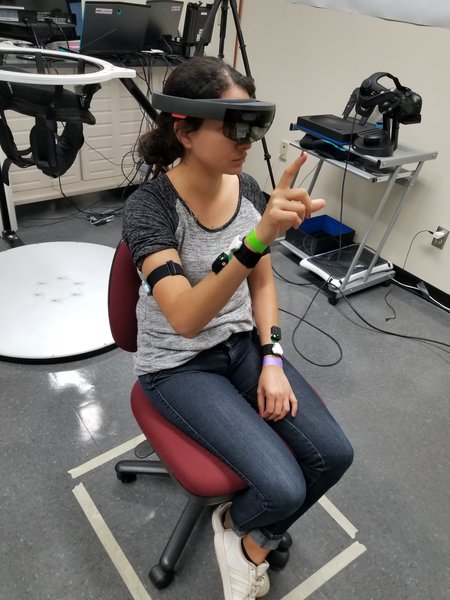
- The Motor Control labs were taught in traditional lab setting. Now, we integrated XR technologies to almost every lab. The students not only get a chance to experience these environments, but also learn how to integrate XR into research and data collection. This allowed students to gain hands-on experience in using these technologies in rehabilitation and research settings.
Describe the class size(s) What technology is being used?
- HTC Vive
- Oculus Rift
- Google Cardboard
- Hololens
- Virtualizer Locomotion Platform for VR
- Wii Balance Board
What professional development activities have you participated during your course redesign?
- Udacity UNITY course (Term 1) | Summer 2018
- LIT Summer Institute hosted by the Chancellor's Office | Summer 2018
- LIT monthly meetings | AY 2018-2019
- CIG monthly meetings | AY 2018-2019
- Gamification FLC (lead) | F2018
- EDUCAUSE two day training on eXtended Reality “ELI Online Event | eXtended Reality (XR): How AR, VR, and MR Are Extending Learning Opportunities” | F2018
- EDUCAUSE Learning Initiatives Annual Meeting, Anaheim (XR demonstration) | S2019
- CSM VR Subchapter Unity coding weekly meetings | S2019
Which Additional Resources Were Needed for the Redesign?
- I worked with my department in building the MiXR Lab for Kinesiology.
- I worked closely with IITS in developing the proposal for XR lab spaces for CSUSM campus.
- I collaborated with colleagues from Computer Sciences and Engineering from our campus, and from other Universities in order to develop the applications we needed.
- I collaborated with the CSM VR Subchapter student group in help creating a student body who are interested in app development.
- I needed our lab technician's assistant in purchasing and setting up the equipment as well as troubleshooting.
- I worked with SDSU VITAL coordinators to help design implemention and assessment of XR into my courses.
LIT Results and Findings
Stage 4
LIT Redesign Impact on Teaching and Learning
- Ultimate goal for this redesign was to give the students more meaningful and unique research experience and in depth understanding of motor control using VR-based labs, otherwise would not have been possible in traditional classrooms. With VR immersion, I hoped to increase student engagement and interest in learning the content material. Furthermore, I wanted to provide the students with a technologically relevant skill set that they can utilize in their fields after graduation.
- I taught this course in Spring 2018 while piloting my ideas of VR immersion, with only a couple of VR-immersive assignments in the lab sections. Then, I worked on the course redesign and implemented it with the new syllabus in Fall 2018. Finally, I was able to tweak and modify the course to overcome technical based on student feedback, and maximize the use of VR in almost every lab section in Spring 2019. However, due to my maternity leave, I was only able to teach the course for the first 8 weeks of the Spring 2019 semester. Due to having a different instructor for the course for the second half of the semester, I did not include course final grade data for Spring 2019 in my assesments below. Nevertheless, I compared student lab assignment grades and their reflections from all semesters, as well as IMMS survey results from the last two semesters.
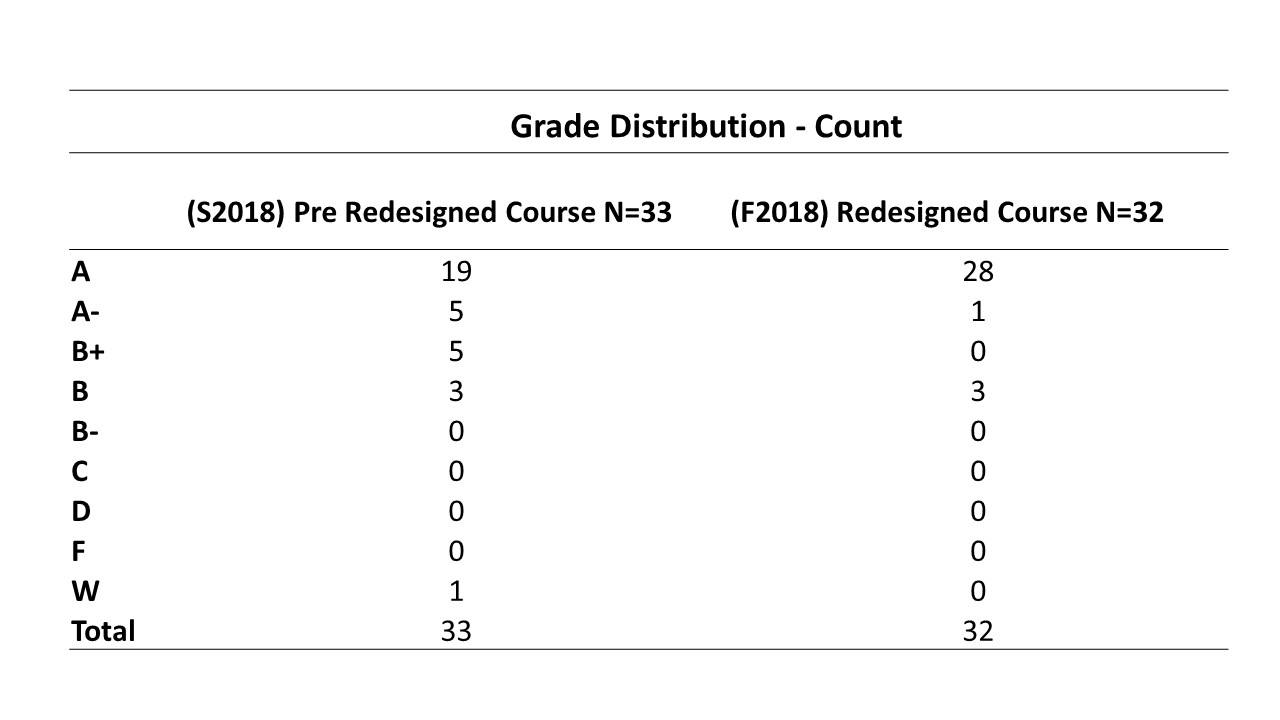
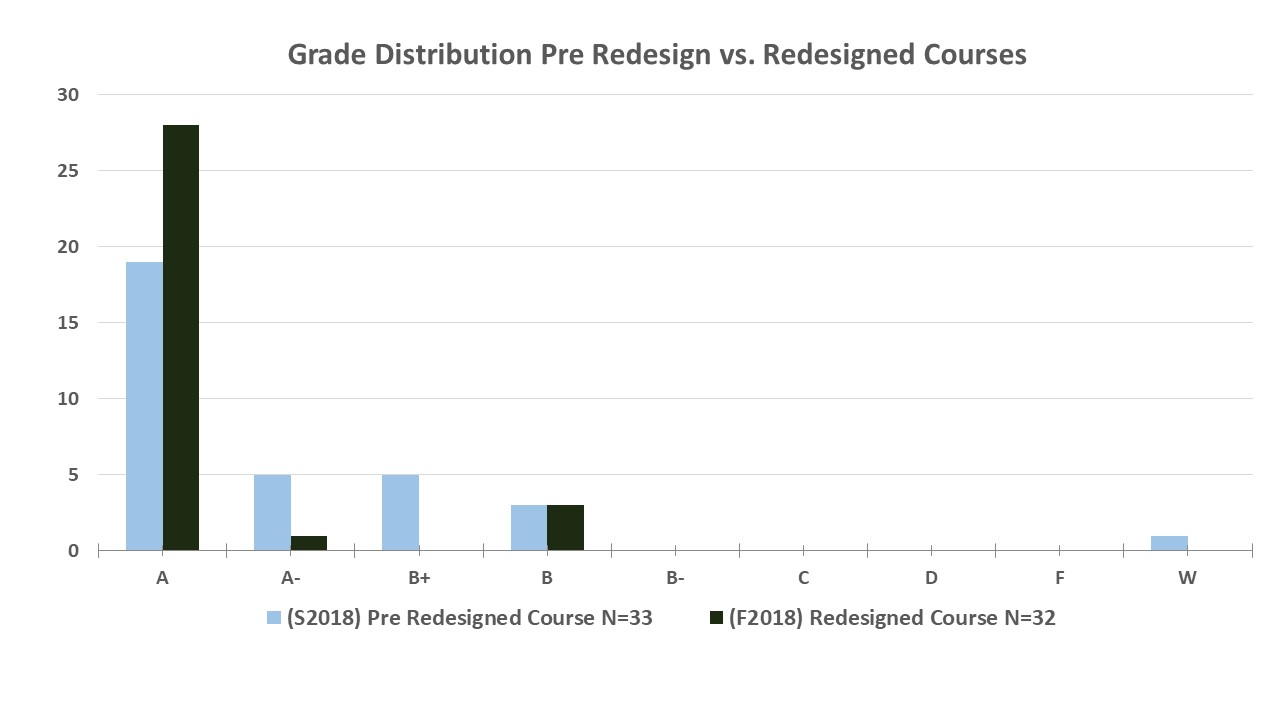
- The course redesign was incredibly succesful. As you can see from the syllabus, integration of VR into the labs across the semester is abundant. Students were able to experience using different VR/AR-related technology, including HTC Vive, Oculus Rift, Virtualizer, and Hololens. Not only they were able to learn how to use these devices, and gain experience using them, but also conducted scientific research, collected data, analyzed and presented the findings. The students' interest, per course evaluations and informal anectodes, in the lab sections has increased drastically. They were excited to come into the lab, and stayed longer than the required amount. Their grades also have reflected their interest in the material. Please find the student reflections, as well as the grade distrubution for before and after redesign below.
Assessment Findings
- Compared to the predesigned course semester, the grades of the students have improved after the redesing, having more A students and less A- and B+. Additionally, comparing the lab assignment averages for the three semesters, it is clear that students started to do much better in their lab assignments:
- S2018 lab average: 79.0
- F2018 lab average: 88.4
- S2019 Lab average: 93.9
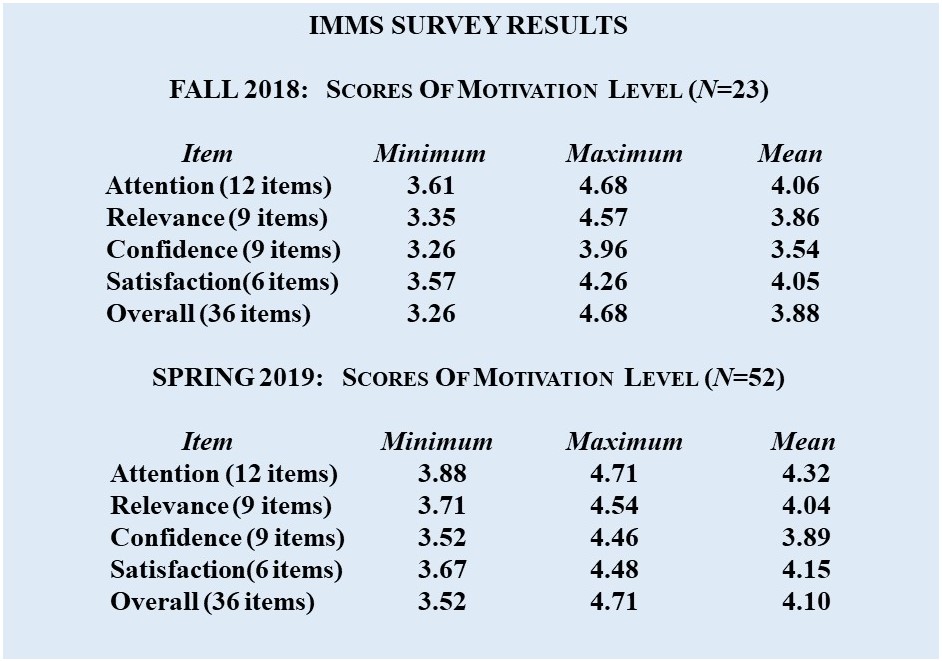
- In the last two semesters, I decided to give the students Keller's Instructional Materials Motivation Survey (IMMS; Cook, 2009) in order to assess the students' motivation for learning. The scores in each item, as well as the overall score, have improved in the last semester.
Student Feedback
- "Overall, VR is a lot more exciting than traditional labs because the interaction is more stimulating. I can remember every lab we have done, because each lab had a greater purpose, and I enjoyed every single lab Compared to other labs, we are using our own data sets instead of sets given to use which is a lot more interesting. We actually get to use the equipment rather than just being told how it is used or just a few people getting to try it. I really like getting the opportunity to see the different equipment we have and how to use it. These things can be useful further in careers."
- "I hope that these VR labs are still interpreted in this course in the future because it allows students to be active and engaged. It has been really interesting in seeing how science and technology has emerged."
- "I am more of a kinesthetic learner so rather than getting information through lectures and reading, doing these activities puts them into a greater perspective of how these concepts actually work leading to better understanding. This lab is definitely more enjoyable than the other labs I have taken. In other labs it is more just do the work and leave, but in this lab it is do the work and learn from it at the same time which I appreciate a lot."
- "I truly enjoy having VR integration labs because I think VR brings more excitement and a different learning perspective to a lab setting. Before taking this course I had very little knowledge of VR and now I find myself being more interested in researching how VR can help with rehabilitation. I think having VR integration in our labs helps us better understand course material because we are able to get hands-on experience and also see how motor control applies to the VR world. VR integration benefits our class because we can learn and have fun at the same time. When students find a lab as a fun activity we are more inclined to learn the material and apply it. "
- "The one thing that specifically stuck out to me in our labs compared to traditional labs is that everyone is involved and engaged in the lab activities. In a traditional lab setting you usually have a partner and either one person does all of the work while the other just observes. I also find our labs fun and traditional labs are on the boring side. Many of the VR labs have been are engaging and I've felt a sense of accomplishment when completing the activities."
- "The VR definitely presents more of a different perspective to the material. I have found that I learn the material much better, because I enjoy doing the VR labs. Since I enjoy doing the VR labs, this makes me more motivated to learn the material presented in both lab and lecture. In previous labs for other classes, I never really looked forward to coming to those labs, because they were very repetitive and uninteresting. I continue to look forward to every lab in this course, because they have been innovating and engaging."
- "I do enjoy having the VR integration labs. I think in this day it is important to have an understanding of technology as it may be used in the future in our field. It is also important to understand what is being developed and potentially integrated into rehabilitation/clinical settings as it will affect me in the future"
- "Rather than teaching us with a ton of supplies and resources you have the option of using a VR set as your resource. Downloading multiple program to achieve those goals would be an awesome solution to an affordable, reusable tactic. I think the VR labs we completed were extremely helpful and intriguing. I would not recommend another form of lab because this lab was the most enjoyable lab I have ever participated in."
- "This has allowed me to retain material more effectively, since I use muscle memory techniques to memorize material."
Challenges my Students Encountered
- Instructions are not clear. While the students complimented the course for being well organized, in the Fall 2018 semester many students complained that the instructions for the labs were not as clear as they could have been. Therefore, in the following semesters, I made sure to add more detail in the lab write-ups, and go over them with the students prior to the activity. These lab write ups also included sample data analysis and graphs so the students had an idea what their reports should look like (see attached sample labs above at the end of Stage 3). Furthermore, I used peer-teaching strategies by doing a demo of the activity to the first group, and having the first group to teach it to the next, and so on and so forth. Students applauded my efforts in introducing peer-teaching. For example, one student stated: "The professor’s way of teaching the labs helps the whole class communicate with each other. By teaching one group and telling them to teach the second group, helps us remember the steps in order to correctly instruct the second group. By doing this it shows us and the professor that we understand the procedure and keeps us accountable."
- Limited equipment and activities. In the Spring 2018 semester some students wished for a more variety of VR activities to be utilized in the labs. A student wrote in his reflection, "One improvement I suggest is more VR equipment so each group can experience a longer and wider variety of VR simulations. I know this requires funding, but more simulations and equipment will expand our experience and maximize lab time." In the Spring 2019 semester, I was able to introduce a variety of equipment, activities, and locomotion styles for the labs.
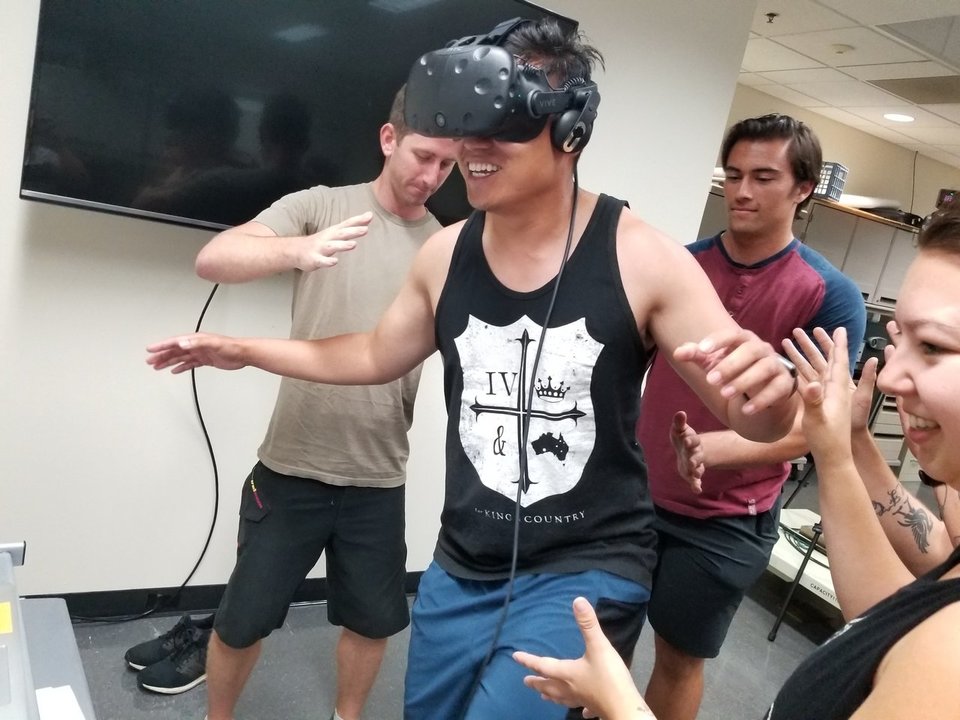
- While one student is using the headset, the others are just waiting around. By having the students work in groups of four, and giving the students who are not using the heaset at the time a task, such as spotting the user for safety, or data collection enabled all the students in the group to be actively engaged with the material. One student mentioned: "I think that the students interact more with their classmates while using the VR headset. We all help each other understand how to move and use the headset, or how to finish tasks. It is a group effort that also allows us to have fun while learning."
Lessons Learned & Redesign Tips
Teaching Tips
- When creating VR-immersive labs, try to find ways where students can physically experience the content as immersive as possible, versus it being close to a simulation.
- It is important to remember not all students are tech savvy or have previous experience with any similar technology. Therefore, it is important to include an ice-breaker intro lab where they can just play a simple agme to learn how to work the devices and get comfortable.
- The safety is very important. As students may get cybersickness, it is important to inform them of the risks, and also provide safety such as decluttered space, spotters, or safety harness while using the headsets.
- It is important that everyone has comparable experiences regardless of their disability, native language, or performance level. I would recommend selecting content with the inclusive strategies in mind, and preparing modifications for those who need it.
Course Redesign Obstacles
- I needed content that is appropriate for what I neeed in my course. Unlike STEM courses or nursing, which has plenty of content available for VR, for Kinesiology, the material out there is very limited. I had to reach out to colleagues from CS departments for help in developing apps, find some games that may serve my purpose, and also learn how to code in UNITY. Furthermore, I had to gather funds in order to purchase all the equipment needs for my MiXR lab.
Strategies I Used to Increase Engagement
- Finding fun activities, relating the material or the skillset to their future careers, having the students run their own research studies, and using peer-teaching methods.
Sustainability
- I already purchased all the big equipment, and prepared my lab activities. From now on, I will only need to work on adding further content and improving the current labs.
Instructor Reflection
- Participating in the LIT project by CSU Chancellor's Office has been a truly amazing experience. Monthly meetings, in addition to the CIG meetings, enabled me to constantly think and work on the redesign, and get ideas and support from various colleagues. I also was able to make invaluable connections with multiple faculty across different campuses.
- With the work I and some other colleagues at CSUSM doing via LIT, we were able to initiate the development of an XR teaching and research space on our campus, and started a student VR club.
- I presented part of my work through the LIT redesign at the EDUCAUSE ELI conference for an XR demo session in 2019. I am also collaborating with colleagues from SDSU in publishing a practitioner's paper on VR immersive education in Kinesiology.